
Most of you reading this will be well aware that the 10 Year Health Plan published in early July failed to include any of the most effective policies to reduce alcohol harm. Leaks in the media around the time are very telling regarding why this happened. It’s pretty clear that the Department for Health and Social Care (DHSC) pushed for effective, evidence-based interventions, including minimum unit pricing (MUP) and advertising bans. However, as The Times reported, a backlash from the alcohol industry and Department for Business and Trade (DBT) led to all of these commitments being removed. If these policies had been kept in, the plan would have been the most ambitious alcohol harm prevention plan in English history. Instead, it’s the opposite, devoid of any measures that could significantly reduce record high alcohol deaths.
A parliamentary debate on alcohol and cancer on 08 July illuminated the government’s rationale for not introducing MUP in the plan. The public health minister stated:
The government are acutely aware of the cost of living pressures being felt by families and individuals [and] have chosen not to pursue policies that could exacerbate economic issues at this time.”
There are several flaws to this argument. Firstly, it’s akin to saying “We understand people are struggling financially, so we are going to ensure that the cheapest, most harmful alcohol remains very cheap.” As Professor John Holmes recently stated on our MUP film:
If we want to tackle problems of people in low income situations, generally making alcohol cheaper isn’t necessarily the best way to go about it. Instead, we should be looking at things like welfare policies, housing policies, improving public transport, employment and so on.”
Very much tied to that is that MUP is fundamentally a health policy. Of course financial impact matters – but so too does the health impact, and MUP has consistently been shown to reduce alcohol-related harm, particularly among those most at risk. In Scotland, the policy led to the largest reductions in deaths in the most deprived communities, significantly narrowing health inequalities. That’s not a marginal benefit – it’s a central public health goal. To judge MUP solely by its short-term financial effects while ignoring its life-saving health outcomes is to miss the point entirely. Since heavy drinkers on low incomes suffer disproportionately high alcohol-related harm, if you want to reduce inequalities in alcohol harm, you have to target the heavy drinking of low-income groups.
Why it’s a short-sighted political decision
There are several reasons why I’d argue it’s a poor political decision.
The government may believe it has limited political capital and fear backlash from the alcohol industry and certain media outlets. But introducing effective alcohol policies as part of the wider NHS plan would have offered the strongest possible justification: saving the NHS. Framing the policies in that context and placing them within a broader set of health measures could have blunted opposition and media attention. Introducing alcohol policies in isolation at a future date would make them more politically vulnerable.
Furthermore, this government has one of the largest parliamentary majorities in history. If it can’t deliver evidence-based, life-saving alcohol policy reforms now, when will it?
Crucially, the public already supports stronger action on alcohol. Recent polling by Public First found that twice as many people believe the government should regulate the alcohol industry more, not less. 65% support restrictions on alcohol marketing – only 11% oppose them. And even on MUP, which is often poorly explained in the media, public support (45%) clearly outweighs opposition (29%). With clear messaging about rising alcohol deaths and the role of pricing in reducing harm, the government could build even stronger public backing.
Alcohol prevention policies save lives fast
The 10-Year Plan includes some ambitious goals, but many of them won’t deliver real change before the next General Election. That’s why alcohol policy – especially pricing policy – should be a top priority for government. These measures work quickly. The sooner reforms like a revived ‘alcohol duty escalator’ or MUP are introduced, the sooner death rates will start to fall – and the sooner the government will have tangible results to point to.
The previous Labour government’s mistake was waiting too long. This time, early action is needed. The chart below says it all: the only recent period when the alcohol death rate declined was when the ‘duty escalator’ was in place – a time when alcohol became less affordable because duty was rising 2% above inflation every year.
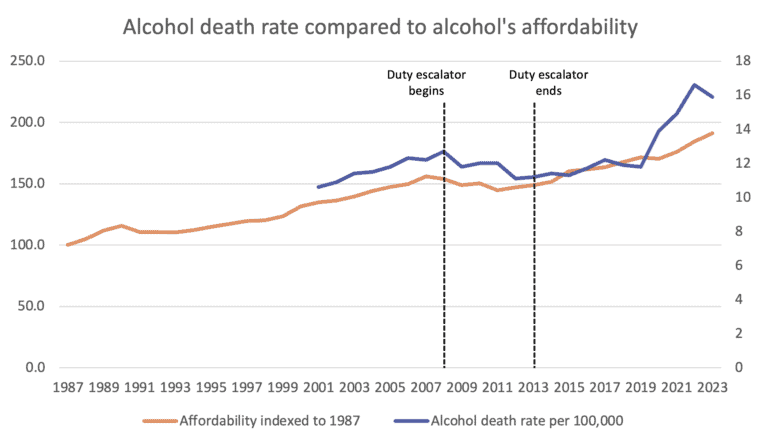
This shows how quickly raising alcohol duty can save lives. If action is taken now, by 2029 the government could show how many lives it has already saved. Just as crucially, during the escalator years, annual increases became the norm – muting trade body opposition. In contrast, after years of real-terms cuts, even small increases now provoke fierce backlash.
It’s not just deaths that fall – violence does too. A 2023 Cardiff Business School study found that raising alcohol duty reduced injuries from violence, especially among men. A 1% rise in alcohol prices cut emergency department visits by 7,000 each year across England and Wales.
MUP similarly delivers immediate results. In Scotland, alcohol-specific death rates had been rising since 2012. But after MUP was introduced in 2018, the rate dropped by 11% the following year – compared to a 1% rise in England. Why? Because people at the brink of death from alcohol-related liver disease can be pulled back by even small reductions in drinking. That’s why, despite being a chronic illness, liver disease responds rapidly to policy changes. The pandemic showed the reverse: more heavy drinking pushed people over the edge, and deaths rose fast.
The new government has a window of opportunity to show real leadership on public health. Alcohol harm is at record highs, the evidence for effective solutions is strong, and the public is more supportive than many assume. Pricing policies like MUP and duty increases save lives – quickly – and reduce harm in the communities that need it most. With political courage and clarity of purpose, the government could turn this from a missed opportunity into a public health success story well before the next election. A new National Alcohol Strategy would deliver precisely that.
Written by Jem Roberts, Head of External Affairs, Institute of Alcohol Studies.
All IAS Blogposts are published with the permission of the author. The views expressed are solely the author’s own and do not necessarily represent the views of the Institute of Alcohol Studies.