

The alcohol industry uses the same tactics as the tobacco industry to intimidate researchers and advocates whose work threatens their profits.
We know a lot about the various tactics and arguments that the tobacco industry and alcohol industry use to undermine tobacco and alcohol control. Until relatively recently, however, there was very little peer-reviewed research focusing specifically on the attacks and intimidatory behaviours experienced by researchers and advocates whose work supports the further regulation of health-harming industries.
A collaboration between researchers at the University of Bath in the UK, the University of Rennes in France and The George Washington University in the US (including the lead author of this post) conducted a scoping review of the literature to categorise the types of intimidation experienced by those researching and advocating for public health in the tobacco, alcohol and ultra-processed food (UPF) spaces. Published at the very end of last year, the results built on a previous framework of intimidation, and identified 10 intimidation types (Image 1).
What intimidation tactics are used across the tobacco, UPF and alcohol sectors?
Intimidation types or ‘tactics’ can be considered on a severity scale ranging from milder forms of intimidation such as public discreditation, where individuals and their work were undermined in public, all the way to threats of, and actual instances of physical violence at the severe end of the intimidation spectrum. In between the mild and severe end of the spectrum were complaints received by individuals and their employers; complaints to authorities such as research funders, government departments and the World Health Organization; industry attempts to get information about research, funding contracts and correspondence via Freedom of Information requests; legal threats, where researchers and advocates were expected to desist with their work or face being sued (some were actually sued); cyberattacks, where phones and computers were bugged; bribery (advocates were offered bribes to stop their work against the tobacco industry in Nepal and India); theft (tobacco control offices were burgled in Brussels); and finally, surveillance. The latter was multifaceted; in some instances, this involved academic surveillance where researchers’ work outputs were closely monitored, and in others it was more personally invasive, with advocates championing increased taxes for sugar sweetened beverages being physically watched and followed.
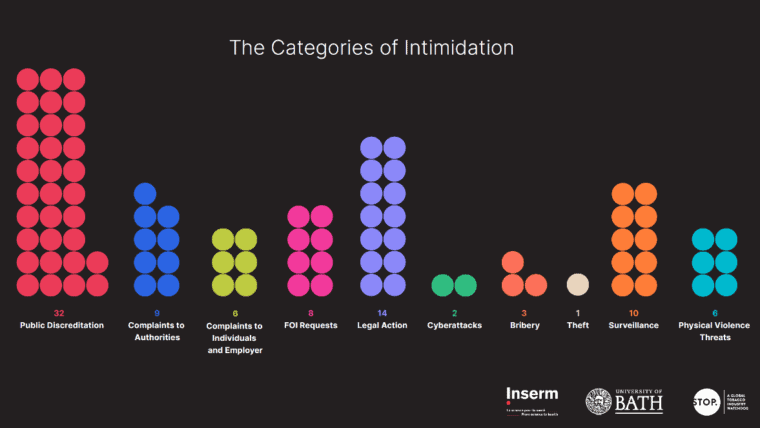
Image1. Intimidation categories from 64 sources (63 written and one webinar) identified by a scoping review by Evans-Reeves et al 2024. Sources detailing intimidations of researchers and advocates working in the alcohol control sector (N=6).
What types of intimidation are reported by alcohol researchers and advocates?
We have combined data from this scoping review with an interview study (published shortly after data collection ended for this review) by Mitchell and McCambridge to reveal that the alcohol industry has engaged in six of the ten intimidatory behaviours in the aforementioned framework: public discreditation, complaints to authorities, complaints to the individual and/or their employer, Freedom of Information requests, legal threats and action, and surveillance.
Intimidation is a global problem with those working in alcohol control reporting intimidation in Australia, New Zealand, Malawi, South Africa, the US, UK, and mainland Europe. We share some examples below.
Public Discreditation
Public discreditation was reported in both the scoping review and interview studies. For example, one case in the scoping review reported that a consultant paid by the New Zealand Food and Grocery Council (an organisation that represents the interests of alcohol and food companies), repeatedly denigrated an alcohol academic. The consultant wrote several blog posts about the academic calling him ‘mad’, a ‘trougher’, a ‘cock-smoker’ and suggesting that he drink a beer and ‘calm the fuck down.’ In subsequent legal action brought by the professor and other public health experts who had been denigrated, the consultant admitted that the comments he made were ‘untrue, unfair, offensive, insulting and defamatory’.
Although we consider public discreditation a less severe form of intimidation, some instances successfully discredited health advocates and influenced decision-makers’ perceptions of them and the policy area.
Complaints to the individual, employer, and authorities
Researchers experience industry contacting them personally as well as their employers such as universities and their research funders to complain about them and their work.
In South Africa complaints were made to a public health academic who supported a draft bill on marketing restrictions via “A personal and belligerent letter written by a board member of a major South African alcohol company…”
In another example, a delegation from the alcohol industry and their lawyer met with the employer of “a proponent of the draft bill to complain about newspaper articles that the proponent had been quoted in.” Targeted complaints by transnational companies with vast resources, power and influence can feel threatening and have a chilling effect on the work especially if protections by employers are not in place.
Freedom of Information requests (FOIs)
The New Zealand-based industry consultant noted above submitted frequent FOI requests to gather information that subsequently used in defamatory blog posts. Alcohol researchers note that responding to FOIs is very time-consuming, especially if the institution is not familiar with vexatious requests.
Surveillance
Surveillance of researcher and advocate activity is commonplace and as is the case with FOIs, can help fuel other types of intimidation.
For example, the industry surveils researchers and advocates at conferences and attempts to interact with them. Informal conversations with industry can seem friendly at the time, but one researcher noted that they gave an answer to a question by an industry representative at a conference, and then this answer later kept cropping up in industry critiques of their work.
Legal threats
Legal threats have been made against individuals, as well as employers. Importantly, just the risk of legal action was enough to slow researchers down and make universities cautious about publishing work that challenges industry behaviour.
What is the impact on the work and on individuals?
The findings of both studies found that these tactics had a chilling-effect on researchers and on the implementation of policy. Responding to intimidation reduced resources available for the work while those targeted responded or raised a defence. In many cases, progress with regulations was achieved, albeit significantly delayed. And on a personal level being intimidated can significantly impact wellbeing, particularly if there is not enough institutional support.
How can we respond to intimidation?
In the scoping review, where information was available, we found four main categories of response to intimidation. In very few cases, individuals withdrew from their research or advocacy activities altogether because of the intimidation. Others reported carrying on as usual with their work as if the intimidation had never happened. Others reported taking some defensive action, such as increasing security measures or amending their research activities to protect themselves. However, the most commonly reported activity was OFFENSIVE ACTION where those intimidated took action to correct misinformation, launched legal action of their own (for example the defamed researchers in New Zealand sued the industry consultant and won), or reported incidents to the police.
Interestingly, in the interview study, many alcohol researchers reported continuing to meet with industry if it was requested, because they wanted to be transparent and share their findings as widely as possible. Such interactions do not take place in the tobacco control field as the industry is recognised as an international pariah.
The alcohol industry’s use of intimidation mirrors tactics long employed by the tobacco industry—aimed at discrediting, delaying, or derailing public health work. These actions have real consequences, both for individuals and for policy progress. While many researchers continue their work despite the pressure, stronger institutional support and recognition of these tactics are essential, as is sharing experiences between those working in different sectors. Exposing and challenging industry interference is key to protecting public health and ensuring evidence, not intimidation, drives policy.
Written by Dr Karen Evans-Reeves, Tobacco Control Research Group, University of Bath and Dr Gemma Mitchell, Institute for Social Marketing, University of Stirling.
- Evans-Reeves, K. A., Matthes, B. K., Chamberlain, P., Paichadze, N., Gilmore, A. B., & Mialon, M. (2024). Intimidation against advocates and researchers in the tobacco, alcohol and ultra-processed food spaces: a review. Health promotion international, 39(6), daae153.
- Mitchell, G., & McCambridge, J. (2022). The ubiquitous experience of alcohol industry involvement in science: findings from a qualitative interview study. Journal of studies on alcohol and drugs, 83(2), 260-266.
All IAS Blogposts are published with the permission of the author. The views expressed are solely the author’s own and do not necessarily represent the views of the Institute of Alcohol Studies.