
Zero-alcohol products, which taste and appear as common alcoholic beverages but contain little or no alcohol, have become an increasingly popular choice. Recent findings suggest around a third of adults in Great Britain have at least tried them, with similar findings observed in a survey of Australian teenagers.
This growth in popularity across cohorts has coincided with (or been driven by) a substantial increase in product availability and associated marketing, particularly in places where restrictions on alcoholic products apply. Alcohol companies, who are the largest producers of zero-alcohol products often as versions or ‘brand extensions’ of their existing brands, have shaped the developing market with new product launches and large-scale marketing campaigns.
Investment in the zero-alcohol market is often framed by the alcohol companies making these products as an effort to reduce or even solve alcohol-related harm. This framing ignores the obvious commercial benefits zero-alcohol products offer alcohol companies and the ongoing issues associated with expanding alcohol brand marketing – which remains a serious concern amongst parents, young people, and leading health organisations.
To gain a better understanding of alcohol industry priorities, we looked at alcohol industry comments about zero-alcohol products in online publications and media. After comparing what was being said in public facing communications versus what was being said in industry facing communications, a familiar pattern of doublespeak and competing motives emerged.
A tool for moderation…
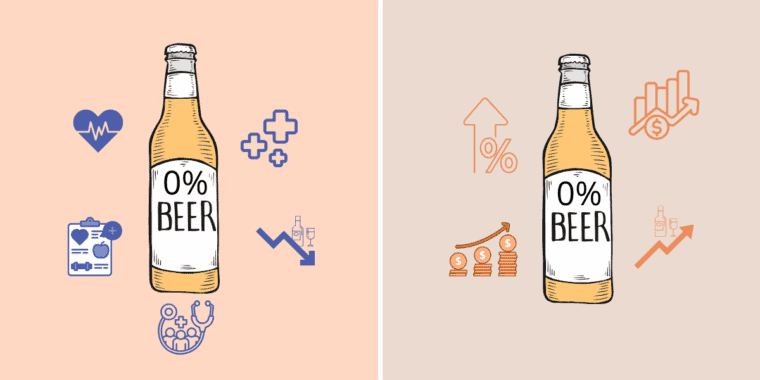
In public-facing publications and communications, such as corporate reports and media releases, zero-alcohol products were presented as tools to encourage moderation, provide choice and support public health. While the expansion of the zero-alcohol market was framed as a reflection of a ‘changing drinking culture’ and an increase in ‘moderate’ alcohol use.
Carlton Zero is playing a role in helping drive the trend towards moderation…
When consumers … incorporate in their drinking occasions the consumption of no-alcohol beer, both moderation and responsible drinking are reinforced and public health outcomes at aggregate levels may improve.
Zero-alcohol products, and their growing market share, were a consistent feature in many companies’ corporate social responsibility strategies and reports, even used as evidence of contributions to the United Nations Sustainable Development Goals.
Or a tool for growth?
While messaging in public-facing channels emphasised health and community benefit, alcohol executives offered a different motivation in industry-facing channels. Among these channels, including interviews for business publications or discussion of commercial opportunities in trade publications, it became quite clear that these products were being viewed as an opportunity to grow the total alcohol market, not cannibalize it.
A bottle of Heineken 0.0 has just 69 calories. You can drink this driving home in your car. If you think about all the occasions that people drink a soft drink today—we can be in that market.
With the Heineken 0.0 NOW YOU CAN campaign we have targeted new beer occasions to expand our Heineken® footprint. With this consistent approach we have been able to attract new consumers, and inspire Heineken® consumers to drink our beer on new occasions all across the globe. A great result for a great tasting beer, with almost no cannibalisation and a positive Halo effect on Heineken.
On the whole, zero-alcohol products were framed as ‘incremental products’ that provided purchasing opportunities that are additional to the traditional alcohol market, compete with non-alcoholic products and support the creation of new drinking opportunities.
It [XXXX Zero] presents an exciting incremental purchase opportunity for retailers, to have consumers purchase XXXX for more occasions through their week.
It’s giving people the freedom to enjoy their favourite drink in places where beer is not usually consumed. There’s no reason why you can’t enjoy Carlton Zero at lunch time at the office or if you are a designated driver.
Growth occurring outside ‘traditional’ drinking occasions is no accident. Marketing campaigns for zero-alcohol products have depicted use in situations where alcohol wouldn’t normally be accepted, including whilst driving, at work, and even operating heavy machinery. Similarly, other campaigns have portrayed zero-alcohol products as competitors to soft drinks by directly comparing nutritional content.
A familiar pattern
There appears to be a rift in how these products are framed publicly by alcohol companies proclaiming their commitment to social responsibility, versus how they are discussed in industry circles by executives weighing up commercial opportunities. Behind the façade of ‘responsibility’, zero-alcohol products are being used to reach new audiences, avoid advertising restrictions, and increase brand visibility.
Alcohol companies citing zero-alcohol products as evidence of their commitment to social responsibility while at the same time using them to enter new markets, create new drinking opportunities, and increase brand awareness reflects a broader pattern – leveraging corporate social responsibility initiatives for commercial gain not the betterment of public health.
For those working to improve public health, it is important to remain wary of the true purpose of activities portrayed as socially responsible, and to challenge attempts by industry to promote and progress their commercial interests.
Written by Fraser Edwardes, Alcohol Project Officer, Cancer Council Western Australia.
All IAS Blogposts are published with the permission of the author. The views expressed are solely the author’s own and do not necessarily represent the views of the Institute of Alcohol Studies.