
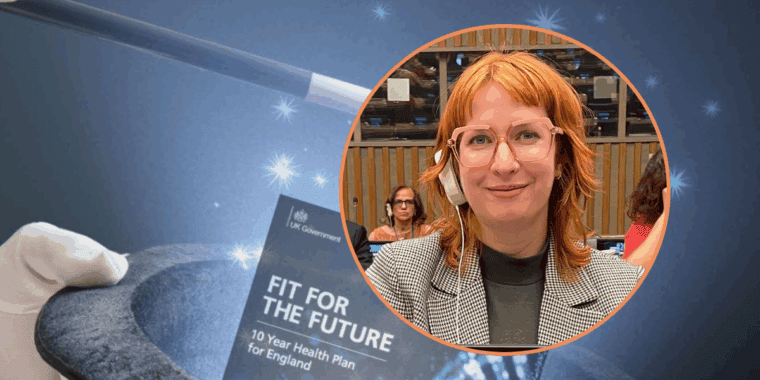
When the UK Government published its 10 Year Health Plan for England last July, a key alcohol policy appeared to be missing from it.
About a week before the Plan was released, leaks in the media and a statement from the Department of Health and Social Care (DHSC) indicated that it would include alcohol marketing restrictions. However, this policy did not make the final document.
So why were alcohol marketing restrictions seemingly dropped from the 10 Year Health Plan within such a short timeframe?
Based on correspondence IAS received via freedom of information (FOI) requests, our new report provides evidence that alcohol companies and trade groups pressured the Health Secretary and other government officials to remove the policy in the days before the Plan was published.
Why are alcohol marketing restrictions important?
Alcohol marketing covers activities like TV and online advertising, social media promotions, and the sponsorship of sport and culture. Evidence shows that marketing increases alcohol consumption and drives alcohol harm, including among children and young people.
Marketing restrictions are an effective tool to reduce harm among children, young people and the wider population. They are recommended by the World Health Organization (WHO) as a ‘best buy’ policy and backed by a 2025 evidence review from Public Health Scotland. Countries like France, Ireland and Norway already restrict alcohol marketing.
Understanding alcohol industry influence on policy
Alcohol industry interference with health policy is well-documented and has been recognised by key institutions like WHO and Public Health England as a threat to effective health policy.
In the UK, as in many other countries, the alcohol industry is powerful and uses a range of techniques to make its voice heard. This is widely considered to be a reason why, despite high levels of alcohol harm in the UK, alcohol policy diverges from the evidence base in several respects.
We therefore wanted to understand to what extent the alcohol industry may have sought to influence the 10 Year Health Plan.
Using FOI requests to study the alcohol industry’s paper trail
IAS submitted FOI requests to several Government departments for correspondence with alcohol companies and trade groups in the lead-up to the Plan’s publication.
As a researcher interested in corporate influence on policy, analysing these documents was an exciting opportunity to uncover what may have happened behind the scenes.
We performed a qualitative analysis of alcohol industry correspondence released to us from the following departments:
- Department for Business & Trade (DBT)
- Department for Culture, Media & Sport (DCMS)
- Department of Health and Social Care (DHSC)
- HM Treasury (HMT)
Some of our FOI requests from these and other departments were turned down, and we are aware of further documents being withheld from us. However, the documents we did receive paint a clear picture of a concerted lobbying effort by the alcohol industry.
Evidence of a coordinated lobbying campaign
The alcohol industry targeted the Health Secretary and DHSC directly over potential marketing restrictions.
This included presenting the sector as a so-called ‘responsible’ partner in improving health.
“We support efforts to improve public health and tackle inequalities.”
BBPA and Heineken in letters to DHSC
Heineken even presented a brand partnership with ITV to place Heineken 0.0 on Coronation Street and Emmerdale in the soaps’ on-screen pubs as providing an educational message about non-alcoholic products to the public in their letter to Wes Streeting. Heineken 0.0 branding is very similar to that for its full-strength products.
“Through product placement and in-script references to ‘pints of zero’, the collaboration has helped normalise alcohol- free choices in everyday settings.”
– Heineken letter to DHSC
Alcohol companies and trade groups also appealed to other Government departments asking them to lobby DHSC on behalf of the alcohol industry.
We found evidence that the alcohol industry urged DBT, DCMS and HMT to put pressure on DHSC regarding marketing restrictions. Sometimes this request was explicit:
“As Chancellor, we urge that you make immediate representations to the Department of Health and ensure that these restrictions are not enforced.”
– Budweiser to the Chancellor of the Exchequer
Alcohol industry actors likely coordinated their approach
Joint letters, the timing of correspondence and the similarities in the content of the letters all suggest a coordinated campaign.
Freedom of Information documents reveal how alcohol companies lobbied ministers across Whitehall to force the removal of marketing restrictions from England’s 10 Year NHS Health Plan.
These included:
- cherry-picking data about alcohol harm trends and the evidence base for restrictions. For instance, the Portman Group claiming that alcohol trends are “generally positive” despite record deaths every year since 2020;
- arguing (contrary to the evidence) that self-regulation is effective;
- making catastrophic economic claims;
- arguing that the alcohol industry is an appropriate partner in reducing harm (despite evidence that this is ineffective and even harmful);
- and stating (contrary to the evidence) that advertising does not increase drinking and benefits society.
Our full report outlines the specific arguments used. It also compares arguments to authoritative sources of evidence and finds them to be misleading.
Industry influence overrode public health evidence: we must turn the tide
It is deeply troubling that the alcohol industry appeared to have had such an influence on the 10 Year Health Plan. Our findings should be a wake-up call for the Government regarding protecting policy from industry influence and conflict of interest.
This is particularly important where health policy is concerned, given the role of unhealthy commodity industries in causing or contributing to many of the health problems that the NHS is contending with.
We therefore make the following recommendations to the UK Government:
- Revisit and introduce the proposed alcohol marketing restrictions
- Issue a new national strategy to tackle rising alcohol harm
- Reject industry self-regulation
- Say no to partnerships with the alcohol industry in line with WHO recommendations
- Recognise the inherent conflict of interest between the alcohol industry and health policy as recommended by WHO
- Introduce principles for government departments to manage conflicts of interest arising from the involvement of companies that profit from unhealthy products in health policy
All the correspondence analysed for this study is annexed in the report for further reading.
Written by Emma Thompson, Researcher, Institute of Alcohol Studies, and PhD student in Global Health Policy at the University of Edinburgh.
All IAS Blogposts are published with the permission of the author. The views expressed are solely the author’s own and do not necessarily represent the views of the Institute of Alcohol Studies.