
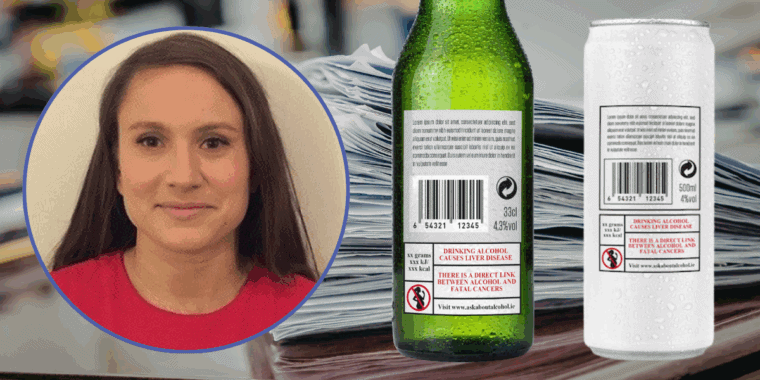
Last year, the alcohol industry managed to delay Ireland’s alcohol health warning labels (AHWLs) for another 2 years. What’s going on and what arguments did they make?
Given the extent of alcohol-related harm across the European Union, member states are increasingly considering warning labels on alcohol products to inform the public of the risks associated with drinking. Ireland has led the way, enacting the Public Health (Alcohol) Act 2018, which provided for the introduction of health warning labels on alcohol products sold in the country and look like this:
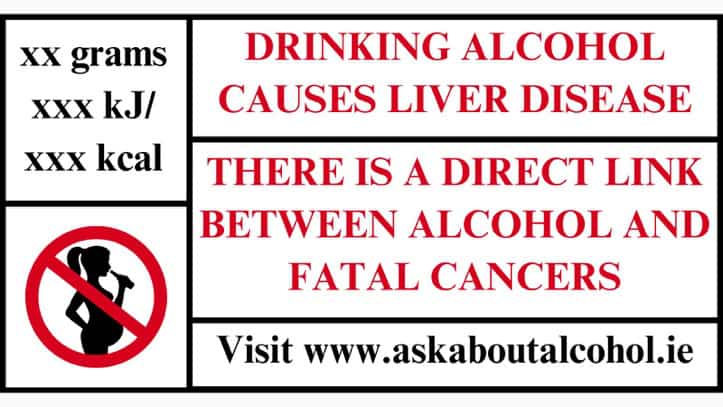
We know that health warning labels are an important public health tool that empower consumers to make informed choices about their health. The alcohol industry, however, vehemently opposes the introduction of these labels and lobbies extensively to block, delay, or weaken the policy.
So, what did we do?
Ireland needed approval from the EU first before enacting the policy. Therefore, my colleagues and I decided to analyse the written arguments submitted by the alcohol industry to the European Commission in opposition to the labelling policy, to better understand what arguments the industry was using.
So, what are some of the industry’s core arguments? And what are the facts?
Industry argument 1: There’s no clear link between alcohol and cancer and the relationship is much too complex to be explained on a label.
Trade associations representing the alcohol industry claimed:
The Irish government has not to date produced any scientific evidence of a “direct link” between the unqualified consumption of alcohol and fatal cancers or causation of liver disease, as suggested by the wording of the proposed health warnings.” – Comité Européen des Entreprises Vins (CEEV)
A single warning label” is incapable of capturing the underlying causes of cancer risks. – The Irish Business and Employers Confederation (IBEC) and the Brewers of Europe
We’ve known for quite some time (since at least 1987 actually) that alcohol causes cancer. There are clearly established biological pathways through which alcohol causes cancer, and a dose-response relationship has been shown between alcohol and seven different types of cancer, increasing from just one drink per day. There is no risk-free level of consumption and the latest research demonstrates that alcohol is in fact one of the leading preventable risk factors for cancer globally (1, 2, 3 4).
Industry argument 2: Labels don’t achieve anything other than scaremongering and the Irish Government hasn’t done its homework.
According to the leading US spirits trade association,
Research on the efficacy of public health warnings […] shows that warning labels using alarmist language are not generally effective, reinforcing the need to carefully craft language that is supported by the current state of science.’’ – Distilled Spirits Council of the United States (DISCUS)
Evidence shows AHWLs improve awareness, shift attitudes and reduce alcohol consumption. Labels provide clear evidence-based information at the point of purchase and consumption (1, 2, 3,).
Industry argument 3: Ireland’s labelling policy will cause severe economic fall-out and disrupt trade.
The International Federation of Wines and Spirits declared that Ireland’s policy:
would disproportionately impact thousands of small, family-owned wineries, vineyards, and other businesses that would suffer increased costs and economic harm if forced to comply with the proposed changes.”
The World Spirits Alliance (WSA) further argued the measure would:
disrupt the free movement and trade flows of alcoholic beverages between Ireland and other EU Member States.”
Ireland’s Department of Health has stated that the warning labels can feature on alcohol products by simply affixing a sticker to the container after being imported into Ireland. What’s more, alcohol companies have already proven to be adept at altering their labelling to promote various social and sporting events, as we can see below (1, 2). Some companies, despite these arguments, have already managed to comply with the regulations.
Industry argument 4: Ireland’s policy will undermine EU governance, digital labelling provides a less disruptive alternative.
Industry claimed the introduction of health warning labels in Ireland could jeopardise the EU’s ability to legislate on labels. The European Cider and Fruit Wine Association (AICV) stated that the European Commission already:
intends to propose a mandatory indication of health warnings on labels before end 2023 in the framework” and so Ireland’s proposal “pre-empts efforts to develop a common EU approach…”
Alcohol health warning labels already exist in a number of European states. This has not jeopardised the functioning of the European Union. Research shows that digital labelling isn’t accessed by the majority of consumers. Health warning labels provide clear evidence-based information at the point of purchase.
Industry argument 5: We are partners in health policymaking.
Industry actors positioned themselves as partners concerned about alcohol-related harm while disputing population health measures that have the most evidence of being effective at reducing harm. Industry consistently individualised the problem citing ‘harmful”, “excessive”, “abusive” consumption of alcohol in a small number of “problem drinkers” as being the key issue. Voluntary codes were hailed as the way forward:
Many of the leading drinks producers are currently implementing labelling policies across the EU to enhance consumer transparency and awareness of the possible health risks of harmful alcohol consumption.” – IBEC
We need only look at the evidence to appreciate that voluntary codes do not work, they simply offer industry a mechanism to circumvent regulation and ultimately serve to further industry’s core objective i.e., to make profit. Analysis of industry outputs demonstrates that the industry consistently misrepresents and distorts the evidence on alcohol and cancer. Given industry critique of the scientific evidence supporting both the content and use of AHWLs, how can we depend on them to provide accurate unbiased information on their voluntary labels?
What’s the take-home message?
Ireland, a country historically plagued by alcohol-related harm, has taken assertive action to protect the health of its population. This harm is not some intangible concept, but is felt by thousands of people up and down the country every day whether it be in the home, at work or in society at large – no one is impervious to its effects. Yet we know this is preventable, and that gives us power. Evidence based alcohol policies have proven to reduce alcohol-related harm. We know that awareness of the link between alcohol and specific types of cancer is low and we know that the people of Ireland support the introduction of alcohol health warning labels. The government did not propose this policy to punish industry, but to protect population health. Why should industry stand in the way? Ireland is not an anomaly, both the US and England for example are committed to reducing the burden of alcohol-related harm in their societies by introducing AHWLs.
While the recent US Dietary Guidelines have possibly succumbed to industry influence, backtracking on decades of evidence, let’s counter this influence to ensure that the UK can stay resolute in its desire to protect and promote population health through the introduction of alcohol health warning labels. The message is clear – follow the unbiased scientific evidence and what the people want.
Written by Eadaoin Cott, PhD Candidate, Department for Health, University of Bath.
All IAS Blogposts are published with the permission of the author. The views expressed are solely the author’s own and do not necessarily represent the views of the Institute of Alcohol Studies.