Alcohol is woven into life across Greater Manchester. It is part of our economy, our high streets and our social lives, tied to how we relax, socialise and celebrate. As we’ve seen again during this summer’s World Cup, alcohol is often presented as part of the occasion.
But when something becomes so normalised, the harm it causes can become harder to see.
The reality is that alcohol harm affects thousands of people across our city-region every year. Between 2021 and 2023, 1,505 people in Greater Manchester died from alcohol-specific causes, an increase of more than 25% in five years. An estimated 38,032 people are also alcohol dependent, and many more are drinking at levels that put their health and wellbeing at risk.
Behind those figures are people, families and communities experiencing illness, grief, financial pressure, relationship breakdown and poor mental health. Alcohol harm also places significant pressure on our public services, from hospitals and GP practices to housing, social care and criminal justice services.
These harms are not inevitable. But reducing them requires us to think and act differently.
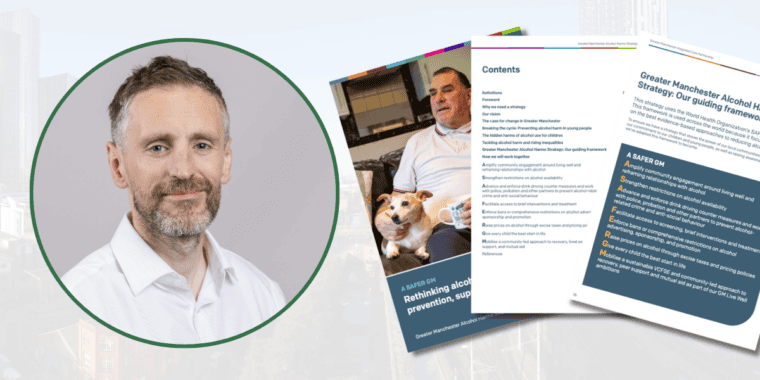
That’s the ambition behind Greater Manchester’s new Alcohol Harms Strategy and our vision to create a city-region free from alcohol harms.
Start with listening
Together, we need a better understanding of people’s experiences.
That means listening to people experiencing alcohol dependency and those in recovery, hearing from families affected by alcohol harm, and learning from the frontline staff and communities living with its impact every day.
Over a 16-month period, partners from across Greater Manchester came together to shape this strategy. Local authorities, NHS organisations, treatment providers, police, probation services, community organisations, peer support groups and people with lived experience have all played a role in understanding where the system is working, where it isn’t, and what people need from us next.
Research through The Big Alcohol Conversation and work led by Manchester Metropolitan University with young people and people using services provided invaluable insight. Together, these conversations highlighted how deeply alcohol is embedded in everyday life, the barriers people face when seeking support, and the changes that could make the biggest difference.
Most importantly, people told us that services and systems can feel difficult to navigate when someone is already struggling. What appears straightforward on paper can feel very different when someone is scared, unwell, dealing with trauma, worried about stigma or unsure where to turn.
The harms are not shared equally
Alcohol harm also does not affect everyone in the same way.
Those experiencing the greatest harm are often already facing significant challenges, including poverty, poor mental health, trauma, homelessness, social isolation or insecure housing.
For children growing up with a parent or caregiver experiencing alcohol dependency, the consequences can be profound and long-lasting, affecting their wellbeing, stability and future opportunities.
At the same time, too many people who need support are not receiving it.
In 2022/23, the estimated unmet treatment need for alcohol dependency in Greater Manchester ranged from 64% to 84%.
That should concern all of us.
Behind those figures are people who may not know support exists, people who cannot access help at the right time, and people who fear being judged if they ask for help.
If we are serious about reducing harm, we must make support easier to find, easier to access and easier to accept.
Listening is only the beginning
Listening alone does not change lives. The real challenge is what we do with what we’ve heard.
People consistently told us they want support that is available earlier, closer to home and delivered without stigma or judgement. They want services designed around real lives and real experiences. They want recovery to be visible and achievable.
That’s why prevention, compassion and community sit at the heart of the strategy.
It means helping people before harm escalates. It means improving access to treatment and recovery support. It means strengthening the role of peer support and lived experience. And it means recognising that alcohol harm is often linked to wider social and economic challenges that cannot be tackled in isolation.
Communities also have a vital role to play.
From alcohol-free activities and community-led projects to peer education and recovery networks, some of the most powerful work happens at a grassroots level. Our role is not simply to support communities, but to create the conditions that allow them to lead.
As delivery continues, we’ll build on our conversations with service users, people in recovery and communities to continue to shape what happens next. Their voices helped create this strategy and must remain central to its delivery.
Looking beyond individual choices
Listening also means understanding that people’s decisions don’t happen in a vacuum. They’re shaped by the environments in which we live, work and socialise.
Alcohol is heavily marketed, widely available and often inexpensive. It is promoted through advertising, sponsorship and pricing strategies that can make drinking feel normal, expected and unavoidable. At the same time, the alcohol industry continues to profit from harmful consumption while communities and public services carry much of the cost.
As one Greater Manchester resident in recovery explained:
Alcohol is everywhere. On TV, in supermarkets and especially during festive seasons like Christmas. In the beginning, seeing it everywhere was overwhelming. Walking down the street and seeing price promotions and special offers can still be triggering, especially in early recovery.
Stories like this remind us that alcohol harm cannot be understood through the lens of individual responsibility but through environments that place profits above people.
That means creating spaces where people can connect without alcohol. It means challenging assumptions that drinking is the default way to socialise. It means supporting communities to lead change. And it means taking action on the availability, affordability and promotion of alcohol.
Turning ambition in action
No single organisation can solve alcohol harm alone.
The impact is felt across healthcare, housing, education, policing, social care, workplaces and communities. That is why Greater Manchester is taking a whole-system approach, guided by A SAFER GM, our adaptation of the World Health Organization’s SAFER framework.
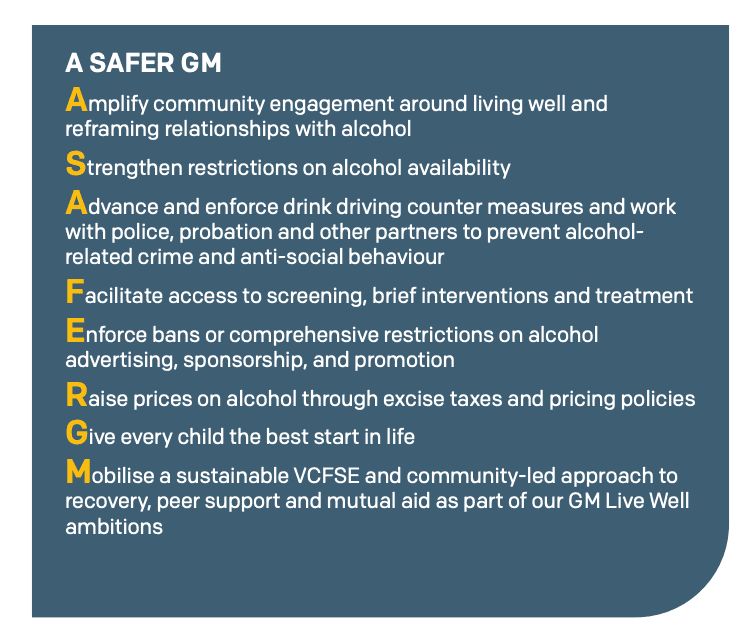
The strategy brings together action on prevention, treatment, recovery, community leadership, crime reduction, road safety, children’s wellbeing and the wider conditions that contribute to harm.
A strategy only matters if it changes what happens next. If it leads to earlier support. If it reduces stigma. If it strengthens recovery. If it empowers communities. If it improves lives.
Greater Manchester has listened carefully. Now we need to act on what we’ve heard.
Because alcohol harm is not inevitable. But reducing it requires all of us to do things differently. Read how Greater Manchester is making that happen: Greater Manchester Alcohol Harms Strategy 2025–2030.
Thank you to everyone across Greater Manchester who contributes to delivering the Alcohol Harms Strategy every day. Your commitment, partnership and hard work are helping to improve lives and reduce alcohol-related harm across our communities.
Written by Jon Hobday, Director of Public Health, Bury Council and lead for the Greater Manchester Tackling Alcohol Harms programme.
All IAS Blogposts are published with the permission of the author. The views expressed are solely the author’s own and do not necessarily represent the views of the Institute of Alcohol Studies.