
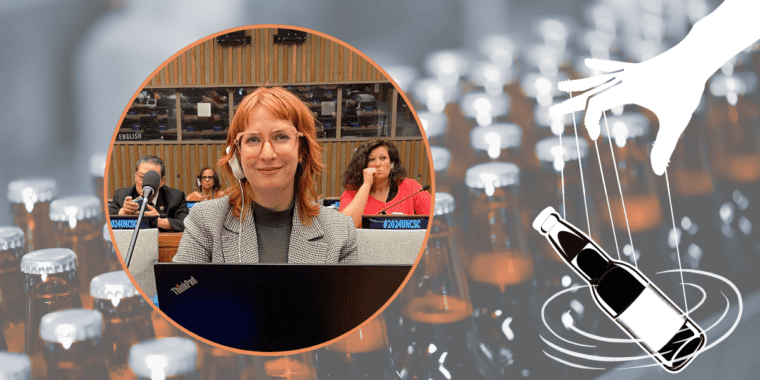
Alcohol deaths are at record levels across the UK, but the alcohol industry would like us to believe things are “going in the right direction”.
Trade groups argue that the alcohol industry offers “rewarding careers” while pushing back against new rights for workers and threatening job cuts over policy to protect health and the environment.
The Scotch Whisky Association (SWA) claims to be a protector of peatlands, while lobbying the Scottish Government to exempt whisky producers from a potential ban on peat sales.
These findings from our recently published report, Spin the bottle: How the UK alcohol industry twists the facts on harm and responsibility, highlight how the UK alcohol industry often says one thing and does another.
Understanding how the alcohol industry uses ‘responsibility’
Alcohol industry influence on policy is recognised as a key barrier to tackling alcohol harm in the UK.
One tactic alcohol companies and trade groups use to avoid new regulations is presenting the sector as ‘responsible’, as part of the solution to alcohol harm, and as making significant contributions to UK growth. As well as lobbying, the industry transmits these messages through corporate social responsibility activities, marketing, and partnerships with charities and government bodies.
We wanted to learn more about how the UK alcohol industry engaged with this type of activity in 2024. Our study reviewed over 140 public communications issued by six alcohol industry organisations (one alcohol company and five alcohol industry-funded organisations).
The research was commissioned by the Institute of Alcohol Studies and Scottish Health Action on Alcohol Problems.
Saying one thing, doing another
We found a clear pattern of the alcohol industry positioning itself as responsible while also behaving in ways which cause harm and obstructing the very policies that evidence shows would save lives.
In other words, there was a clear gap between the industry’s claims and its actions.
We identified claims across five main areas: economic, health, social and community, environment, and problematic partnerships.
Below is a summary of our findings and some examples:
Economic claims
The alcohol industry emphasised its contributions to the UK economy, via jobs and taxation, while underplaying the fact that alcohol harm costs the UK much more than alcohol taxes bring in. Despite signs of growth, it made claims about economic hardship and being ‘overtaxed’, and called for government intervention.
Example: Trade groups engaged in misleading practices to repeatedly state that HMRC lost billions of pounds in revenue due to changes in alcohol duty rates. These claims are untrue.
Health claims
Despite steep rises in alcohol harms in recent years, the alcohol industry cherry-picked positive trends and promoted ineffective solutions like ‘responsible drinking’, while detracting from evidence-based policy measures.
Example: Alcohol deaths are at an all-time high in the UK, yet at a UK Parliament inquiry speakers from the British Beer and Pub Association, Drinkaware and the Portman Group all referred to trends in alcohol harm as going “in the right direction”.
Social and community claims
The alcohol industry also made claims about how it supports communities and its contributions to a more inclusive world, despite alcohol’s clear harms to communities.
Example: Alcohol companies like Diageo are deliberately targeting women and LGBTQ+ people and making gestures of support and allyship. The fact that both groups experience distinct and significant harms related to alcohol raises questions about the ‘progressiveness’ of efforts to drive sales among these groups.
Environment and sustainability claims
The alcohol industry presented itself as a leader in environmental sustainability, while resisting environmental regulations.
Example: The SWA positioned itself as supporting peatlands by sponsoring the IUCN UK Peatland Conference and hosting a trip with MSPs to a peatland restoration project. At the same time, the SWA pushed back against a potential policy to protect peatlands.
Problematic partnerships
The alcohol industry frequently partnered with charities and organisations to ostensibly tackle alcohol harm while also promoting alcohol brands and disseminating misinformation.
Example: While claiming independence, organisations such as Drinkaware receive most of their funding from the alcohol industry. In 2024, Drinkaware repeatedly worked with companies to promote its ‘Drinking Check’ through activities which more closely resembled promotions for no- and low-alcohol versions of well-known alcohol brands than public health interventions.
Why are these findings important?
Our report sheds light on the seemingly endless ways in which the UK alcohol industry is seeking to shape the narrative and present itself as responsible. It also highlights how, on many occasions, the industry’s claims do not always match its actions, or statements made in other forums.
This is important because the industry uses the illusion of ‘responsibility’ and being ‘part of the solution’ to alcohol problems to maintain its seat at the table in policy discussions. Industry involvement in such debates makes effective action to tackle alcohol harm less likely.
How can we fix this?
We need to limit the alcohol industry’s ability to use such tactics to influence policy debates.
The good news is that there are plenty of concrete ways to improve this situation and ensure that decisions are made in the public interest.
Our report makes several recommendations to the UK and devolved governments, including:
- Acknowledge the essential conflict of interest between alcohol industry economic objectives and public health goals.
- Establish good governance processes that promote transparency and protect health-focused policymaking from alcohol industry interference.
- Put communities first: pay attention to community-level harms, which disproportionately impact the most vulnerable and worsen inequalities.
- Focus on the three policy measures to tackle alcohol harm for which there is the strongest evidence, as identified by WHO as ‘best buys’.
As members of the public, we can ask our local politicians how they are ensuring that alcohol policy decisions serve our interests and not those of alcohol companies.
And next time an alcohol company or trade group makes a claim about caring for our health, our communities, or the environment, we can take a closer look and consider whether their actions back it up.
Written by Emma Thompson, Global Health Policy, University of Edinburgh.
All IAS Blogposts are published with the permission of the author. The views expressed are solely the author’s own and do not necessarily represent the views of the Institute of Alcohol Studies.