
Our new study published in the British Journal of Cancer finds that over 7,800 cancer cases (4.6% of all cancers) in Australia were caused by alcohol use in 2024.
Alcohol and cancer
Alcohol use is an important cancer risk factor, and is known to cause at least seven types of cancer, including cancers of the mouth, throat, larynx, oesophagus, colorectum, liver and breast. Australia has a relatively high level of alcohol use, with approximately 80% of adults consuming alcohol in the year 2022-2023 according to the National Drug Strategy Household Survey. Previous studies have estimated that the proportion of cancers caused by alcohol use in Australia was 2.8% in 2010 and 4.1% in 2020.
In 2020, the Australian National Health and Medical Research Council (NHMRC) guideline to reduce the risk of alcohol-related harm was revised, advising the public that “healthy men and women should drink no more than 10 standard drinks a week and no more than 4 standard drinks on any one day”. We calculated estimates of cancer caused by alcohol use in Australia according to the updated recommended limits.
What did we do?
We analysed alcohol consumption behaviour among 225,000 people in the 45 & Up Study cohort in New South Wales (NSW) – Australia’s largest ongoing study of health and ageing. By comparing different drinking levels and their associated cancer rates, while accounting for other risk factors for cancer such as tobacco smoking and overweight and obesity, we were able to estimate the risk of seven cancers in relation to alcohol use in Australia.
We also used national cancer rate data to estimate risks of alcohol-related cancer over the lifetime, and the proportion of cancers caused by alcohol in Australia in 2024. A key point of difference from previous studies was that we generated and used Australian risk estimates in these calculations, and we also incorporated both current and former alcohol use in the calculation of the proportion of cancers caused by alcohol.
What did we find?
We estimated that 7,804 cancer cases (4.6% of all cancer cases) were attributable to alcohol use in 2024, which was somewhat higher than previous estimates. This included 2,084 cases of colorectal cancer, 1,837 cases of breast cancer, 1,808 cases of upper aerodigestive tract cancer, and 1,399 cases of liver cancer. If everyone in Australia followed the NHMRC alcohol guidelines and consumed no more than 10 standard drinks per week, we estimated that the number of alcohol-related cancers diagnosed each year would fall by more than 3,700.
We also found that for every 10 drinks consumed per week, alcohol-related cancer risk rose by 19%, including by 16% for colorectal cancer, by 18% for breast cancer, by 27% for upper aerodigestive tract cancer, and by 46% for liver cancer. Over a lifetime to age 85 years, those who consumed >10 drinks/week had an estimated 4.9% higher absolute risk of an alcohol-related cancer than those consuming no alcohol or less than 1 drink/week.
Conclusions
At over 7,800 cases in 2024, the proportion of alcohol-attributable cancers in Australia is substantial and somewhat higher than previously estimated. While drinking within the NHMRC alcohol guidelines would prevent just under half of these cases, even drinking within the 10 drinks/week guideline increases cancer risk over time, so the fewer drinks consumed, the less likely people are to be diagnosed with an alcohol-related cancer.
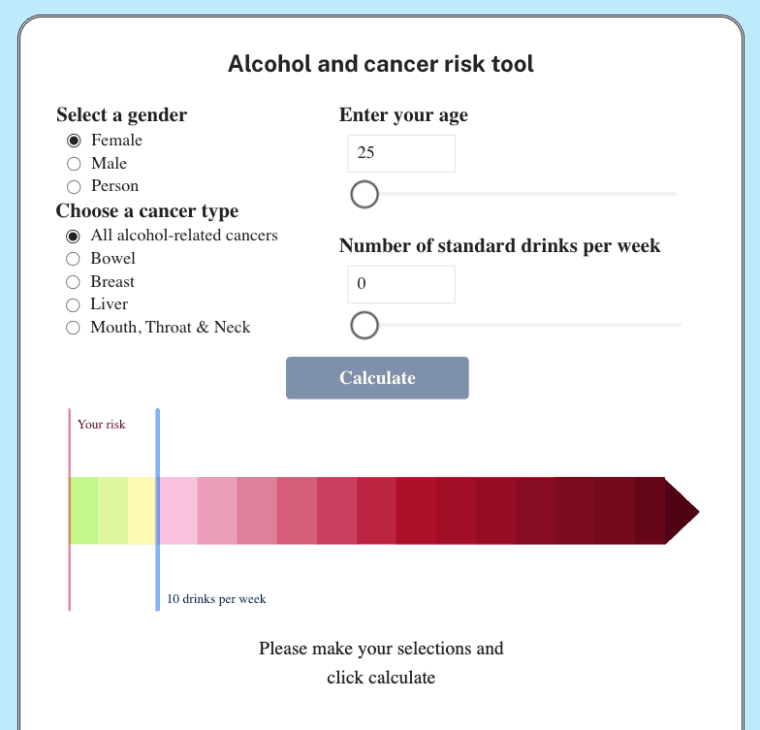
The findings from this study have been used by the Cancer Institute NSW to create a practical online alcohol use calculator to help people understand their cancer risk. You can learn more about alcohol and cancer risk and try out the tool by clicking here.
Studies show that only around half of the population is aware that alcohol causes cancer – and far fewer are aware that common cancers such as breast cancer are strongly associated with alcohol consumption. This new evidence adds to the growing case for stronger awareness of alcohol as a modifiable cancer risk factor, and public health action to address alcohol use in Australia. These include the four focus areas of the Australian National Alcohol Strategy, which include improving community safety and amenity, managing availability, price and promotion, supporting individuals to obtain help and systems to respond, and promoting healthier communities.
There is a clear need for public health interventions in Australia to focus on the longer-term harms of alcohol use among middle aged and older persons, in addition to the short-term harms in younger persons that are often the target of public health campaigns. Our study supports actions to lower alcohol consumption in Australia to reduce the burden of cancer.
Our goal at the Cancer Elimination Collaboration is to advance the elimination of all cancers, through effective use of established science, fast-tracking new evidence into practice and prioritising cancer research for optimal public health benefit. Preventing cancers caused by alcohol, by enabling informed, evidence-based consumer choices, is a measurable and achievable step towards cancer elimination.
Please click here if you would like to read more about our study.
Written by Dr Peter Sarich, Senior Research Fellow at the Cancer Elimination Collaboration, the University of Sydney, Australia.
All IAS Blogposts are published with the permission of the author. The views expressed are solely the author’s own and do not necessarily represent the views of the Institute of Alcohol Studies.
1. Sarich P, Canfell K, Egger S, Banks E, Joshy G, Wellard-Cole L, Hughes C, Houssami N, Grogan P, Weber MF. Alcohol-attributable cancer risk and burden estimates for Australia’s updated alcohol consumption guidelines. Br J Cancer. 2026 [Available from: https://doi.org/10.1038/s41416-026-03403-3].
2. World Health Organisation European Region. Alcohol and Cancer. Copenhagen: WHO/EUROPE; 2026 [Available from: https://www.who.int/europe/news-room/fact-sheets/item/alcohol-and-cancer].
3. Australian Institute of Health and Welfare. National Drug Strategy Household Survey 2022-2023. Canberra: AIHW; 2026 [Available from: https://www.aihw.gov.au/reports/illicit-use-of-drugs/national-drug-strategy-household-survey/contents/about].
4. Pandeya N, Wilson LF, Webb PM, Neale RE, Bain CJ, Whiteman DC. Cancers in Australia in 2010 attributable to the consumption of alcohol. Aust N Z J Public Health. 2015;39:408–13 [Available from: https://doi.org/10.1111/1753-6405.12456].
5. Rumgay H, Shield K, Charvat H, Ferrari P, Sornpaisarn B, Obot I, Islami F, Lemmens VEPP, Rehm J, Soerjomataram I. Global burden of cancer in 2020 attributable to alcohol consumption: a population-based study. Lancet Oncol. 2021;22:1071–80 [Available from: https://doi.org/10.1016/S1470-2045(21)00279-5].
6. National Health and Medical Research Council. Australian guidelines to reduce health risks from drinking alcohol. Canberra: NHMRC; 2020 [Available from: https://www.nhmrc.gov.au/health-advice/alcohol].
7. Foundation for Alcohol Research & Education. 2020 Annual Alcohol Poll: Attitudes & Behaviours. Canberra: FARE; 2020 [Available from: https://fare.org.au/wp-content/uploads/ALCPOLL-2020.pdf].
8. Foundation for Alcohol Research & Education. 2019 Annual Alcohol Poll: Attitudes & Behaviours. Canberra: FARE; 2019 [Available from: https://fare.org.au/wp-content/uploads/FARE-Annual-Alcohol-Poll-2019-FINAL.pdf].
9. Australian Government Department of Health. National Alcohol Strategy 2019-2028. Canberra: Australian Government Department of Health; 2019. Contract No.: 12045 [Available from: https://www.health.gov.au/resources/publications/national-alcohol-strategy-2019-2028].