

Over the last ten years, the “no/lo” drinks market has grown considerably. No/los are alcoholic-type drinks that emulate their standard-strength alcoholic equivalent but have little to no alcohol in them (≤1.2% ABV). High-quality alternatives now exist for a wide range of products, spanning from craft ales to botanical spirits and sparkling wines. The UK government remains committed to promoting no/los as a public health strategy in their NHS 10-year plan.
Current trends in no/lo consumption
No/lo consumption appears more prevalent among heavier drinkers. This trend is promising, provided these consumers are substituting alcohol with alcohol-free alternatives rather than using them in addition to their usual alcohol intake. However, consumption rates vary across the socioeconomic spectrum; less affluent populations are currently less likely to purchase these products. Consequently, health policies designed to promote no/lo drinks risk inadvertently widening health inequalities. Qualitative research suggests that why people drink alcohol might influence whether they drink no/lo, and in turn explain some of this socioeconomic variation. While some consumers champion no/lo alternatives, others remain sceptical, often viewing these products as an expensive or pointless imitation of the “real thing”.
The current study – using drinking motives to explore variation in no/lo consumption
For my PhD, I conducted a cross-sectional study to explore whether regular (at least monthly) consumption of no/lo drinks was associated with the reasons people drink alcohol, and whether this could help explain sociodemographic differences in no/lo consumption. My data came from a nationally representative sample of 2,549 adult drinkers. Questions from the Drinking Motives Questionnaire-Revised[i] captured drinking alcohol:
- for the “buzz” (enhancement)
- to fit in (conformity)
- to facilitate social occasions (social)
- as a coping strategy.
I used path analysis, a statistical method that allowed me to unpick both direct and indirect relationships between variables, to explore the data. The findings are complex, reflecting the nuanced nature of human behaviour.
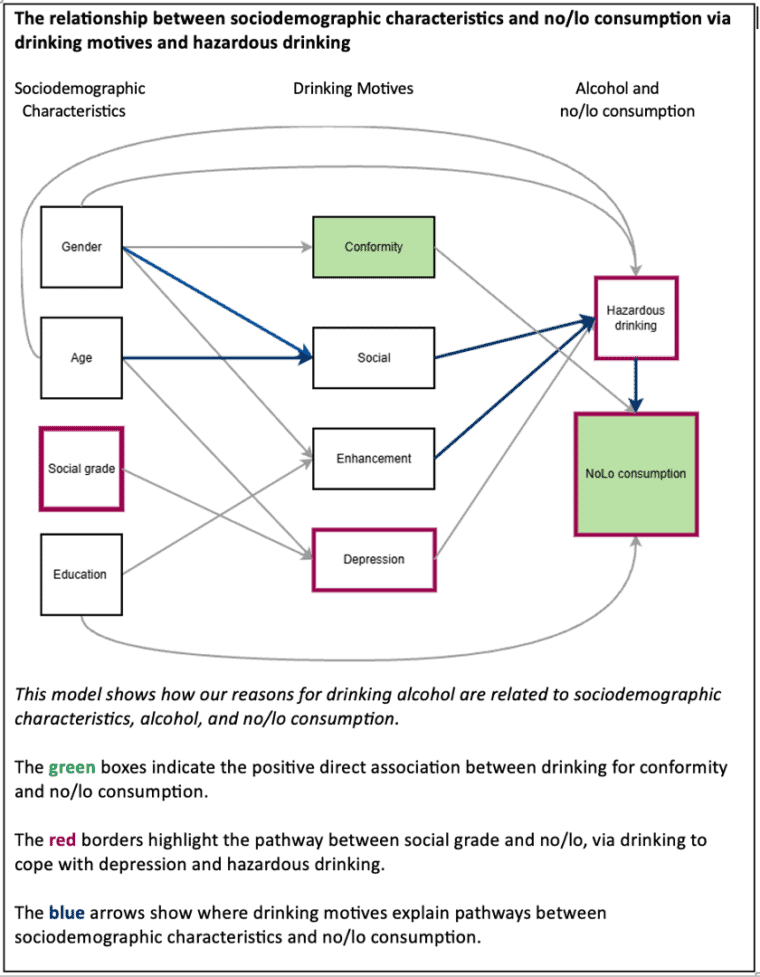
1. Drinking to conform is positively associated with no/lo consumption
Conformity was the only drinking motive directly associated with no/lo consumption. Adults who reported drinking alcohol to “fit in” were significantly more likely to consume no/lo alternatives at least monthly than people who drank alcohol for other reasons. For “conformity drinkers”, these products may serve as an effective tool for navigating social expectations without the need for alcohol. This finding supports qualitative research that reports the ability to participate in alcohol-centric occasions as a key benefit.
2. Drinking to cope partly explains socioeconomic differences in consumption
Individuals from lower social grades were more likely to use alcohol as a coping strategy, a motive linked to hazardous drinking. However, while hazardous drinking generally correlates positively with regular no/lo use, this relationship was not observed for those drinking to cope. For those using alcohol to manage psychological distress, who are more likely to be from a lower social grade, these findings suggest that no/lo products may be an unsatisfactory alternative.
3. People who drink for inebriation may find no/lo drinks unappealing
Similarly, heavier drinkers who drank for enhancement or for social reasons showed no increased likelihood of consuming no/lo products. These findings suggest that these drinks may also not appeal to those who value inebriation.
The analysis demonstrated how drinking motives can obscure broader demographic patterns. Among men, those drinking to conform were more likely to regularly consume no/lo drinks, whereas those drinking for enhancement were not. These conflicting associations help explain why a factor like gender might not appear significant in simpler statistical models as the effect is dependent on underlying reasons for drinking alcohol.
Conclusions
While no/lo drinks may offer an acceptable lower-risk alternative for those drinking to conform to social expectations, they may be a poor substitute to standard alcohol for those who drink for the psychoactive effects of alcohol, including drinking alcohol to provide temporary relief from mental health difficulties. Further research needs to explicitly explore substitution effects.
What does this mean for no/lo policy?
I am not suggesting we “throw the baby out with the bathwater” and abandon the idea that no/lo drinks may be of benefit to public health; however, these findings indicate that a nuanced approach is required. Future strategies may benefit from considering the potential effectiveness of the no/lo policy, and indeed all alcohol policies, within the broader context of why people drink alcohol. It may also be useful to consider how no/los function within the wider policy framework: they have the potential to augment the impact of pricing policies, such as alcohol duty reform and Minimum Unit Pricing (MUP), provided they become more affordable than their full-strength counterparts.
Written by Lucy Burke, Research Associate, The University of Sheffield.
Acknowledgements
This blog reports the findings from a study published as part of my Wellcome funded PhD, co-authored by Dr Inge Kersbergen, Professor Jamie Brown, and Professor Colin Angus. The originating study was funded by a Wellcome Trust PhD grant (218462/Z/19/Z, grant recipient LB). The views presented are my own, and not necessarily those of my funder.
All IAS Blogposts are published with the permission of the author. The views expressed are solely the author’s own and do not necessarily represent the views of the Institute of Alcohol Studies.