
When the Government recently closed its public consultation on a new Road Safety Strategy, one issue stood out above almost any other: drink driving.
Campaigners, clinicians and road safety experts have argued for decades that the drink-drive limit in England and Wales is too high. The latest public mood suggests that the argument is no longer confined to specialists.
New research commissioned by AlcoSense found widespread support for lowering the legal alcohol limit and introducing tougher enforcement powers for drink and drug driving offences. Just 12% of respondents believe the current limit of 0.80 ‰BAC (80mg of alcohol per 100ml of blood) should remain unchanged. By contrast, 78% favour some form of reduction.
England and Wales now have the highest drink-drive limit in Europe. Scotland reduced its limit to 0.50 ‰BAC in 2014. Most European countries already operate at this level, or below. Some have adopted near-zero limits for novice or professional drivers.
Yet despite the growing international consensus, public debate in England and Wales often still frames the issue as if the evidence were uncertain or finely balanced. It is not.
Risk rises long before 80mg
One of the persistent misconceptions in public discussion is that risk only becomes serious near the legal limit. In reality, impairment begins well below 0.80 ‰BAC.
Research published in the Journal of Studies on Alcohol and Drugs based on more than 4,000 fatal crashes, found that the likelihood of being involved in a fatal collision rises sharply as blood alcohol concentration increases.
The findings are striking. At around 0.50 ‰BAC – the current Scottish limit – drivers were approximately five times more likely to be involved in a fatal crash than sober drivers. At 0.80 ‰BAC, the risk rose dramatically further to thirteen times more likely. The relationship is not linear. Risk accelerates rapidly as alcohol levels increase.
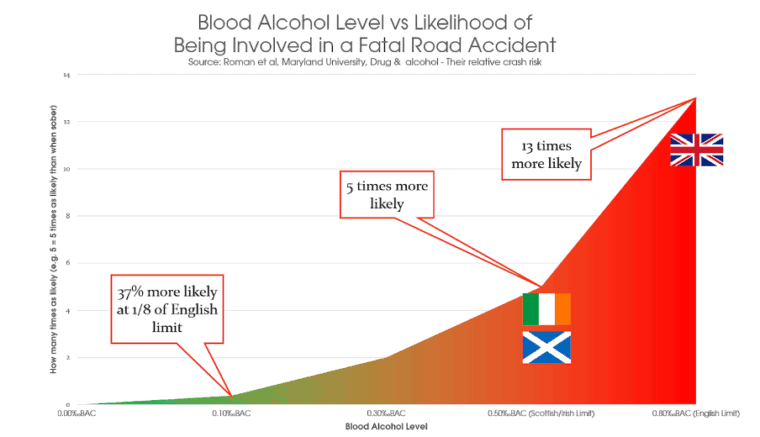
The implications are important because 0.80 ‰BAC can still be portrayed publicly as a “safe” threshold. But the legal limit is not a safety limit. It is simply the point at which criminal liability begins.
In practice, this means many drivers on English and Welsh roads may be legally entitled to drive despite being measurably impaired. The distinction between “legal” and “safe” is a significant one, and it is often poorly understood in public debate.
Even at one eighth of the current English limit, the Romano research identified a measurable increase in fatal crash risk.
That is consistent with decades of evidence showing that alcohol affects reaction time, concentration, judgement and hazard perception well before drivers feel significantly impaired.
Public opinion appears to have shifted
What is particularly interesting about the AlcoSense findings is not simply support for lower limits, but public backing for a broader package of enforcement measures.
Three quarters of respondents supported roadside licence suspensions for motorists who fail or refuse a breath test. Nearly as many backed vehicle seizure powers for drink and drug driving offences. Seven in ten were in favour of random breath testing.
The findings suggest many people increasingly view drink driving as a public safety issue rather than simply a motoring offence.
Historically, opposition to lower drink-drive limits has often focused on inconvenience, hospitality trade concerns or fears of “criminalising” moderate drinkers. Those arguments appear to carry less weight than they once did.
More than a third of respondents who visit pubs and restaurants said their habits would not change if the limit was reduced, while only a small minority said they would be likely to visit licensed premises less often.
Evidence from Scotland also suggests lower limits may influence behaviour beyond simple legal compliance. Polling conducted in 2024 – ten years after Scotland reduced its drink drive limit to 0.50 ‰BAC – showed many motorists changing their drinking habits entirely when planning to drive, with substantial numbers saying they now avoid alcohol altogether if driving later that day or the following morning.
There also appears to be growing acceptance that deterrence relies not just on legal limits but on visible enforcement.
A majority of respondents in our research said the best approach would be a combination of lower alcohol limits and stronger police enforcement, rather than either measure alone.
Enforcement matters as much as the law itself
This is perhaps the most important point emerging from the debate.
Changing the legal limit alone is unlikely to transform behaviour if drivers believe enforcement is unlikely.
At present, England and Wales rely heavily on targeted enforcement campaigns and post-incident testing. Random breath testing remains unavailable to police. Immediate roadside licence suspension powers are also absent.
Many other countries take a different approach. In several European jurisdictions, visible roadside testing forms part of normal traffic policing rather than exceptional enforcement activity.
That matters because perceived likelihood of detection is one of the strongest behavioural deterrents.
The Government’s consultation also comes against a backdrop of continuing drink-drive casualties. Department for Transport figures show there were 260 fatalities in drink-drive collisions in 2023, alongside more than 6,000 injuries.
Although drink-drive deaths are far lower than the levels seen in the 1970s, progress has slowed in recent years. Fatalities fell to around 200 by the mid-2010s but have remained stubbornly above that level despite major advances in vehicle safety technology.
Each figure represents a preventable death or injury.
The case for reform is becoming harder to ignore
Lowering the limit will not eliminate drink driving. No single measure will.
But international evidence increasingly suggests that lower limits, combined with visible enforcement and public awareness, can help shift social norms and reduce casualties over time.
Importantly, this is not simply about punishment. It is about clarity.
The current 0.80 ‰BAC limit can unintentionally create the impression that driving below that threshold is safe. Yet the evidence suggests impairment and increased crash risk occur well before that point.
That is why road safety organisations and researchers continue to argue for reform.
The Government consultation has offered an opportunity to reassess whether current policy still reflects the evidence, international practice and public expectations.
The emerging picture suggests all three may now be pointing in the same direction.
Written by Hunter Abbott, Managing Director of AlcoSense Laboratories– a leading manufacturer of alcohol breathalysers – and a member of the Parliamentary Advisory Council for Transport Safety (PACTS).
All IAS Blogposts are published with the permission of the author. The views expressed are solely the author’s own and do not necessarily represent the views of the Institute of Alcohol Studies.