
In this month’s alert
Under the influence? Perspectives of alcohol in the parliamentary workplace among UK MPs and staff

Alcohol is woven into the working life of Parliament in ways that would be highly unusual in most other UK workplaces – raising real questions for the wellbeing, inclusion and safety of MPs and staff – our latest report finds.
This is the first study to systematically survey MPs and parliamentary staff about their experiences of alcohol at work. Key findings included:
- 42% of MPs and 29% of Westminster-based staff said they were offered alcohol at a work meeting or event on a weekly basis – compared with just 1% of constituency staff.
- Almost six in ten respondents said alcohol was more available in Westminster than in other workplaces they had experienced.
- Interviewees described being handed wine at breakfast events and, at times, struggling to find a soft drink without leaving the room.
Labour MP Cat Smith said in The Guardian:
We wouldn’t accept a surgeon operating after a drink or a driver getting behind the wheel – so why should we accept legislators voting on the laws of the land after one?
The report frames alcohol in Parliament as first and foremost a workplace health and wellbeing issue, rather than simply a matter of tradition. Participants described real, measurable effects on colleagues, productivity and support:
- Almost one in ten respondents (8%) said they had experienced a negative consequence at work in the past six months because of someone else’s drinking – rising to 13% among Westminster-based staff.
- The most common harms reported were unwanted sexual attention, harassment, insults or humiliation, and feeling threatened.
- 17% said their work had been negatively affected by a colleague being hungover or under the influence.
- 70% either did not know, or were unsure, how to report concerns about a colleague’s drinking.
Dr Beccy Cooper MP said:
This report is a wake-up call, but also an opportunity. Westminster is changing for the better, and this is our chance to make sure our own workplace lives up to the standards we ask of everyone else. A modern Parliament should be one that support the health and wellbeing of everyone who works here.
The report does not call for alcohol to be banned from the parliamentary estate. Instead, it recommends a formal parliamentary workplace policy on alcohol, including:
- Limiting the routine free provision of alcohol during the working day, with free alcohol restricted to evening events.
- Making alcohol-free options and spaces the default at daytime events and venues.
- Clearer, better-publicised, confidential support for people seeking advice or experiencing alcohol problems – including support offered at times MPs and staff will likely be available.
- Addressing the underlying drivers of drinking in Parliament – long hours, loneliness and stress – through bodies such as the Commons Modernisation Committee.
A parliament spokesperson said:
Any changes to parliament’s provision of alcohol would ultimately be a matter for members to decide on. The estate is a unique working environment that includes public access and events. Parliament’s behaviour code makes clear that everyone should be treated with respect at all times, and those who choose to drink alcohol on the estate must do so responsibly.
Ireland sees beginnings of health warning label implementation
One-third of Irish adults have already noticed new alcohol health warning labels despite implementation being delayed until 2028, with many reporting that the labels increased awareness of alcohol-related risks and influenced purchasing decisions, according to a new cross-sectional survey.
Of those who had seen the labels, 66% said they informed them about alcohol-related risks, 40% said they prompted them to think about alcohol’s impact on health, and 25% said they influenced them to buy less or no alcohol during that shopping trip. Overall, 74% of respondents described the labels as informative, while 79% agreed that everyone should be aware of the information they contain.
The study found positive signs of the impact of labelling, but suggested it should be used in conjunction with other information measures:
While there are indications of early impact of the cancer message on the label, exposure to the media messaging on alcohol and cancer appears to play a stronger role in association with knowledge increase at this point.
This comes as alcohol industry giant and Guinness owner Diageo has increased its lobbying efforts on alcohol labelling in Ireland and Europe, despite closing its EU Affairs lobbying office in Brussels. Statistics from industry group Drinks Industry Group of Ireland (DIGI) this month stated that alcohol consumption in Ireland continues to fall, although Health Research Board data suggests increased amounts of harmful drinking and drinking at home.
Alleged proposals to restrict “vertical drinking” spark political row

In August, The Guardian reported that Westminster Council, which oversees licensing in Soho and the West End, had proposed guidance discouraging “vertical drinking” (standing while drinking) and encouraging more seating and table service in licensed premises. Its original headline characterised the measure as a “ban” on standing while drinking.
The story quickly gained traction, prompting critical commentary in op-eds in The Guardian (including in cartoon form), The Times, The Daily Mirror and The Independent. Opposition also came from across the political spectrum, including Reform UK spokesperson Zia Yusuf, Labour MP Dawn Butler, and London Mayor Sadiq Khan, who said he would use newly granted powers to intervene in licensing decisions if necessary.
A 10 Downing Street spokesperson said:
Busy pubs full of people talking to each other is not a public nuisance, it is British life, and it is thousands of jobs.
The government is devolving new licensing powers to the mayor [of London] to help support pubs and nightlife. Soho did not become world famous by taking last orders early, switching the lights off at 10 o’clock.
Westminster Council subsequently argued that the controversy was based on a complete misrepresentation of its draft licensing policy. The proposals formed part of a routine statutory review of the council’s licensing policy, rather than any new restrictions. Conservative council leader Paul Swaddle said: “There is no plan, and never has been, to ban drinking while standing up in a Westminster pub.”
Additionally, a statement from Westminster Council stated:
[The alleged ban on ‘vertical drinking’] is 100 percent untrue.
In the West End, where there are already hundreds of venues, it can be harder to justify a new premises. The policy says that in a small number of cases, it may be easier to get one for a venue where you sit at tables rather than stand up. Most new licences will look just like they do anywhere else, but for this small group, there’s an extra option to encourage more continental cafe-style drinking.
Other local authorities have been quick to deny intentions to ban ‘vertical drinking’ – including Merton Council and Blackpool Council.
Venue design, capacity, and associated licensing have an influence on alcohol-related harm. A 2020 IAS report identified the density and types of premises (such as high risk, ‘vertical drinking’ establishments) as contributing to alcohol-related crime and disorder in the night-time economy, alongside price and extended drinking hours.
GLP-1 ‘weight-loss’ drugs and alcohol harm: emerging evidence
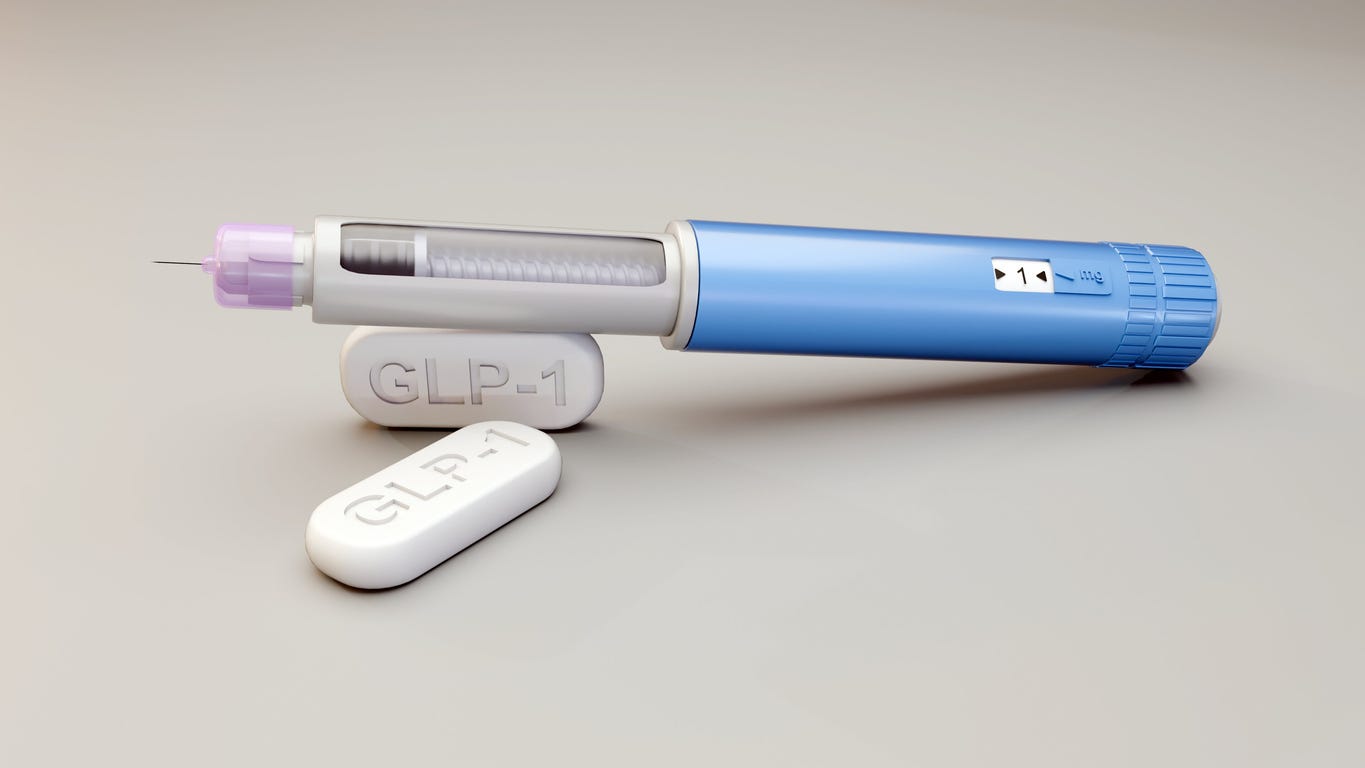
A growing body of evidence suggests that GLP-1 receptor agonists, a category of medications including Ozempic and Mounjaro that are used to treat obesity and type 2 diabetes, may help reduce heavy drinking among people with alcohol use disorder (AUD).
A study by Schacht and colleagues in the American Journal of Psychiatry found that oral semaglutide (a GLP-1 drug) reduced heavy drinking, drinks per drinking day, naturalistic alcohol craving and alcohol-related harms among treatment-seeking adults with alcohol use disorder (AUD). While the drug did not significantly affect the study’s primary endpoint of laboratory-measured craving, participants receiving semaglutide were more likely to reduce their WHO drinking risk level and drank less heavily when they did drink.
Meanwhile, Rodriguez and colleagues reported in BMJ Open that adults with AUD and either obesity or type 2 diabetes who were prescribed semaglutide or tirzepatide had lower rates of alcohol-related hospitalisation than those receiving other diabetes or obesity medications. Although observational, the findings add to growing evidence that GLP-1 drugs may have potential as treatments for alcohol-related harm.
Together, the studies add to growing interest in GLP-1 drugs as a potential treatment for AUD, although larger trials are needed to confirm their effectiveness. Announced clinical trials include a four-year, £2.7m trial of semaglutide in 268 NHS patients with alcohol dependence and obesity, examining its effects on alcohol intake, liver disease and weight loss.
The findings have attracted growing media attention amid wider interest in the effects of GLP-1 drugs beyond weight loss, including their potential influence on reward, craving and addictive behaviours. This includes coverage in BBC Science Focus, The Conversation, and The Independent. While anecdotal reports cannot demonstrate effectiveness, users of GLP-1 medications interviewed by the BBC described having “no appetite” for alcohol, losing interest in drinking, or experiencing nausea and discomfort after smaller quantities than they were used to.
Influencer marketing remains core to alcohol brands targeting Gen Z

A Snapshot Report by the Advertising Standards Authority (ASA) this month examined the extent to which people aged under 25 feature in gambling and alcohol ads online. The ASA is the UK’s independent regulator of advertising across all media.
10.8% of online alcohol ads containing faces were given an “Amber” rating, meaning there was a risk that some people would perceive a person in the ad as being under the age of 25. Meanwhile, 2.5% of alcohol ads containing faces were given a “Red” rating, indicating the ASA confidently identified the age of a person in those ads as being under 25 or seeming to be under the age of 25.
This compares to 3.4% and 0.4% respectively for gambling ads.
The ASA stated:
The highest risk ad types were organic (e.g. posts) and influencer ads, particularly where advertisers shared user-generated content featuring people’s faces. Such ads might not be subject to the same level of compliance scrutiny as would likely to be the case for ads appearing in paid-for space online. In addition, a small number of brands partnered with influencers who were under 25.
By promoting their own products, influencers can market alcohol as part of their personal content, often without ad disclosures, while regulation hasn’t caught up. This topic was explored further in last month’s IAS film: ‘Digital Intoxication: Online Alcohol Marketing Explained.’
A meta-analysis of 19 cohorts across 10 countries, published this month, provides further evidence that greater exposure to alcohol advertising increases the likelihood of young people drinking. It also found young people are now primarily exposed to alcohol marketing through social media platforms such as Instagram, TikTok and YouTube, where advertising can be harder to identify and more precisely targeted:
The alcohol marketing to which youth are exposed today is qualitatively and quantitatively different from traditional marketing channels, using sophisticated algorithms to behaviourally and temporally target potential consumers. Promotional messages are increasingly difficult to distinguish from other content on these platforms, because of the participatory nature of social media and the growing presence of paid messaging that is not necessarily or clearly acknowledged as such, such as influencer-driven messaging.
The power of celebrity and influencer-led “organic” marketing is also explored in an interview of Kathleen Braine, CMO of Kendall Jenner’s 818 Tequila, in alcohol trade outlet The Spirits Business. She credits the brand’s success particularly with younger drinkers to social media, influencer networks and experiential marketing rather than traditional advertising. This includes university campus activations and brand ambassador programmes, influencer and social media-led promotion, festival sponsorships and experiential marketing, and leveraging Kendall Jenner’s personal following and authenticity.
A minority stake in the 818 brand has recently been acquired by industry giant Sazerac, whose BuzzBallz brand was also found by industry self-regulators the Portman Group to have held a “particular appeal” to children in a London-based activation this summer. The ruling upheld that a BuzzBallz-branded Gacha machine dispensing products appealed to children through collectable toys, cartoon-style imagery, emojis and gaming-related mechanics.
As the complainant, a member of the public, asked:
How is handing out free alcohol from a huge arcade machine, covered in emojis and cartoon characters, socially responsible? I could see children immediately drawn to it. Finally, it was giving out free soft toys, the sort a 5-year-old might like.
The case also highlights a broader weakness of complaints-led regulation. By the time a complaint is made, investigated and upheld, the marketing activity has already taken place and children may already have been exposed. The system also relies on members of the public knowing that they can complain and understanding how to do so.
Experiences of alcohol treatment among people experiencing homelessness
People experiencing homelessness often describe alcohol use as a way of coping with trauma, instability and difficult life circumstances, according to a new qualitative study of 32 people in London. Researchers interviewed people who were currently using, had previously used, or had never accessed alcohol treatment services to better understand their experiences of drinking, recovery and support.
Participants described alcohol as both a coping mechanism and a response to prolonged periods of hardship. Many traced their drinking to experiences of trauma, with alcohol becoming a means of managing emotional distress that had often gone unaddressed. Recovery, meanwhile, was seen less as a linear journey through treatment and more as a personal process requiring motivation, autonomy and access to supportive environments.
The study highlights how alcohol use was shaped not only by individual circumstances but also by wider social and cultural factors. Participants described social norms that normalised heavy drinking, while repeated experiences of trauma, stigma and exclusion could deepen dependence over time. Shame and fear of judgement were also identified as important barriers to seeking help, contributing to social withdrawal and disengagement from services.
The authors argue that improving outcomes for people experiencing homelessness requires action beyond treatment services alone. Alongside sustained investment in prevention, early intervention and flexible, person-centred support, they call for broader policy measures addressing the conditions that can drive alcohol harm, including reducing alcohol affordability and availability, improving access to safe housing and tackling child poverty.
The study was part-funded through the Institute of Alcohol Studies’ Small Grants Scheme.
The future of pubs: protection and viability
After Andy Burnham’s proposal of a 20% business rates cut for pubs, a Sheffield Addictions Research Group blog suggests it could offer genuine financial breathing room and help sustain local economies, but argues it won’t reverse the sector’s long-term decline, since the deeper economic and cultural pressures pubs face remain unaddressed.
Regarding health impacts, SARG’s Prof Colin Angus writes:
The public health impacts are less clear, although it is positive that the relief to pubs isn’t being implemented in a way that directly incentivises them to increase alcohol sales (as would be the case if pubs were supported by increasing the scale of draught relief).
Meanwhile, Secretary of State for Housing, Communities and Local Government Angela Rayner announced stronger planning protections for all pubs in England, making it much harder for developers to convert them into houses or offices. Previously, proposals would only have protected the last pub in a local area. Under the new rules, developers must demonstrate there is no reasonable prospect of the pub remaining viable, including evidence that it has been marketed for sale for at least 12 months. Councils must also consider the community impact of losing the venue.
It comes as Stonegate Pub Partners, the UK’s largest pub landlord, is under scrutiny after allegations that some tied tenants were effectively trapped in financially unviable businesses, with critics claiming landlords were encouraged to take on pubs that later proved difficult to run profitably. The investigation is examining claims that Stonegate may have provided inaccurate information on pub conditions, unrealistic financial forecasts, incorrect rent calculations, unfair treatment by business development managers, and failures to properly report alleged code breaches to the regulator.
Rachael Maskell MP, calling for total reform of the tied tenancy system, said:
It’s a feudal relationship at best. It entraps you into a financial loss situation, where you cannot make the best of your business but you’re tied to a failed business model.
Finally, the Campaign for Real Ale (CAMRA) announced that their membership fell to 143,038 in 2025, its lowest level in eight years, while the organisation recorded a pre-tax loss of almost £800,000. CAMRA described 2025 as one of its most challenging years, involving restructuring and redundancies. The group also cancelled its flagship Great British Beer Festival for the foreseeable future due to financial pressures. Despite this, research from the Society of Independent Brewers and Associates (SIBA) suggests growing interest in cask ale among Gen Z drinkers, while closures among independent breweries have slowed compared with 2025.
Alcohol Toolkit Study: update
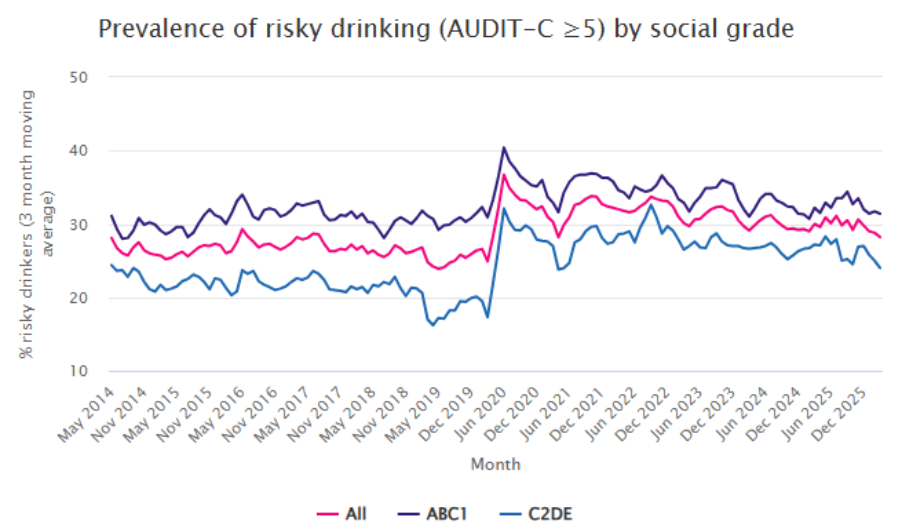
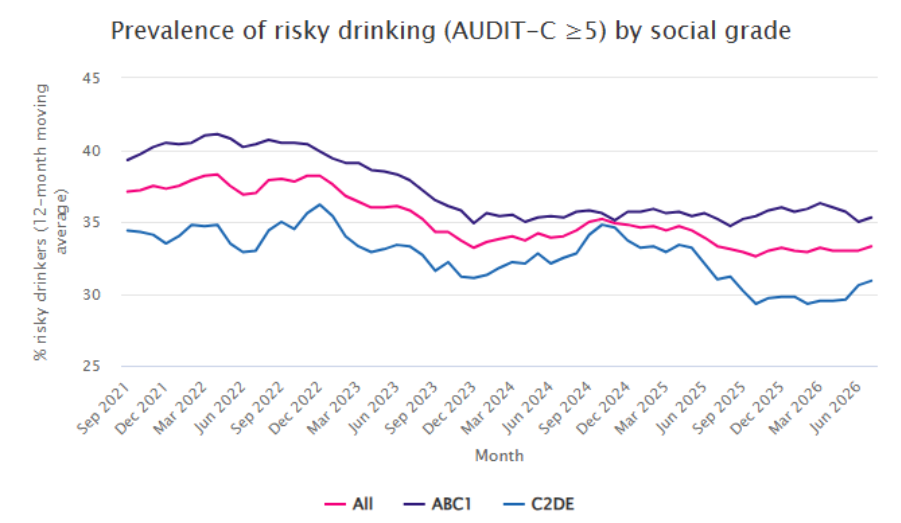
The Alcohol Toolkit Study is a long-running survey of alcohol consumption in England, Scotland, and Wales. The English monthly data has been collected since March 2014, and the Scottish and Welsh data from mid-2021. Each month involves a new representative sample of adults aged 16 and over.
You can find further charts and data for each country here:
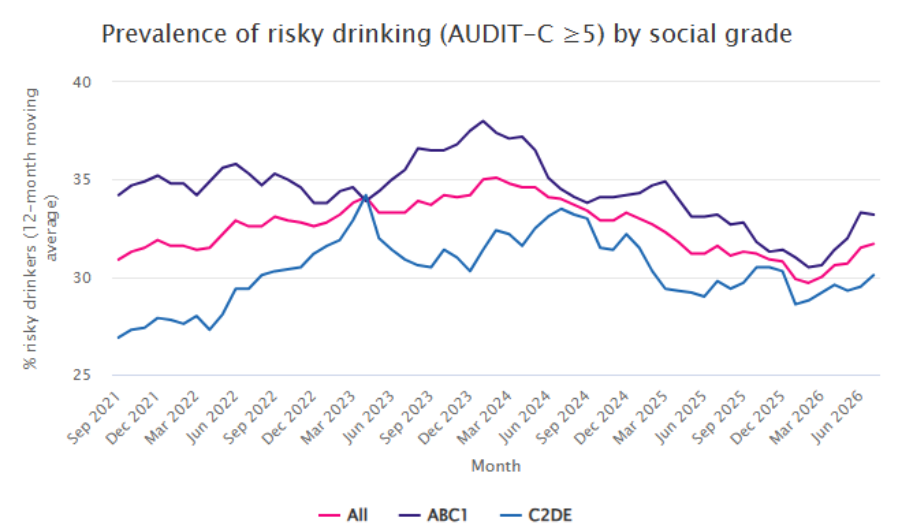
The following charts are a snapshot of the prevalence of risky drinking by social grade.
Prevalence of increasing and higher risk drinking (AUDIT-C)
Risky drinking defined as those scoring AUDIT-C ≥5
ABC1: Professional to clerical occupation; C2DE: Manual occupation
England
Scotland
Wales
Podcast
Our monthly podcast features interviews with experts from across the sector.
Power, polluters and public health – inside the world of a Director of Public Health
Peter Roderick –
Director of Public Health, City of York, and ADPH spokesperson for the Commercial Determinants of Health