
In this month’s alert
Alcohol duty to increase in line with inflation
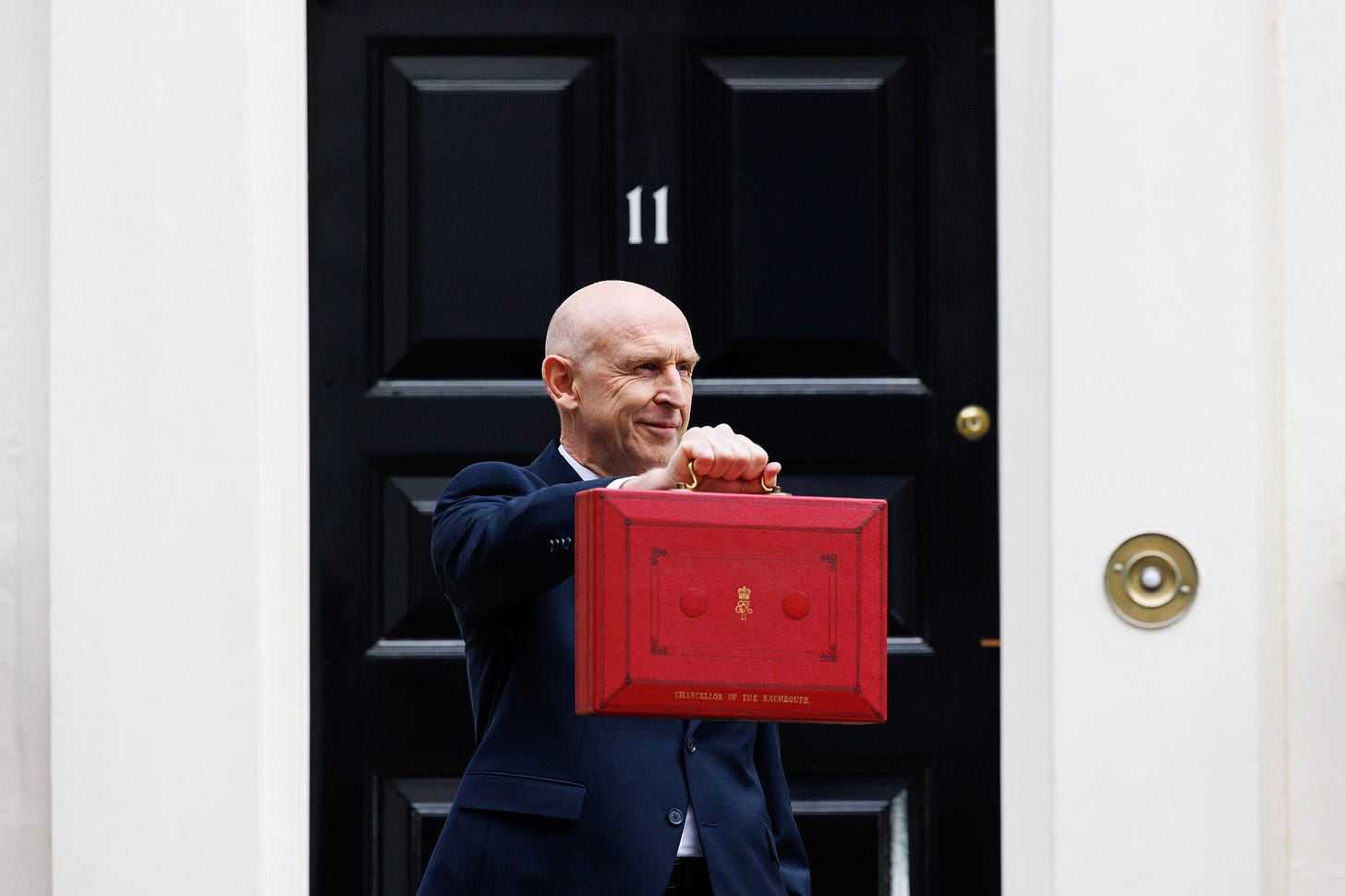
The Chancellor has announced that alcohol duty rates will increase in line with inflation from 1 February 2027, maintaining their value in real terms despite calls from parts of the alcohol and hospitality industries for another freeze.
In the Budget on 28 October, the Government confirmed that all alcohol duty rates will rise by 4.55%, in line with Retail Price Index (RPI) inflation.
The decision was welcomed by a number of public health organisations. Institute of Alcohol Studies Chief Executive, Dr Katherine Severi, said:
Keeping alcohol duty in line with inflation is both fiscally and morally responsible. Alcohol harm costs England £27.4 billion every year, equivalent to £485 for every person in the country. At a time when the NHS and other public services are under immense pressure, we simply cannot afford to hand further tax breaks to multinational alcohol producers.
Dr Severi also called for a comprehensive national alcohol strategy, including evidence-based measures to reduce alcohol harm. Read the full IAS response here.
The announcement was also welcomed by Alcohol Health Alliance UK Chair Professor Sir Ian Gilmore, who described maintaining the real value of alcohol duty as “a sensible and welcome approach”.
Alcohol Change UK likewise said it “cautiously welcome[d]” the decision to protect the value of alcohol duty against inflation, while arguing that further action is needed to reduce alcohol harm. Chief Executive Dr Richard Piper said:
[T]he Government must go further by reintroducing an annual alcohol duty escalator. This could deliver a triple win: reduce and prevent alcohol harm, help narrow the gap between alcohol duty revenue and the wider costs of harm, and encourage even more producers, especially large multinationals, to make lower-strength products.
The duty increase was criticised by organisations within the alcohol and hospitality industries, many of which had campaigned for a freeze ahead of the Budget. The Scotch Whisky Association described the decision as a “disappointing blow” to the sector, arguing it would increase the tax burden on the average bottle to 74% and hinder growth. UK Spirits Alliance spokesperson Jen Heeley-Wiggins similarly described the Budget as “a sad day for the nation’s distillers, pubs and the wider hospitality sector”, while the Wine and Spirit Trade Association said the move would “further stifle British business”.
However, some hospitality organisations welcomed measures outside alcohol duty. Allen Simpson, chief executive of UKHospitality, praised the expansion of business rates relief for pubs, social clubs and live music venues, describing it as “the first Budget in several years to deliver any positive news for hospitality at all”.
Meanwhile, the Campaign for Real Ale (CAMRA) welcomed the Budget’s support for small brewers, cider makers and tied pub tenants, including changes to Small Producer Relief that will increase duty discounts for products below 3.5% ABV and enhance relief for qualifying drinks up to 8.4% ABV. The group also backed plans to give tied pub tenants in England and Wales the right to serve a guest beer of their choice. However, it criticised the decision to increase alcohol duty, arguing that the rise would ultimately be passed on to pubgoers.
CAMRA chairman Ash Corbett-Collins said:
The announcement in the chancellor’s ‘Red Book’, that tied pub tenants in England and Wales will be allowed to serve a guest beer of their choice, is incredibly welcome.
[…] Drinkers will be disappointed to see a beer tax rise that will be passed on to pints in pubs in today’s Budget. The chancellor could and should have cut tax specifically on beer and cider served in pubs, and hiked duty on cheap supermarket alcohol to help level the playing field.
Corbett-Collins’ comments echo findings in the IAS and Balance report ‘Behind the bar: what publicans really think about alcohol policy‘, which found that 62% of publicans say supermarket alcohol is too cheap, and 60% want government to close the price gap with pubs. This month saw similar views on the price of supermarket alcohol expressed by publicans in BBC News and the Metro.
Finally, media coverage focused heavily on the effect the measure would have on the price of alcoholic drinks. Headlines in the Daily Express, Telegraph, Times, and GB Newshighlighted estimates that the duty increase could add around 2p to the cost of a pint.
Altogether, the announcement marks a continuation of the recent shift away from the pattern of duty freezes and cuts that characterised much of the previous two decades. While the increase does not raise alcohol duty in real terms, it prevents a further erosion in the tax’s value at a time when alcohol harm continues to place substantial pressure on health services and public finances.
Government evaluation says duty reforms a success
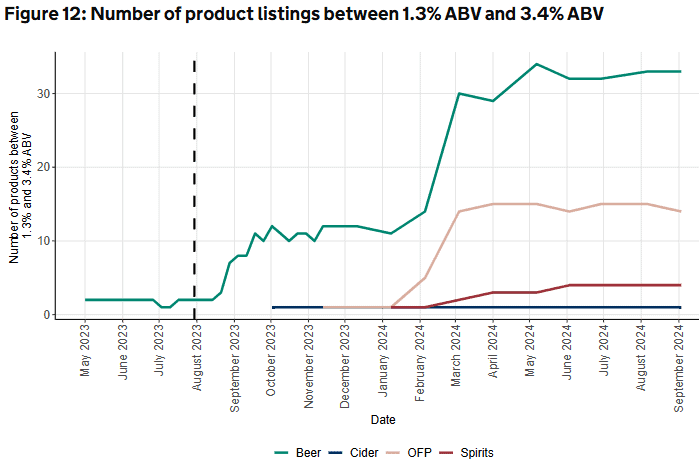
Three years after the introduction of the new alcohol duty system, the government’s Alcohol Duty Reforms Evaluation Report has concluded that the reforms are broadly delivering on their intended objectives. The report assesses the impact of the August 2023 changes, which linked alcohol duty more closely to product strength and introduced both Draught Relief and Small Producer Relief. Evaluating the reforms against five objectives, the Treasury found evidence that producers have responded by developing more low-strength products, while the overall administration of alcohol duty has become simpler and more efficient.
The report also finds that Draught Relief and Small Producer Relief are supporting pubs and smaller producers, while HMRC’s digital alcohol duty system has reduced administrative burdens. However, the evaluation says it is still too early to determine whether the reforms have reduced alcohol-related harms related to health outcomes or crime, with more time and evidence needed to assess their wider public health impact.
James Murray, Financial Secretary to the Treasury, said:
The evaluation shows that one of the great successes of the reforms is how the strength-based duty system is encouraging producers to innovate, reformulate, and meet the demand for lower-strength products. Over time, we expect these changes to help improve the nation’s health, as people consume fewer units of alcohol while, still being able to enjoy a drink.
Wales’ minimum unit price uprated to 65p

The minimum unit price (MUP) for alcohol in Wales has increased from 50p to 65p per unit, helping to maintain the policy’s effectiveness in the face of inflation since its introduction in March 2020.
Wales now matches Scotland’s 65p minimum unit price, which was introduced in 2024.
Nerys Evans, Deputy Minister for Public and Preventative Health at the Welsh Government, said:
Evidence shows that the introduction of the minimum unit price for alcohol has made an important contribution in tackling the health risks associated with excessive alcohol consumption.
But we also know that that the 50p minimum price has been made less effective by inflation, so raising it to 65p is not about punishing people who drink responsibly, it’s about closing that gap and making sure the MUP keeps doing its job by keeping high strength low-cost alcohol off the shelves.
The Welsh Government noted that inflation had reduced the real-terms value of the original 50p threshold to around 39p in 2020 prices. Independent evaluation suggested that the uprating to 65p could prevent more than 900 alcohol-related deaths in Wales over the next 20 years and reduce the number of harmful drinkers by nearly 5,000.
Alcohol-specific deaths in Scotland fall by 3% but remain above pre-pandemic levels
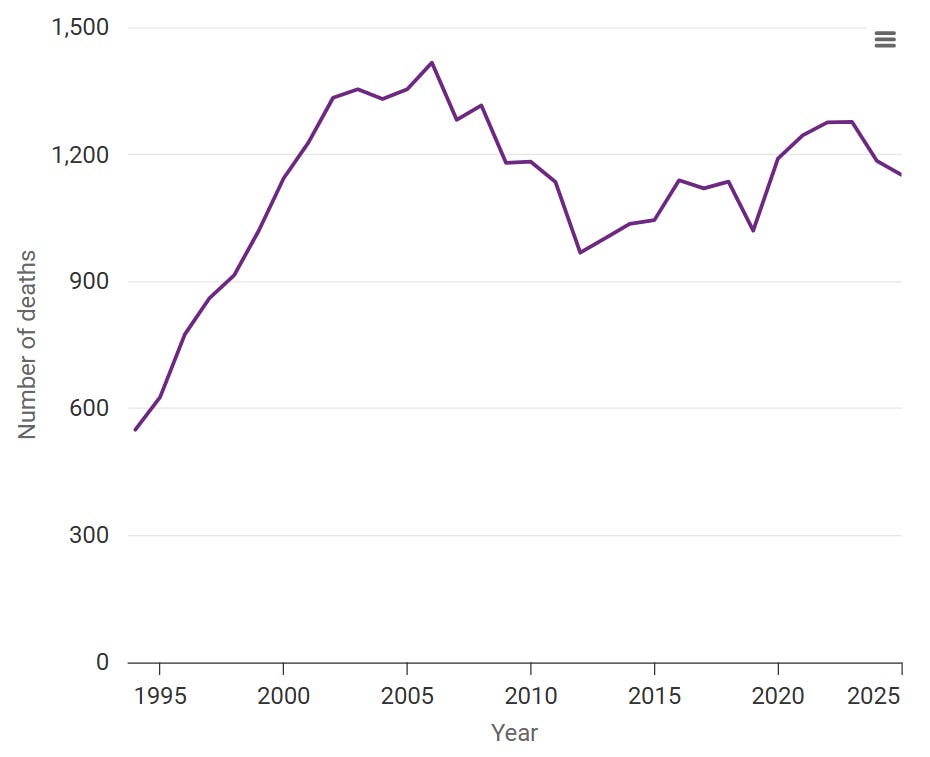
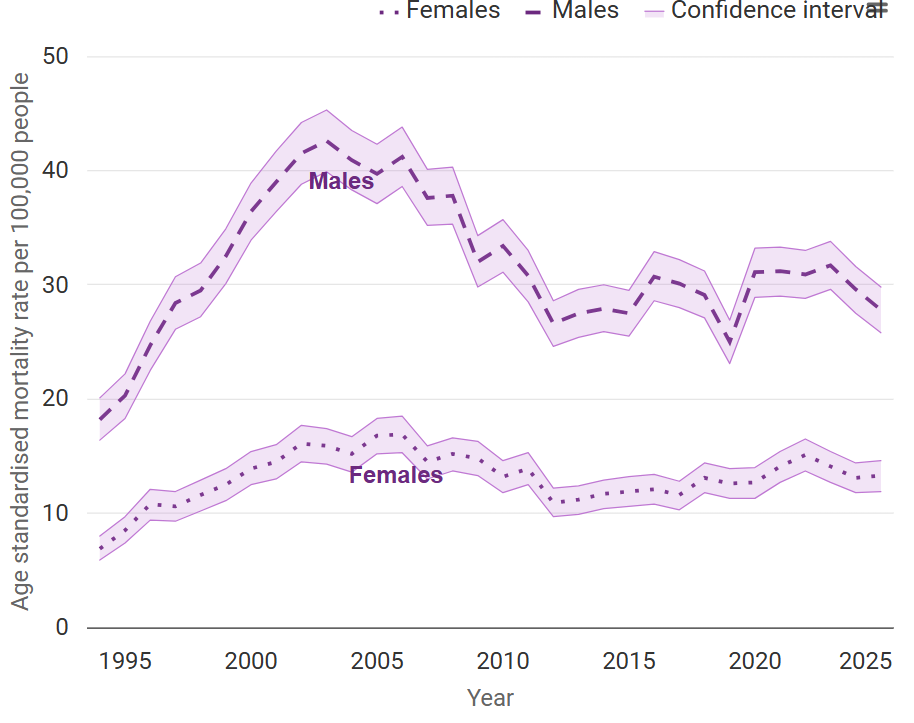
Official statistics from the National Records of Scotland show that there were 1,152 alcohol-specific deaths registered in Scotland in 2025, a decrease of 3% (33 deaths) compared with 2024.
This marks the second consecutive annual fall in alcohol-specific deaths, following four successive yearly increases between 2020 and 2023. However, deaths remain above pre-pandemic levels. The alcohol-specific death rate is 1.7 times higher than when records for the series began in 1994, and 2025 is the thirteenth consecutive year in which alcohol-specific deaths have exceeded 1,000.
Alcohol-specific deaths cover only conditions wholly attributable to alcohol, such as alcohol-related liver disease, and do not capture the wider burden of alcohol-related harm.
Responding to the figures, Alcohol Focus Scotland, Scottish Health Action on Alcohol Problems (SHAAP), WithYou and Scottish Families Affected by Alcohol and Drugs said the reduction is welcome but argued that deaths remain unacceptably high, renewing calls for stronger government action to reduce alcohol harm and prevent avoidable deaths.
Carolyn Lochhead, chief executive of Alcohol Focus Scotland said:
The Scottish Government has rightly described the situation as a public health emergency, but we’re yet to see a response matching the scale and urgency required. The recent alcohol and drug strategy commits to improving treatment and services, which is vital. But to make real change, we need to give equal priority to preventing people from needing these services in the first place: and that means government action to make alcohol less central in our society.
SHAAP also drew attention to contrasting trends between men and women. While alcohol-specific deaths fell by 5% among men, they increased by 3% among women.
Dr Alastair MacGilchrist, SHAAP Chair, said:
[I]t is deeply concerning that while deaths among men have fallen, deaths among women have risen. This comes after years in which the alcohol industry has made a targeted effort to encourage more women to drink, from products and packaging designed to appeal to women to marketing that links alcohol with wellbeing, celebration and empowerment.
SHAAP also called on Chancellor John Healey to bring back an annual alcohol duty escalator, citing University of Sheffield modelling suggesting the move could prevent 420 alcohol-attributable deaths, 8,719 hospital admissions, and save the Scottish NHS £46m by 2032.
In further media reactions, BBC News highlighted the human impact behind the statistics through the story of Paula Gibson, whose daughter Clare died in November 2023 aged 45 after a two-decade struggle with alcohol dependence. Paula said her family had accessed every available source of support but that “sometimes, it is just not enough”. The article used Clare’s experience to highlight rising alcohol-specific death rates among women and illustrate the lasting toll of alcohol harm on individuals and families.
STV News highlighted persistent inequalities in alcohol harm. Alcohol-specific deaths remain around 4.8 times higher in the most deprived communities than in the least deprived, despite the overall decline.
The figures also show that the age profile of alcohol-specific deaths has grown older over time, rising from an average age of 54 in 1979 to 60 in the latest data.
Political figures also responded to the figures. Scottish Drugs Minister Maree Todd welcomed the 3% reduction in alcohol-specific deaths but said levels remained “far too high”. She described the statistics as only the “tip of an iceberg”, noting that they do not capture the full range of alcohol-attributable harms, including some cancers, cardiovascular disease and accidents.
During a visit to Whyteman’s Brae Hospital in Kirkcaldy, Todd also announced £164,000 for a pilot alcohol care team and said she was open to discussions about a further increase in Minimum Unit Pricing.
Elsewhere, Scottish Labour deputy leader Jackie Baillie said the gap between the richest and poorest was “shameful”:
There is so much more we must do to tackle this problem, save lives, and support those in our communities who are living with the devastation.
Meanwhile, Scottish Conservative health spokesperson Miles Briggs argued that the Scottish Government has focused too heavily on harm reduction measures such as minimum unit pricing at the expense of rehabilitation and recovery services, saying ministers should do more to support people seeking treatment and long-term recovery from addiction.
Despite the overall decline, reaction to the figures focused less on the year-on-year reduction itself and more on longer-term trends, including persistently high mortality, widening inequalities, and rising alcohol-specific deaths among women. These issues continue to shape debate over Scotland’s approach to alcohol policy and public health intervention.
New tracker finds low ambition and limited progress on alcohol policy
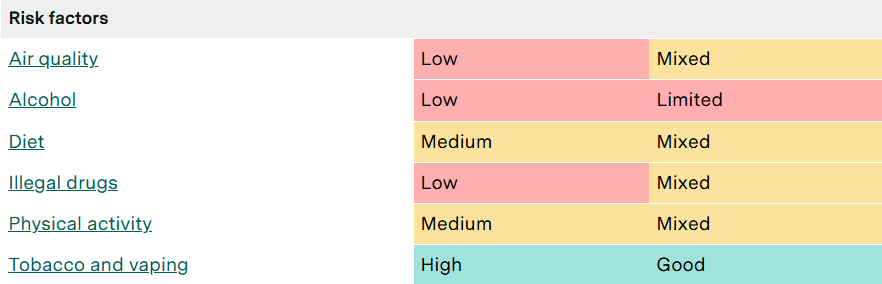
A new policy tracker from the Health Foundation has rated government ambition on alcohol policy as low and progress as limited, making alcohol the weakest-rated public health risk factor included in the tool.
The tracker evaluates how government policies across a range of areas affect health and assesses both the current level of ambition and the progress made towards improving outcomes. On alcohol, the policy tracker found:
Alcohol policy in England has been limited, fragmented and slow to progress, despite strong evidence of harm and the effectiveness of population-level interventions. The previous Conservative government ended the alcohol duty escalator and chose not to introduce minimum unit pricing.
[…] England lacks a coherent national alcohol strategy, and Labour’s manifesto included limited commitments on alcohol-related harm. Alcohol has not been prioritised to the same extent as other risk factors to health.
Health Foundation commentary contrasts this with policy progress on tobacco and vaping, including the ‘smokefree generation’ and other measures in the Tobacco and Vapes Act 2026.
In accompanying commentary from Policy and Engagement Manager Alex Kennedy, the Health Foundation contrasts alcohol’s ratings with the substantial policy progress made on tobacco and vaping, highlighting the ‘smokefree generation’ policy and other measures contained in the Tobacco and Vapes Act 2026.
The contrast between alcohol and tobacco policy was also highlighted by Ailsa Rutter, Director of Fresh and Balance, speaking on the September episode of the Alcohol Alert podcast. Rutter said:
For me, the big stark contrast between tobacco and alcohol and how seriously it’s been taken is by the absolute lack of national regulation, and the lack of legislation there has been.
On the podcast, we explored how this divide emerged, why it persists, and what lessons alcohol policy can learn from tobacco control.
In similar news, Alcohol Focus Scotland and Scottish Health Action on Alcohol Problems (SHAAP), have this month criticised the Scottish Government for failing to introduce new measures on alcohol harm, arguing that alcohol deaths receive less political attention than drug deaths despite causing a comparable or greater toll.
Dr Alastair MacGilchrist, SHAAP, said:
Drug deaths have rightly been made a national mission, backed by dedicated funding. People dying from alcohol, and the families they leave behind, deserve the same urgency.
The findings reinforce the case for a more comprehensive approach, as set out in A Healthier Future: A long-term vision to tackle alcohol harm in the UK. The report outlines how a coordinated, evidence-based alcohol strategy could reduce health inequalities, improve population health and lessen the wider social and economic harms caused by alcohol. The challenge, as highlighted by the Health Foundation’s assessment, is turning that evidence into sustained policy action.
Industry predicts GLP-1 medications to reshape alcohol consumption
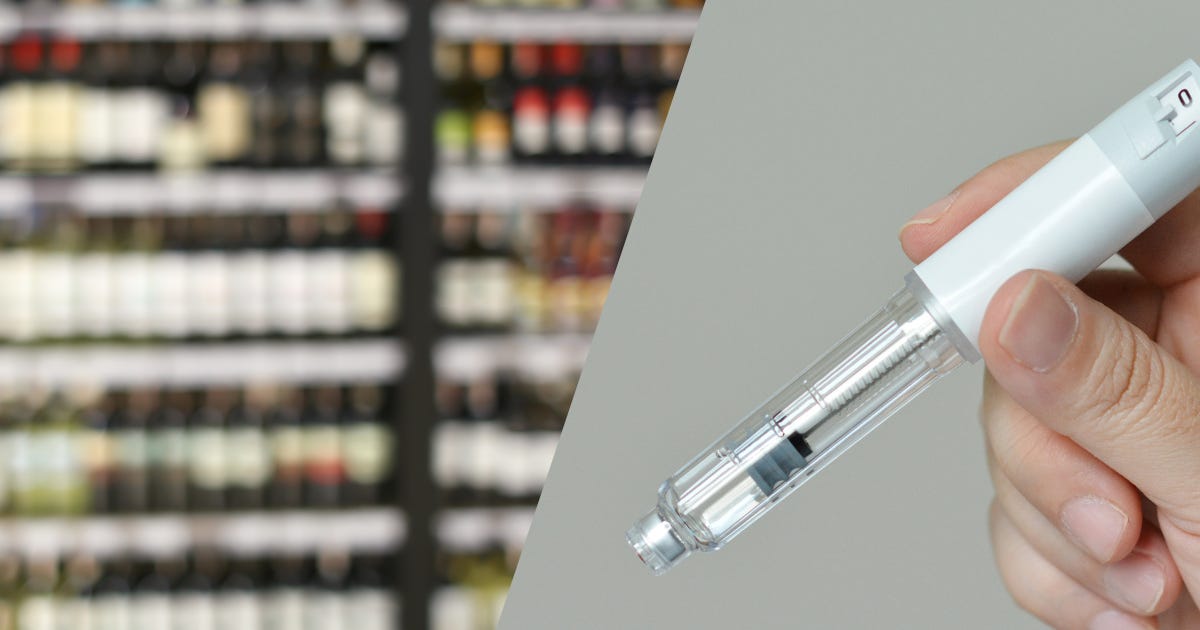
Growing interest in GLP-1 receptor agonists (’weight-loss’ medications) such as Mounjaro, Wegovy and Ozempic is prompting retailers, hospitality businesses and alcohol producers to reassess future drinking patterns and consumer demand.
Reporting in The Timeshighlighted claims from retail analyst Clive Black that supermarkets could reduce alcohol shelf space and promotional activity as GLP-1 medications contribute to it becoming a lesser driver of store traffic. Black said:
The days of when you walked into a supermarket and you walked into boxes and boxes of discounted beer, those days are coming to an end. There will be fewer promotions of booze in stores because, frankly, why promote [it] if people are going to drink less? You’re pushing water up a hill.
[…] As tablets replace jabs, this is going to go through two or three gears. It’s here to stay. I think alcohol sales are going to fall everywhere.
Meanwhile, Heineken has privately warned pubs and bars that growing use of GLP-1 medications could reduce demand for beer and cider. In a presentation seen by Reuters, the company suggested consumers may opt for “fullness and fewer serves”, leading to fewer multi-drink drinking occasions. Heineken advised venues to promote half-pints, low- and no-alcohol drinks and pair drinks with small plates, or risk declines in customer visits and spending as use of GLP-1 medications becomes increasingly mainstream in Britain.
This follows comments from Tesco chief executive Ken Murphy, who predicted a “marginally healthier Christmas” in 2026, with higher sales of low- and no-alcohol drinks.
The growing interest in GLP-1 medications extends beyond questions of retail demand and consumer spending. A new $13.3 million US trial will test whether semaglutide (Ozempic/Wegovy) can reduce alcohol and opioid use among people with substance use disorders, reflecting emerging evidence that the drugs may reduce cravings and drinking. CASPR executive director Nicholas Reville said they could help “restore personal agency” by quieting cravings for alcohol and other substances.
While evidence on long-term effects remains limited, the possibility that GLP-1 medications may reduce alcohol consumption is attracting growing attention from public health researchers and the alcohol industry alike. For more, see the August 2026 edition of Alcohol Alert.
Local authorities renew focus on alcohol harm

Local authorities across England continued to develop approaches to alcohol harm this month, with both Liverpool and Reading publishing major strategies and reports.
Liverpool City Council adopted a new five-year alcohol strategy, supported by a £70 million investment package for prevention, treatment and recovery services. The strategy sets out ambitions to reduce alcohol-related hospital admissions, crime and health inequalities, while recognising alcohol’s impact on families, communities and public services. It comes after new data revealed more than 13% of the city’s adults are affected by binge drinking.
Prof Matt Ashton, Liverpool’s director of public health, said:
We want to support our thriving and often fantastic hospitality sector while also helping people to make informed choices, reducing alcohol-related harm and ensuring support is available as early as possible for those who need it.
Alongside local measures, Liverpool City Council’s strategy advocates for evidence-based policies on a national level – including minimum unit pricing (MUP), mandatory health warnings on packaging, and restrictions on alcohol marketing.
Meanwhile, Reading Borough Council’s latest Director of Public Health Report focused on alcohol and drug harms, highlighting the scale of alcohol-related ill health in the area and the benefits of early intervention and treatment. The report cites Institute of Alcohol Studies modelling suggesting alcohol harm costs Reading around £98 million annually across healthcare, criminal justice and wider social impacts.
A central theme of the report is recovery, featuring the experiences of local recovery ambassadors helping shape services and support others in recovery. Through their stories, the report seeks to challenge stigma.
Dr Matthew Pearce, Director of Public Health for Reading Borough Council, said:
Recovery ambassadors are helping shape our services and strengthen the recovery community in Reading. From their stories we all have much to learn about our own personal resilience, they remind us that recovery is possible, that people can and do recover from whatever life throws our way.
Alcohol Toolkit Study: update
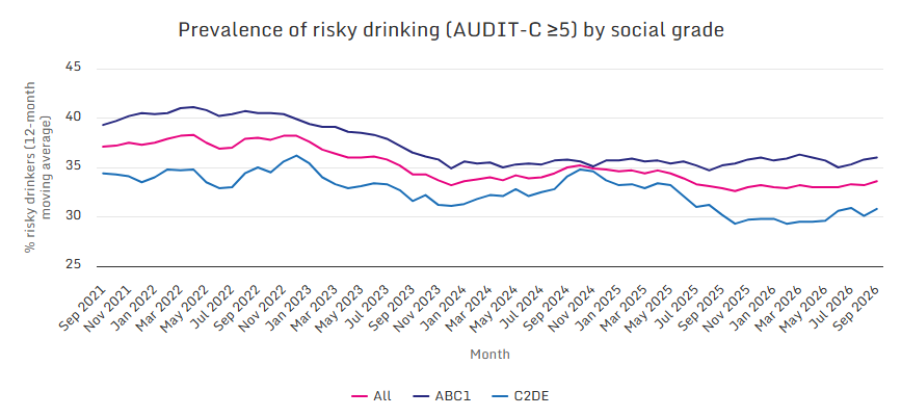
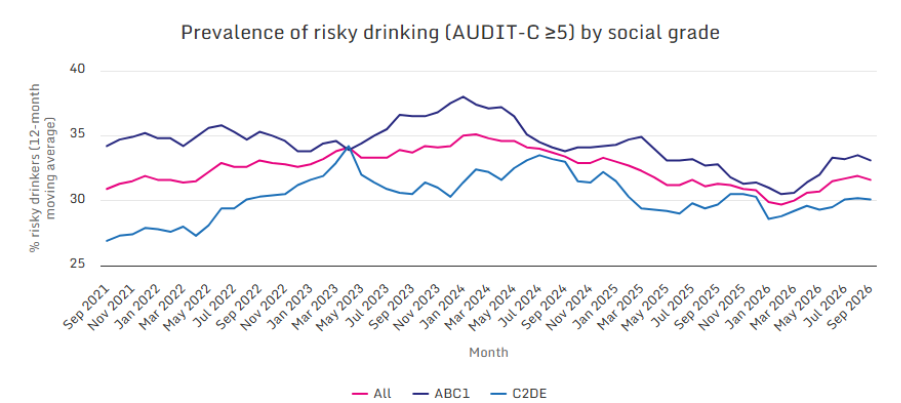
The Alcohol Toolkit Study is a long-running survey of alcohol consumption in England, Scotland, and Wales. The English monthly data has been collected since March 2014, and the Scottish and Welsh data from mid-2021. Each month involves a new representative sample of adults aged 16 and over.
You can find further charts and data for each country here:
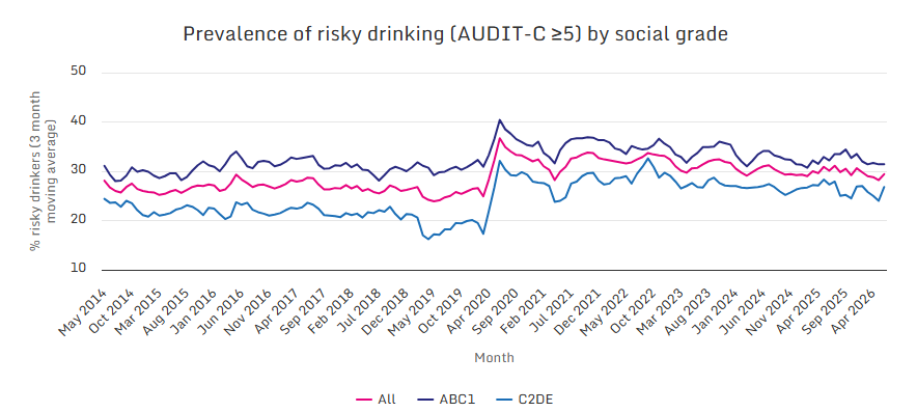
The following charts are a snapshot of the prevalence of risky drinking by social grade.
Prevalence of increasing and higher risk drinking (AUDIT-C)
Risky drinking defined as those scoring AUDIT-C ≥5
ABC1: Professional to clerical occupation; C2DE: Manual occupation
England
Scotland
Wales
The UK Alcohol Alert (incorporating Alliance News) is designed and produced by The Institute of Alcohol Studies. Please click the image below to visit our website and find out more about us and what we do, or the ‘Contact us’ button. Thank you.
Podcast
Our monthly podcast features interviews with experts from across the sector.
The Tobacco and Vapes Act – and how alcohol is being left behind
Ailsa Rutter –
Director of Fresh and Balance