
It is a truism to say that alcohol is a highly contested policy space. The industry downplays its harms and seeks fewer regulations while their free marketer supporters claim that individuals have the right to choose what to do with their lives. Public health advocates point out that such choices with their attendant risks are perhaps not being made freely given the power of the alcohol industry to influence those behaviours through saturation marketing of a risky product which is widely available at cheap prices.
What gets less attention, but which is also a source of deep conflict, is the impact of alcohol harm in the home. That silence often begins in the family, with a reluctance to discuss or even acknowledge the resulting chaos and trauma from heavy alcohol consumption that can have a lasting legacy on children. Such denial and secrecy can sometimes come from a place of shame and fear of consequences in letting others know about problems. It is often compounded by complex loyalties and shared love. In wider society though, there can be a particular discomfort in viewing the dark side of Ireland’s most widely available and acceptable drug, especially when the reality is so far from the glossy messaging expensively produced by the alcohol industry, which often suggests that drinking is part and parcel of Ireland’s national identity.
Ending the Silence
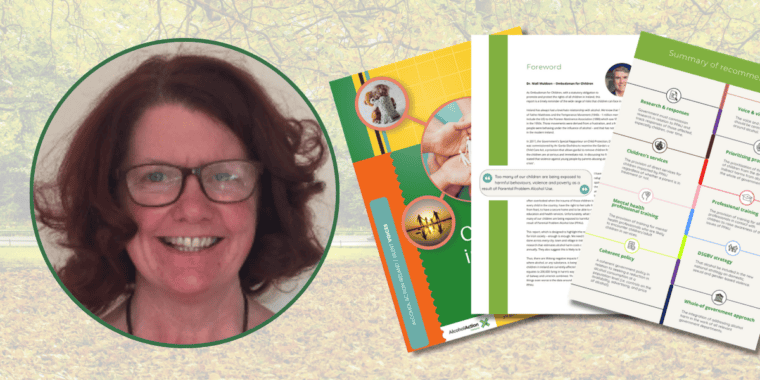
Alcohol Action Ireland has a specific initiative, Silent Voices, which has been highlighting this very hidden harm from alcohol since 2019. We have recently published a report ‘Childhood Interrupted: Parental problem alcohol use and its harms to children‘. It draws together national and international evidence and puts forward a series of recommendations. It includes a powerful foreword from Ireland’s Ombudsman for Children, Dr Niall Muldoon, pointing to the right of children to grow up feeling safe and have a family life free from fear.
Beyond the evidence and data, the report is vividly illustrated by quotes from multiple contributors to our Shared Voices platform. This provides a space for adults to share their stories of growing up with alcohol harm in the home and we greatly appreciate the generosity of those who have laid bare their experiences and reflections on what might have made a difference.
An enormous issue hiding in plain sight
The scale of the problem is startling. In Ireland data from the Health Research Board indicates that a third of children live with a parent who is either a regular binge drinker or is dependent on alcohol. A Health Service Executive survey found that at least one in six children have experienced harm from the drinking of a carer while research from Maynooth University indicates that a quarter of the adult population in Ireland (almost a million people) grew up with alcohol harm in the home. Including partners of those drinking at problematic levels, this suggests that it is likely more than 1.5 million people across the state are, or have been, affected by this issue. On a daily basis, most of us are in contact knowingly or otherwise with multiple individuals who can be carrying a heavy burden. People who right now can be finding the approach to Christmas with its regular increase in drinking and alcohol ads very painful.
Immediate impacts and lasting legacies
The outworking of this is both immediate and lasting harm as parental problem alcohol use (PPAU) is strongly linked to neglect, abuse, mental and physical health difficulties, family breakdown and other Adverse Childhood Experiences such as loss of a parent at an early age, sexual and domestic violence.
At a fundamental level a child’s neurodevelopment can be significantly interrupted, given the overwhelming need for safety and security that normally comes from a predictable parent. Their education can suffer – as seen through lower attendance records, behaviour issues and poorer results. By contrast, though, some children excel in school, finding security in routines and often important adults who can make a real difference to outcomes. However, such achievements can conceal a disturbing home life, meaning they are even less likely to be identified. Some of this though, may come to the fore in adulthood, perhaps on first leaving home, going to college, starting work or beginning a family – with higher rates of depression, anxiety, eating disorders and substance use problems. For others the coping mechanisms of a childhood of constant vigilance and reading the room can leave a legacy of trust issues with partners and friends. It can show up in workplaces, with people pleasing and crippling perfectionism issues.
At a macro level, European research indicates that the Adverse Childhood Experiences highlighted in the report likely cost Ireland in the region of 2% of GDP – that’s €12bn for 2025.
What can be done?
Leaning on national and international good practice, the report makes multiple recommendations, beginning with the imperative to seek out and listen to the voices of children. There is a clear need for much more training of all professionals who may be in contact with children to be alert to the signs of PPAU. Trauma informed schools are a particular priority, along with dedicated services for families. However, children should also have access to services without their parent necessarily being in treatment. For adults living with the impacts, much more information is needed both for the individuals but also for health professionals, and indeed for workplace policies at least to be able to acknowledge the likely effect and signpost for services.
Fundamentally, though, the protection of children should be at the heart of alcohol policymaking. Reducing Ireland’s high alcohol consumption and our particularly dangerous binge drinking patterns (second highest amongst OECD countries) would help reduce harms to children in the family.
When vested interests make overblown claims about the importance of alcohol to the economy – arguing against increases in excise duty or seeking extended licensing hours or crying wolf about the difficulties in adding warning labels to their products – policymakers need to be asking whether they are prioritising an enormously wealthy industry over the rights of children to grow up free from fear. Do they really want to interrupt childhood? This is one area where surely there should be no conflict.
Full report: Childhood Interrupted: Parental problem alcohol use and its harms to children.
Written by Dr Sheila Gilheany, CEO, Alcohol Action Ireland.
All IAS Blogposts are published with the permission of the author. The views expressed are solely the author’s own and do not necessarily represent the views of the Institute of Alcohol Studies.