
Every alcohol duty decision since 2008, at a glance
Each stripe is a Budget or fiscal statement that changed alcohol duty. The rows show what happened to each product. Select a stripe for the detail.
2008–12: above-inflation rises every year. 2013–22: mostly cuts and freezes. 2023–26: inflation-matching rises, apart from freezes during 2024.
Show all decisions as a list
Source: IAS timeline of alcohol duty decisions, 2008–2026. Only rises, freezes and cuts are shown; fiscal events with no change to duty are left out. Stripes are placed by announcement date. “Draught” marks changes to draught relief.
What happened to alcohol duty at the Budget?
The aim of this year’s Budget was to get through it with minimal drama, and alcohol duty was no exception: rates will rise by RPI again, so they hold their value in real terms. As the timeline above shows, Labour has consistently done this since coming into power in 2024.
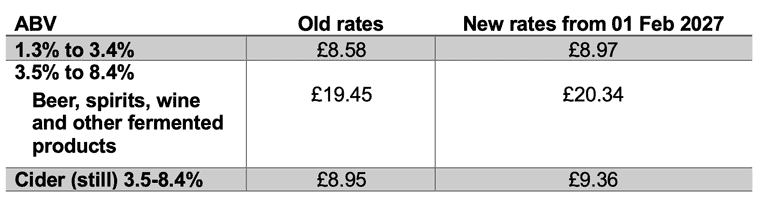
The government said this balances the contribution of alcohol producers and hospitality with duty’s role in reducing harm. With RPI at 4.55%, all draught and non-draught rates rise by that amount from 01 February 2027.
The Budget also increased the generosity of the Small Producer Relief, which essentially charges less duty to producers that make under a certain quantity of alcohol, including a more generous discount taper for lower-strength products under 3.5% ABV.
As the default assumption is that duty rates will increase by RPI, the forecast attributes no loss or gain in revenue to this. But there will be a small loss of £10 million a year from the increase in Small Producer Relief, as the forecast table shows:

How will that affect duty rates and the price of alcohol?
This 4.55% rise leads to increases of the following for each non-draught and draught product within each relevant ABV band:
Table 1: Alcohol duty rates – non-draught products
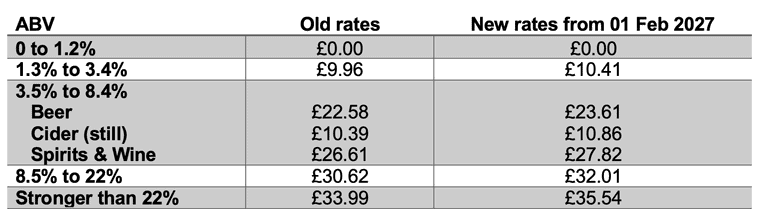
Table 2: Alcohol duty rates – qualifying draught products under 8.5%
What does that actually mean for a can of beer or cider, or bottle of wine or spirits though?
- 440ml can of beer at 4.5% ABV: 47p of the price is duty (up from 45p)
- 440ml can of cider at 4.5% ABV: 22p of the price is duty (up from 21p)
- 750ml bottle of wine at 11% ABV: £2.64 of the price is duty (up from £2.53)
- 700ml bottle of spirits at 37.5% ABV: £9.33 of the price is duty (up from £8.92)
In other words, if the increase is passed through to consumers, it adds 2 pence on a can of average strength beer, 11 pence on a bottle of wine, and 41 pence on a bottle of spirits.
And for a draught pint of beer or cider, the increase will be about 2 pence and 1 pence respectively.
Again, this is only if retailers pass these additional costs on to consumers. Research suggests that retailers tend to pass on less of a duty rise on the cheapest products and more on pricier ones, possibly to protect prices on cheaper, more price-sensitive products.[1]
But one year’s rise hides the bigger picture. Duty has only recently been kept in line with inflation; before that it was cut in real terms year after year, so rates are far lower than they would otherwise be, as the chart below shows. Compared with 2012/13, in real terms from February 2027:
Chart 1: Real alcohol duty rates, indexed: 2012/13=100
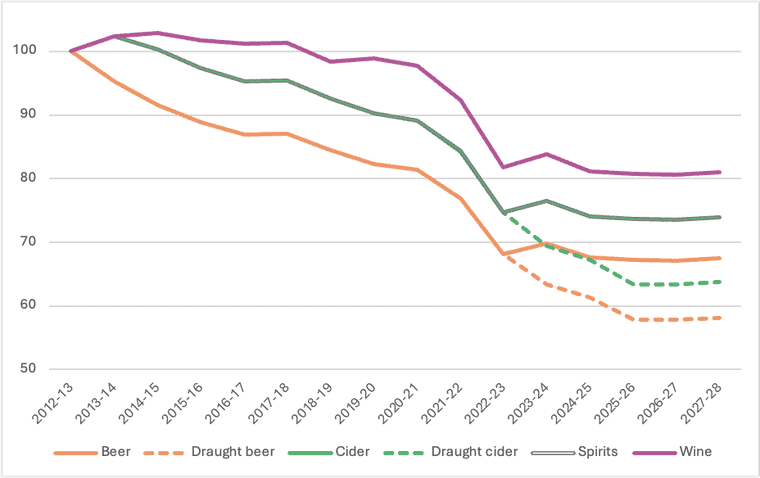
From this we can see that, compared to rates in 2012/13, from February 2027:
- Beer duty will be 33% lower
- Draught beer duty will be 42% lower
- Cider and spirits duty will be 26% lower
- Draught cider duty will be 36% lower
- Wine duty will be 19% lower
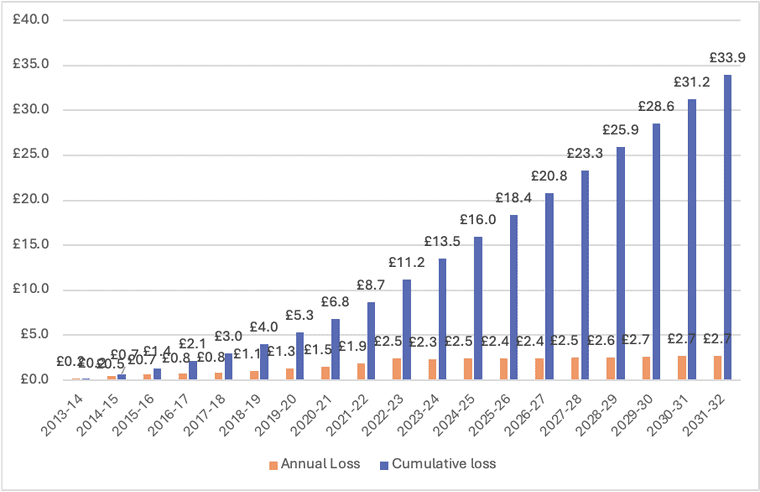
And the cost of these cuts and freezes continues to affect Treasury revenue. Any real-terms cut to duty creates a permanent deficit: a single £10 million cut loses £10 million in revenue every single year moving forward. Over time, repeated cuts and freezes build up a massive cumulative loss. It’s mind-boggling to consider how much the Treasury would have collected otherwise: £33.9 billion since 2013 – enough to cover England’s entire Public Health Grant for nearly a decade, or to fund the construction and equipping of around 30 modern NHS hospitals.
Chart 2: Lost Treasury revenue due to alcohol duty cuts 2013-2032 (in £billions)
How did public health groups respond?
Public health organisations and spokespeople were generally very positive about the decision, with IAS’s Chief Executive Dr Katherine Severi stating it was “both fiscally and morally responsible” and Professor Sir Ian Gilmore of the Alcohol Health Alliance saying it was “a welcome foundation to build on”.
Both Professor Gilmore and Alcohol Change UK’s Dr Richard Piper said the government should build on this by introducing an alcohol duty escalator, which would increase duty by more than RPI each year.
It’s an odd position to be in. After years of cuts and freezes, an inflation-linked rise now feels like a win, and welcoming it is reasonable when the alternative has so often been a real-terms cut. But holding duty steady in real terms is the minimum we should expect, not the most. With alcohol deaths at record highs and not coming down quickly, there is a strong case for the government to go further.
How did industry bodies respond?
Alcohol trade bodies representing producers were less positive. The Scotch Whisky Association (SWA) said it was a “disappointing blow” and brought the tax on whisky to 74% of the price of the product. It’s worth briefly dwelling on this. Duty on a 70cl bottle of 40% whisky will be £9.95; add VAT and the total tax is £12.84. For that to equal 74% of the price, the bottle would cost around £17.35: a standard blended Scotch from the budget end of the shelf. That is hardly the whisky the industry puts in its marketing, where premium bottles and Highland distilleries do the talking. It can’t have it both ways: heritage and craftsmanship when it wants goodwill, and a budget bottle on the shelf when it wants a tax cut.
The Wine and Spirit Trade Association said the decision was “breathtaking” and will lead to reductions in Treasury revenue. We’ve challenged this claim before, including in a 2025 article: consumers would have to be implausibly price-sensitive for a rise this size to cut revenue.
The British Beer and Pub Association’s response was more mixed, as it welcomed support on business rates, but said the duty rise would increase the price of a pint (by about 1-2p, as above).
CAMRA – a member-led body for the pub trade – similarly welcomed various decisions, including support for small brewers and a proposed guest beer right for some tied pub tenants, but said that the Chancellor “should have cut tax specifically on beer and cider served in pubs, and hiked duty on cheap supermarket alcohol to help level the playing field” – a position IAS essentially pushed for in our recent report on pubs and public health.
What could the government do to support public health further?
At risk of sounding like a broken record, there are pricing mechanisms that the government could use to significantly reduce alcohol harm, while also supporting the hospitality industry. Both publicans and public health groups want the government to increase the price of cheap supermarket alcohol, and duty increases targeting non-draught products alongside minimum unit pricing would help achieve this. Public health groups would even be likely to support more generous Draught Relief, if that were done alongside effective action to reduce off-trade sales.
For detailed recommendations, please see IAS’s Budget Submission 2026.
Written by Jem Roberts, Head of External Affairs, Institute of Alcohol Studies.
All IAS Blogposts are published with the permission of the author. The views expressed are solely the author’s own and do not necessarily represent the views of the Institute of Alcohol Studies.
[1] Wilson, L. B., Pryce, R., Angus, C., Hiscock, R., Brennan, A., & Gillespie, D. (2021). The effect of alcohol tax changes on retail prices: how do on-trade alcohol retailers pass through tax changes to consumers?. The European Journal of Health Economics, 22(3), 381-392.