
In this month’s alert
UK Government to consult on reducing drink-drive limit – podcast feature
The UK Government launched its new Road Safety Strategy in early January, which aims to reduce deaths and serious injuries on Britain’s roads by 65% by 2035.
The strategy is a comprehensive plan and includes many potential policies, most of which are currently out for consultation. These include introducing a minimum learning period for learner drivers, eye tests for older drivers, and lowering the alcohol limit in England and Wales to match Scotland’s.
The drink-drive limit in England and Wales hasn’t changed since 1967 and is the highest in Europe, at 80mg of alcohol per 100ml of blood (or 35µg of alcohol per 100ml of breath). The proposal is to reduce this to match Scotland’s limit of 50mg (22µg), a limit that most European countries have. Northern Ireland plans to reduce its limit from 80mg to 50mg. The remaining European countries have a zero tolerance limit of 0-20mg.
The Strategy and ‘motoring offences’ consultation also propose other alcohol-related plans:
- Setting a zero tolerance limit for new drivers
- Introducing new technologies, including alcohol interlock devices (that mean people found guilty of a drink-drive offence could be fitted with a device that they blow into to start their car).
- Suspending the driving licence of people suspected of committing a drink-drive offence until court attendance or a guilty plea.
A new Road Safety Board, chaired by the Minister for Local Transport, will oversee delivery of the strategy, supported by an expert advisory panel drawing membership from local authorities, emergency services, active travel groups, and road safety organisations.
Road safety charities have welcomed the plans, but The Guardian reported that the alcohol industry and right-wing papers are framing it as a threat to rural pubs:
The pub sector continues to face huge challenges, so any additional policy measures that further impact trade will be of real concern to licensees, especially those in rural areas – said the BBPA.
Reactions
IAS’s Chief Executive Dr Katherine Severi said:
This is a hugely welcome set of measures that has the potential to save many lives… bringing it [the drink-drive limit] down – alongside a zero-tolerance approach for new drivers – brings us into line with the evidence and almost all other European countries.
There is overwhelming public support for reducing the drink-drive limit, because people understand that even small amounts of alcohol can impair judgement and reaction times. The decision to introduce a much stricter limit for novice drivers is particularly important and sends a clear message that drinking and driving simply do not mix.
Claims that lower drink-drive limits harm pubs, particularly in rural areas, are not supported by the evidence. Rural roads are among the most dangerous in the country, accounting for well over half of fatal collisions, and protecting rural communities means reducing risk, not turning a blind eye to it. Maintaining the status quo puts pub customers and staff at risk, and today’s pubs are already adapting to changing habits, with more alcohol-free options and designated drivers more common.
The question of the impact on pubs was also put to IAS’s Jem Roberts on Talk TV, where he said that there are far bigger issues facing pubs, and that a road safety strategy is about saving lives on the road, not about the financial viability of pubs.
On BBC 5 Live, Dr Severi also highlighted that public understanding of the current drink-drive limit is poor, with the majority of people when polled failing to identify it correctly.
As explained in a recent IAS blog, for a reduction in the drink-drive limit to work in saving lives and reducing injuries, it has to be combined with improved and visible enforcement – such as roadside breath testing, ongoing public awareness campaigns of what the limit is, and sufficient alternative modes of transport.
On this month’s podcast, we spoke to Luca Straker, Campaigns Manager at the road safety charity Brake. Luca welcomed the strategy, but highlighted that there needs to be more support for victims and families of those killed or injured in road collisions.
In a parliamentary debate on the Strategy, several Conservative MPs, including leader of the opposition Kemi Badenoch, challenged the assumption that lowering the limit would meaningfully improve safety. They pointed to the Scottish experience, the potential impact on rural pubs, and raised questions about effective enforcement.
As the AHA’s Professor Sir Ian Gilmore pointed out in a letter to The Telegraph, there was no long-term economic impact on hospitality when Scotland introduced a lower drink-drive limit in 2014. He highlighted that people’s habits are changing, with customers choosing meals, soft drinks, or low-alcohol options.
Protecting lives and supporting pubs are not mutually exclusive. They must go hand in hand.
The consultation deadline is 31 March and we would encourage as many organisations to respond as possible.
FOI documents show how alcohol industry pressure forced marketing restrictions out of NHS health plan
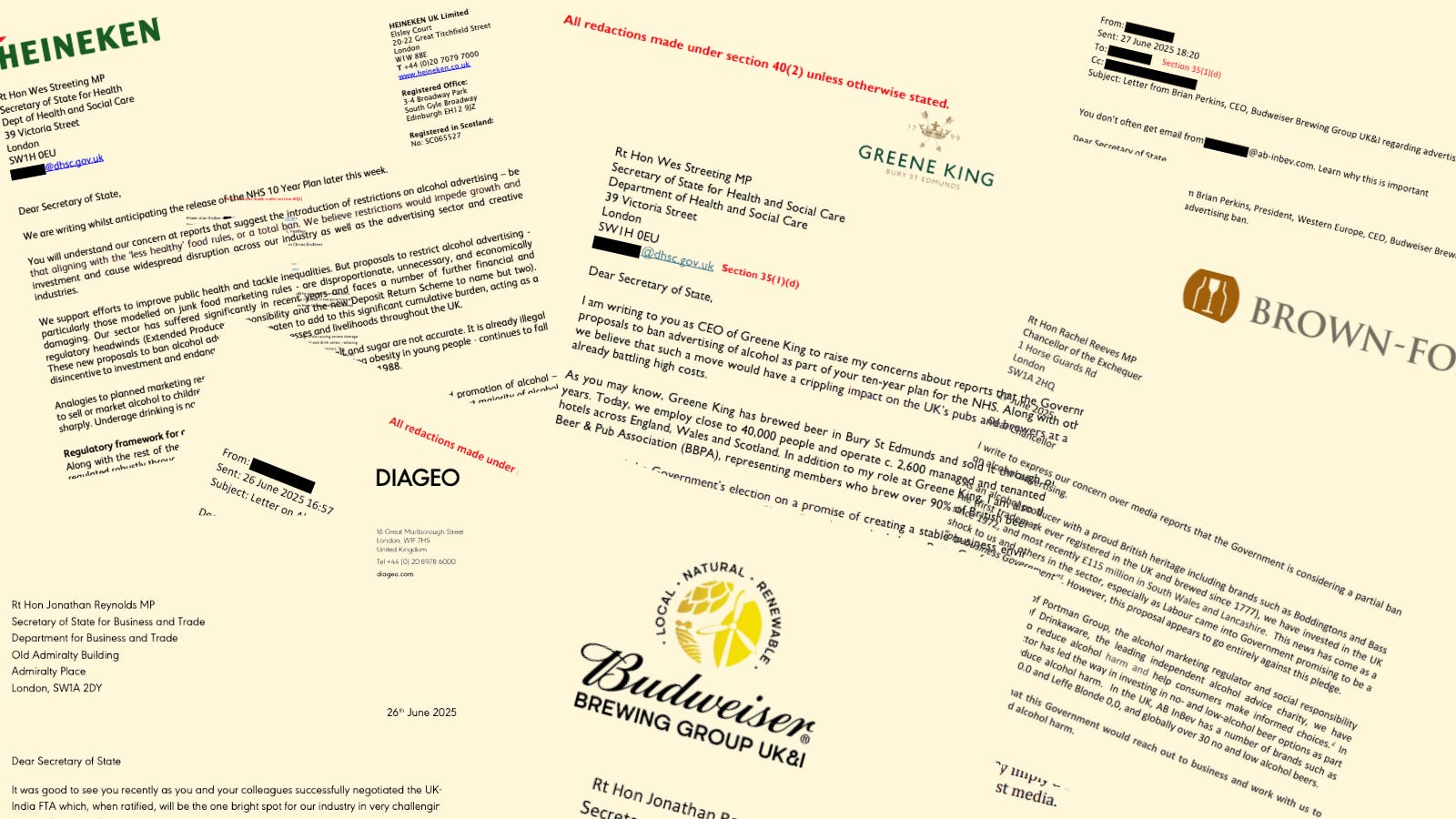
IAS analysis of Freedom of Information (FOI) documents released today reveals how alcohol companies and industry-funded bodies mounted a coordinated lobbying campaign to force the removal of alcohol marketing restrictions from England’s 10 Year Health Plan – an NHS strategy intended to improve the nation’s health.
The new report shows that in the days leading up to the Plan’s publication, alcohol producers and trade groups including Diageo, Budweiser, Heineken, Molson Coors, and the Portman Group wrote directly to the Health Secretary, while urging The Chancellor and Business Secretary to intervene on their behalf.
Alcohol marketing restrictions – recommended by the World Health Organization as one of the most effective measures to reduce alcohol harm — were widely expected to feature in the Plan following media leaks and confirmation from the Department of Health and Social Care (DHSC). They were absent from the final document.
The FOI disclosures show alcohol companies explicitly asking the Chancellor to pressure Health Secretary Wes Streeting to drop proposed marketing restrictions – despite those measures being supported by strong international evidence and aligned with NHS prevention goals. In a letter to Rachel Reeves, Budweiser stated that: “As Chancellor, we urge that you make immediate representations to the Department of Health and ensure that these restrictions are not enforced.”
In total, 47 documents were released under FOI, revealing strikingly similar arguments, shared language, and coordinated timing – pointing to a concerted industry effort to derail health policy.
Dr Katherine Severi, Chief Executive of the Institute of Alcohol Studies and co-author of the report, said:
These documents reveal alcohol companies doing exactly what we might expect but should never accept: lobbying aggressively and out of sight to block public‑health measures that threaten their profits – even when those measures were part of an NHS plan to prevent illness and save lives.
We cannot allow this pattern to continue. With the industry causing such significant harm, the government must put guardrails in place to protect the remaining plans to reduce alcohol harm, including mandatory labelling and lowering the drink-drive limit. Private profit must never outweigh public safety, and policy decisions must be rooted in independent evidence and the public interest.
The report highlights how alcohol industry correspondence relied on misleading claims about evidence, exaggerated economic threats, and repeated assertions that the industry should be consulted on health policy, despite a clear conflict of interest. Industry trade body the Portman Group wrote to DHSC claiming that: “We believe that such a proposal would be disproportionate and ill-targeted, given the generally positive trends on alcohol across society” – despite record alcohol deaths year-on-year since 2020.
Public First polling shows that an overwhelming majority of people (74%) want the government to prioritise the public’s health over business growth and the NHS was ranked the second most important issue facing the country right now. This makes the removal of these measures not just a health failure, but also a clear departure from public priorities.
Alice Wiseman MBE, Director of Public Health at Gateshead and Newcastle, said:
This is a textbook example of why the alcohol industry should have no role in shaping health policy. Their business model depends on increasing consumption, while public health depends on reducing it.
Allowing companies that profit from harm to influence NHS policy undermines prevention, weakens public trust, and costs lives. The parallels with tobacco are impossible to ignore.
The findings raise serious concerns about the government’s continued treatment of the alcohol industry as a stakeholder in public health, despite evidence that such partnerships are ineffective and risk regulatory capture.
Authors Emma Thompson and Dr Katherine Severi argue that this case underlines the urgent need for formal safeguards to protect health policy from industry interference, including clear conflict-of-interest rules across government departments, in line with WHO recommendations.
Men more likely to abstain, but older age groups at higher risk of alcohol harm
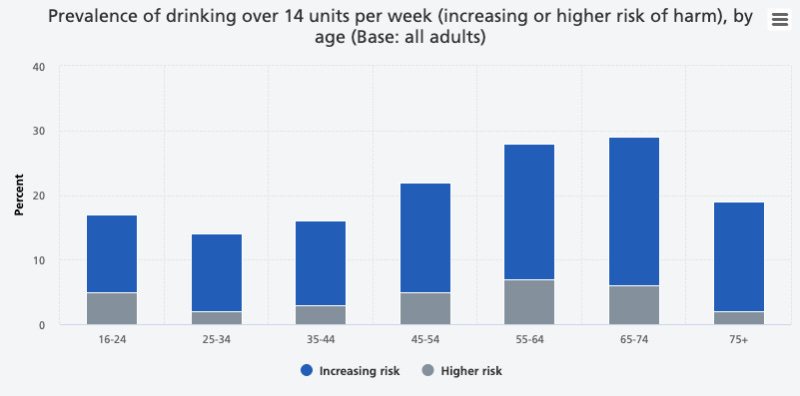
The latest Health Survey for England, published on 27 January, suggests more men are abstaining from alcohol than any previous survey year, while older age groups are much more likely to drink than younger groups. The number of people abstaining increased from 19% to 24% from 2022 to 2024, driven by more men abstaining (there was no change among women).
Worryingly, almost a third of people aged 55-74 drink over the 14 unit CMO guidelines each week. Only 14% of 25-34-year-olds do, and 16% of 35-44s.
Dr Katherine Severi told The Times that:
It’s really worrying that older age groups are the most likely to drink at risky levels. We also know that they are far more likely to die of alcohol-related harm than younger groups.
Research suggests that those who are choosing to cut back or stop drinking altogether are often doing so not just for health reasons, but because of deeper concerns about the world they’re growing up in, from economic insecurity to climate anxiety.
This points to a generational shift in how alcohol fits into people’s lives, even if harmful drinking remains widespread among young people in the UK.
Jem Roberts told the BBC that the increase in men abstaining shouldn’t distract from the scale of alcohol harm in England.
Millions of people are still drinking at levels that significantly increase their risk of serious harm, from alcohol-related cancers to life-changing injuries and long-term illness, and we have seen record high alcohol deaths in recent years.
Another area of concern is the number of young men drinking above 50 units a week, with 7% of those aged 16-24 drinking at this higher risk level, up from 4% in 2014.
39% of people living in the most deprived areas do not drink, compared to 16% in the least deprived. Similarly, 14% of people in the most deprived areas drank above the CMO guidelines compared to 22-23% of people living in the least deprived.
Budget business rates decision sparks industry backlash and partial government U-turn
The UK Government’s Budget decision on business rates for retail, hospitality and leisure (RHL) businesses has prompted a strong response from the hospitality sector and parts of the alcohol sector, as well as parliamentary scrutiny, and a subsequent announcement of additional support for pubs.
Under reforms linked to the 2026 business rates revaluation, many hospitality venues are set to see significant increases in rateable values as Covid-era reliefs are phased out. Media reporting and industry analysis suggest that most pubs will face substantial rises in bills from April 2026. Analysis cited by The Morning Advertiser found that 87.6% of hospitality venues are expected to see higher rateable values, with average pub bills rising by around 78%, from £8,899 to £15,630. Larger venues could see increases exceeding 200%.
Reporting in The Standard highlighted individual cases where bills could rise by up to 65.9% by 2026/27. Industry bodies warned that these pressures come on top of already high operating costs, with data showing that eight pubs closed each week in the first half of the year and more than 2,200 pubs shutting over the past five years.
The issue moved beyond industry lobbying into the political arena. According to the BBC and The Guardian, hundreds of pubs across the UK joined a protest campaign barring Labour MPs from their premises, arguing that the Budget unfairly targeted pubs compared with supermarkets and warehouses. Ministers rejected this characterisation, with Downing Street and the Treasury pointing to a £4.3bn package of transitional support for RHL businesses, including caps on annual increases and a new, permanently lower multiplier funded by higher rates on larger and online firms.
Business rates were debated in the House of Commons, where opposition MPs accused the government of promising “permanently lower” rates while allowing sharp increases in rateable values. Ministers responded that the revaluation had been initiated by the previous Conservative Government and that pandemic-era relief could not continue indefinitely.
On 27 January, the Treasury announced “a major support package”, which included a 15% cut to new business rates bills for pubs from April 2026, followed by a two-year real-terms freeze, and a review of the method used to value pubs for business rates. The Chancellor also announced £10 million of funding for the Hospitality Support Fund over three years – up from £1.5 million for one year announced last April – to support pubs across the country.
89% of organisations support minimum unit pricing
A new report by the Alcohol Health Alliance has found that 89% of organisations that have commented on minimum unit pricing (MUP) support the policy.
The report maps over 300 organisational positions on MUP in the UK, analysing hundreds of government consultations, media reports, and academic research.
Only 8% of respondents opposed the policy and 3% were neutral or undecided.
Of those organisations that opposed the policy, 85% were industry or industry-funded bodies. Although, perhaps surprisingly, overall the report found more support than opposition for MUP within the alcohol industry.
Two-thirds of on-trade organisations or representatives, and half of major supermarkets, have stated that they are in favour of the policy.
In a blog on the report, the AHA’s Policy and Advocacy Manager, Lisa Erlandsen, wrote:
Our report shows strong national support across England for MUP… Industry voices frequently wield disproportionate influence in the debate, delaying or derailing policy progress. The Alcohol Health Alliance urges the UK government to consider the overwhelming evidence on Minimum Unit Pricing and to implement the policy in England without delay.
Alcohol labelling plans prompt industry backlash
Proposals for new alcohol labelling requirements have prompted a strong response from the drinks industry, as the government considers one of the remaining public health measures from its longer-term health strategy.
According to the Financial Times, the Department of Health and Social Care (DHSC) met with more than two dozen alcohol producers and trade bodies on 27 January, including Diageo, the British Beer & Pub Association, and the Wine and Spirits Trade Association, to discuss reforms to alcohol labelling. Industry figures expressed concern that the government may introduce more explicit health warnings, including references to cancer and other health risks, and that rotating labels could increase production costs and reduce sales.
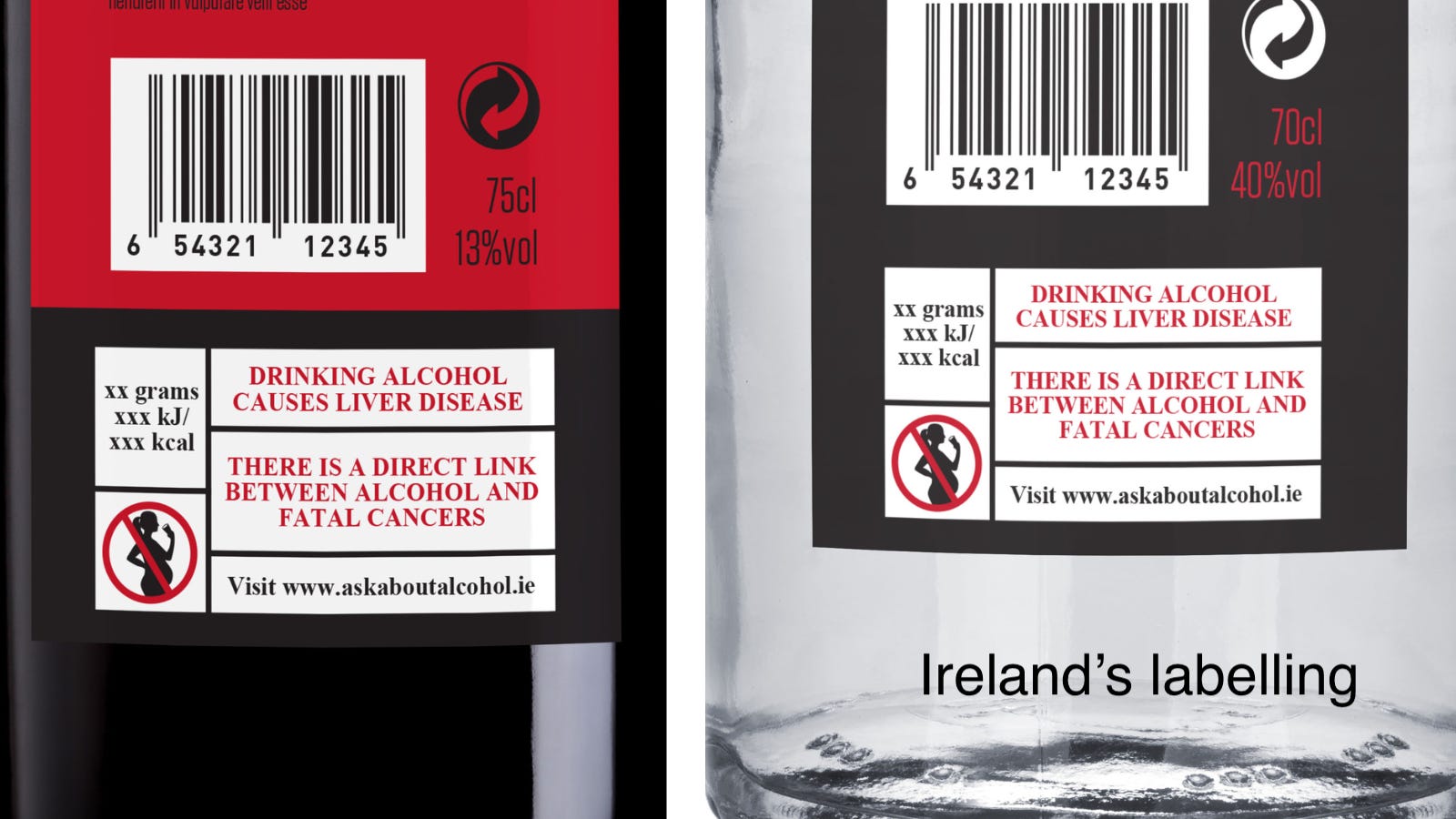
Executives told the FT that any additional costs would likely be passed on to consumers, arguing that the sector is already under financial pressure. Some companies raised concerns about the possibility of graphic, cigarette-style warnings, although a DHSC spokesperson said such labels were not under consideration.
Public health advocates have pointed out that labelling proposals remain one of the few population-level interventions still under active consideration following marketing restrictions being pulled from the 10-Year Health Plan under industry pressure. Dr Katherine Severi, told the FT that:
Public awareness of risks like cancer remains low, while support for clear alcohol labelling is high.
Mandatory labelling would create a level playing field, ensuring consumers get the same clear information no matter what they choose to drink.
Zero alcohol products could be banned for children
Alongside the debate on labelling, media coverage has focused on possible changes to the regulation of zero-alcohol products. The Telegraph reported that Labour is considering restricting the sale of these drinks to under-18s, citing concerns that products designed to closely mimic alcoholic drinks could normalise drinking behaviour or act as a gateway to later consumption.
The proposal has attracted criticism from parts of the drinks industry and from some commentators, who argue that alcohol-free options allow young people and adults to make lower-risk choices and that restrictions could have unintended consequences for pubs and retailers.
The emerging policy debate comes alongside new research on youth exposure to alcohol branding. A study published in the International Journal of Drug Policy examined young people’s perceptions of alcohol sponsorship and marketing in sport, including so-called “alibi” branding and NoLo products. The researchers found that participants aged 11–17 showed strong recognition of alcohol brands through sponsorship and often associated NoLo or alibi branding with full-strength alcohol. Many viewed these approaches as deliberate attempts to circumvent marketing restrictions, and participants recommended clearer differentiation between alcohol and non-alcohol products to avoid misleading messages.
Temperance, teetotalism and the shaping of Britain’s high streets
In January, the BBC ran a series of pieces revisiting Britain’s temperance movement as a force that reshaped everyday life, from high streets to public health.
The articles highlight how, during the 19th century, millions pledged to abstain from alcohol in response to what reformers saw as a major social evil: widespread drunkenness, poverty, and poor living conditions. Far from being marginal, temperance became “one of England’s largest social campaigns”, creating a parallel alcohol-free world of coffee taverns, billiard halls, hotels, theatres, and even hospitals.
As historian Andrew Davison explained, the movement was about offering alternatives, not simply prohibition.
The temperance movement was very much into providing alternative facilities for people who didn’t drink.
These spaces rivalled pubs for comfort and entertainment – and, ironically, many later became pubs themselves, such as this Wetherspoon in Manchester.

The BBC also traces the movement’s lasting legacy, from ornate buildings on today’s high streets to public water fountains that offered clean drinking water as an alternative to beer. Davison notes that temperance created “one of the most remarkable but forgotten chapters in English social and architectural history”.
While the BBC is careful to distinguish Victorian temperance from modern initiatives like Dry January, the coverage is a timely reminder that concerns about alcohol harm – and collective action to reduce it – are nothing new.
Alcohol Toolkit Study: update
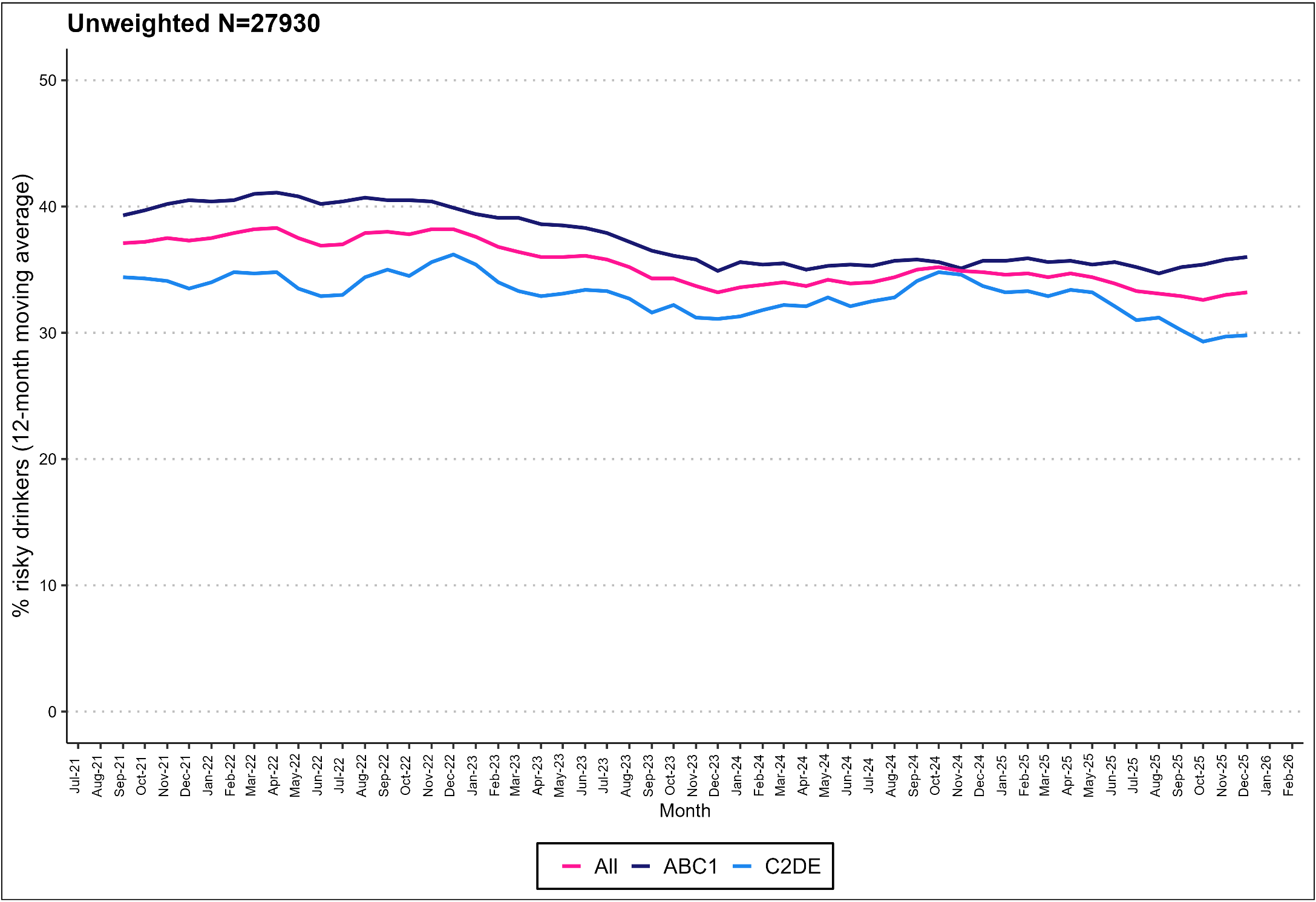
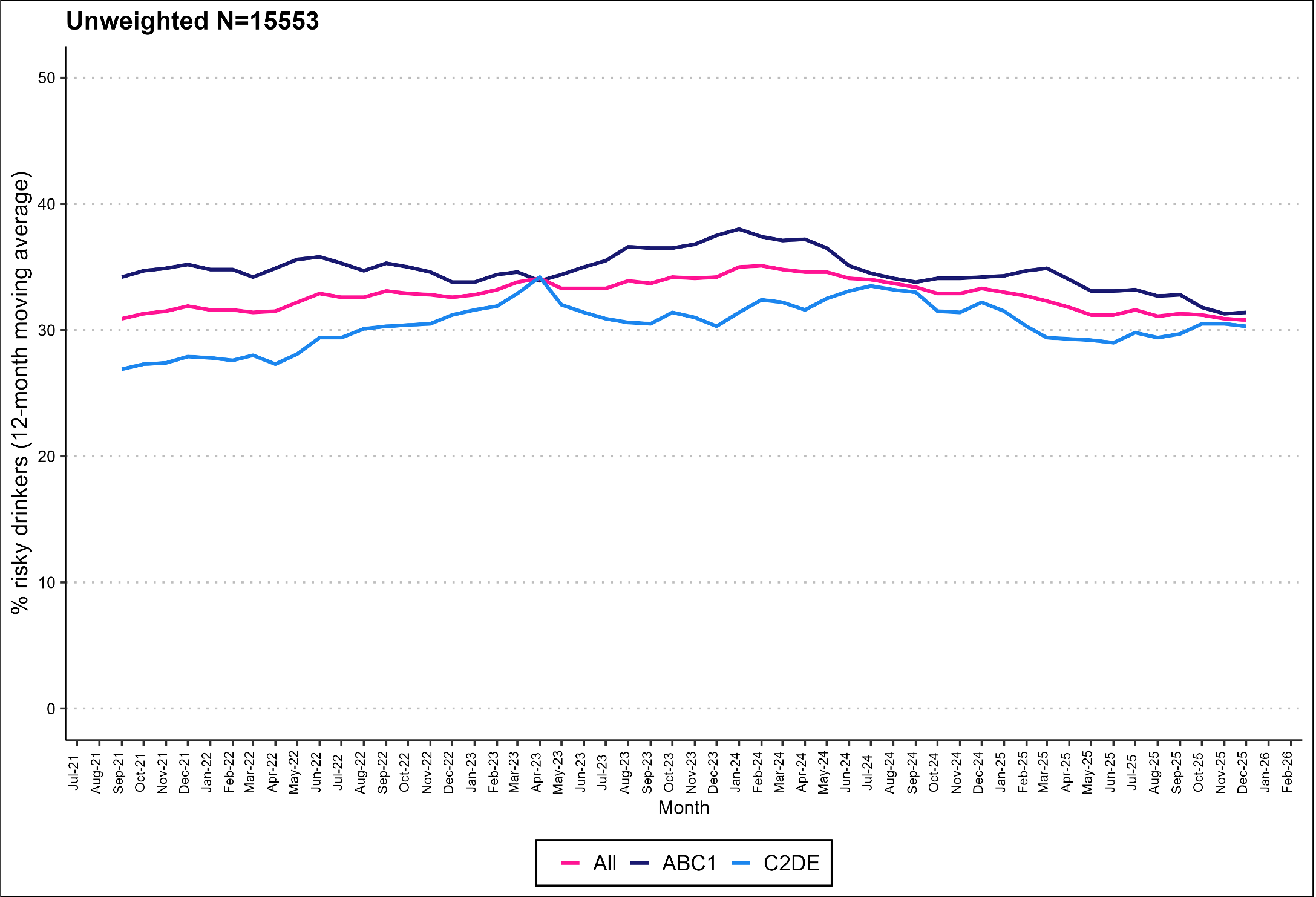
The Alcohol Toolkit Study is a long-running survey of alcohol consumption in England, Scotland, and Wales. The English monthly data has been collected since March 2014, and the Scottish and Welsh data from mid-2021. Each month involves a new representative sample of adults aged 16 and over.
You can find further charts and data for each country here:
The following charts are a snapshot of the prevalence of risky drinking by social grade.
Prevalence of risky drinking (AUDIT-C)
Risky drinking defined as those scoring AUDIT-C ≥5
ABC1: Professional to clerical occupation; C2DE: Manual occupation
England
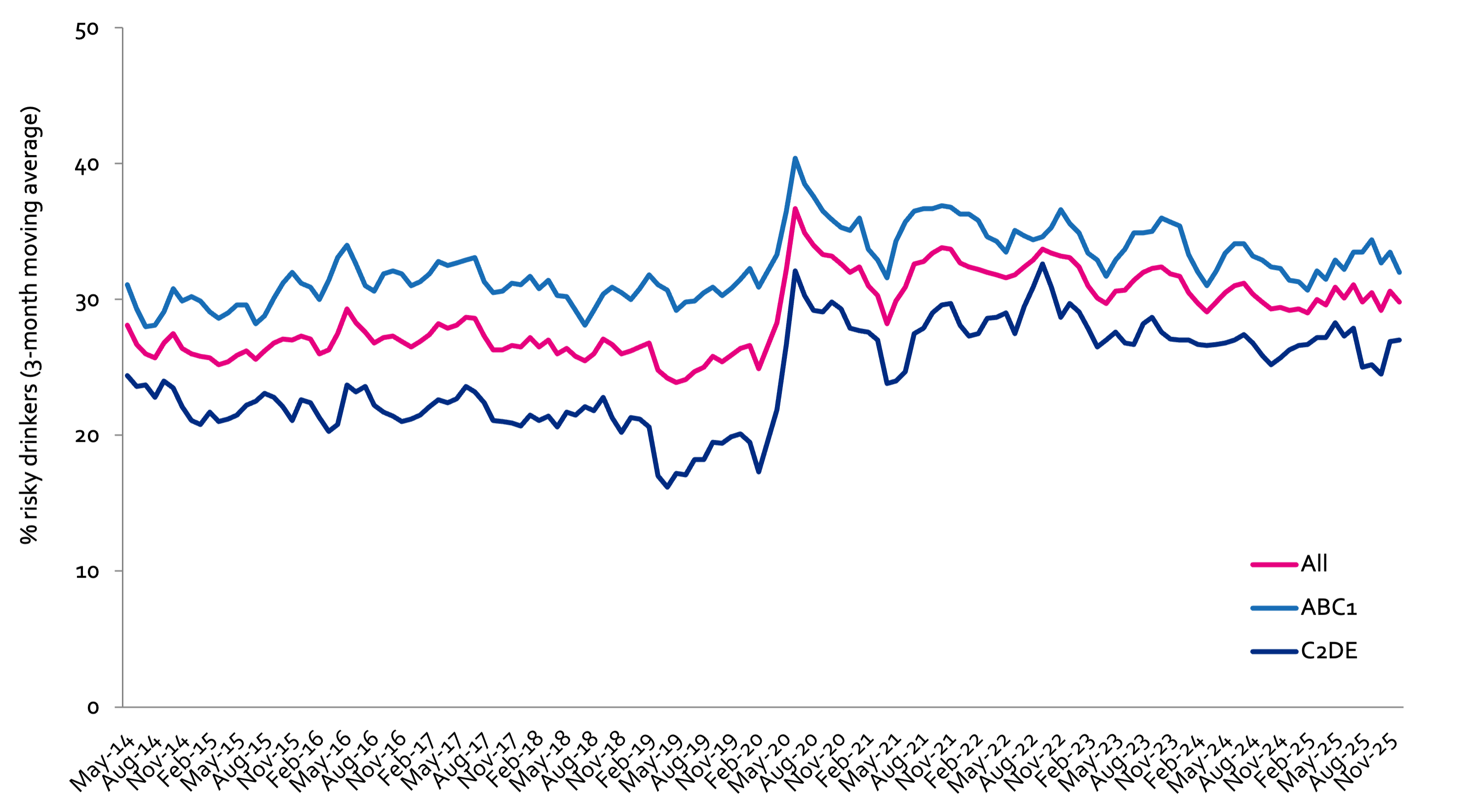
Scotland
Wales
Podcast
Our monthly podcast features interviews with experts from across the sector.
Humanising Healthcare’s Conversation Café: transforming medical education
Dr Hugo Jobst –
Humanising Healthcare
Dr Seonaid Anderson –
Consultant Psychiatrist
Allan Houston –
Glasgow City Council