
In this month’s alert
Democratic Unionist Party blocks minimum unit pricing in Northern Ireland
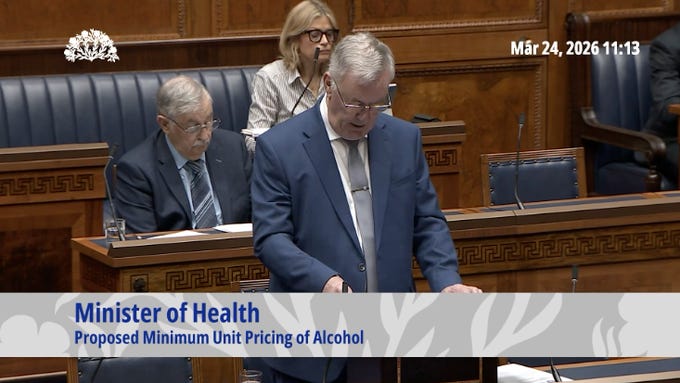
On 24 March, Northern Ireland’s Health Minister Mike Nesbitt told the Northern Ireland Assembly that he is disappointed to announce that minimum unit pricing (MUP) will not be brought forward in this mandate. He told members that:
It has not been possible to secure Executive agreement, and we’ve now reached the point sadly where legislation for MUP is no longer deliverable in this mandate. This will have an impact on many vulnerable and at risk people in Northern Ireland.
Other Members of the Legislative Assembly (MLA) criticised the Democratic Unionist Party (DUP) for blocking the measure in the Executive, with one Member saying it was “a disgrace”.
Sinn Féin MLA Philip McGuigan said it was “deeply disappointing that the DUP ignored scientific and medical evidence”. And SDLP health spokesperson Colin McGrath said it was unacceptable that “one party is able to weaponise its veto” in the Executive:
MUP is not a solution on its own, but it has been repeatedly shown to reduce alcohol-related harm and deaths – surely that is enough to support this policy and save lives?
Deputy First Minister and DUP MLA Emma Little-Pengelly denied her party blocked the proposals:
The questions were put to the health minister to demonstrate that this intervention would actually work and would actually result in the outcomes that people want to see. Of course we want to reduce alcohol related deaths, this hits at a particular type of issue but the vast majority of alcohol for sale would not be impacted by this measure, and alcohol deaths hit on every part of our society. Alcohol misuse is something that is a huge burden for the health service.
IAS’s Chief Executive Dr Katherine Severi told the Irish News that Northern Ireland was the only country in the UK that saw an increase in alcohol deaths in 2024, and that:
The DUP’s continued resistance to MUP – despite the weight of evidence, despite the calls from health professionals, and despite historically supporting the principle – is costing lives. Politics should never be allowed to override good public health policy, and that is exactly what is happening here.
Minister Nesbitt has shown leadership – it is deeply frustrating that his own Executive colleagues are undermining it and preventing him from saving lives.
Irish News’ political correspondent John Manley wrote that the DUP appears to have:
gone out of its way to deliberately derail Health Minister Mike Nesbitt’s proposed legislation… Given its close association historically with Free Presbyterianism, there would have been an expectation that the DUP would support any measure that sought to curb the consumption of what its former leader would’ve described as ‘the devil’s buttermilk’.
He went on to write that former DUP health minister Jim Wells has said DUP opposition was a result of lobbying from the drinks industry.
Professor Sir Ian Gilmore, Chair of the Alcohol Health Alliance, said:
Northern Ireland is facing its highest levels of alcohol harm on record, placing unacceptable burden on individuals, families, and public services. Choosing not to implement this policy means those harms will persist, with grave consequences, and hitting the most vulnerable groups in society the hardest.
We urge policymakers to reconsider this decision and to prioritise evidence-based measures that protect public health over political wins. Lives are being lost that could be saved with this proven, preventative policy.
Reduced consumption of supermarket alcohol, tobacco, gambling, and confectionery would be unequivocally good for the UK economy – podcast feature

New research has dealt a significant blow to the alcohol, tobacco, and gambling industries’ core economic argument against regulation, finding that the sector’s claims that reduced consumption would harm the economy and cost jobs do not stand up to scrutiny when the full picture of consumer spending is considered.
The study, by the Sheffield Addictions Research Group (SARG), modelled how a 10% reduction in consumer spending on alcohol, tobacco, gambling, and confectionery would flow to different sectors in the UK economy, finding significant benefits to the UK economy if spending moves to more productive industries.
This was particularly the case for spending on off-trade alcohol, tobacco, and gambling, as money spent on these industries often leaves the country – to global supply chains and international headquarters. Therefore, any reallocation of spending to other industries will keep more money in the UK economy and be a net positive. For on-trade alcohol, reductions in spending negatively impacted the UK economy.
The key findings were:
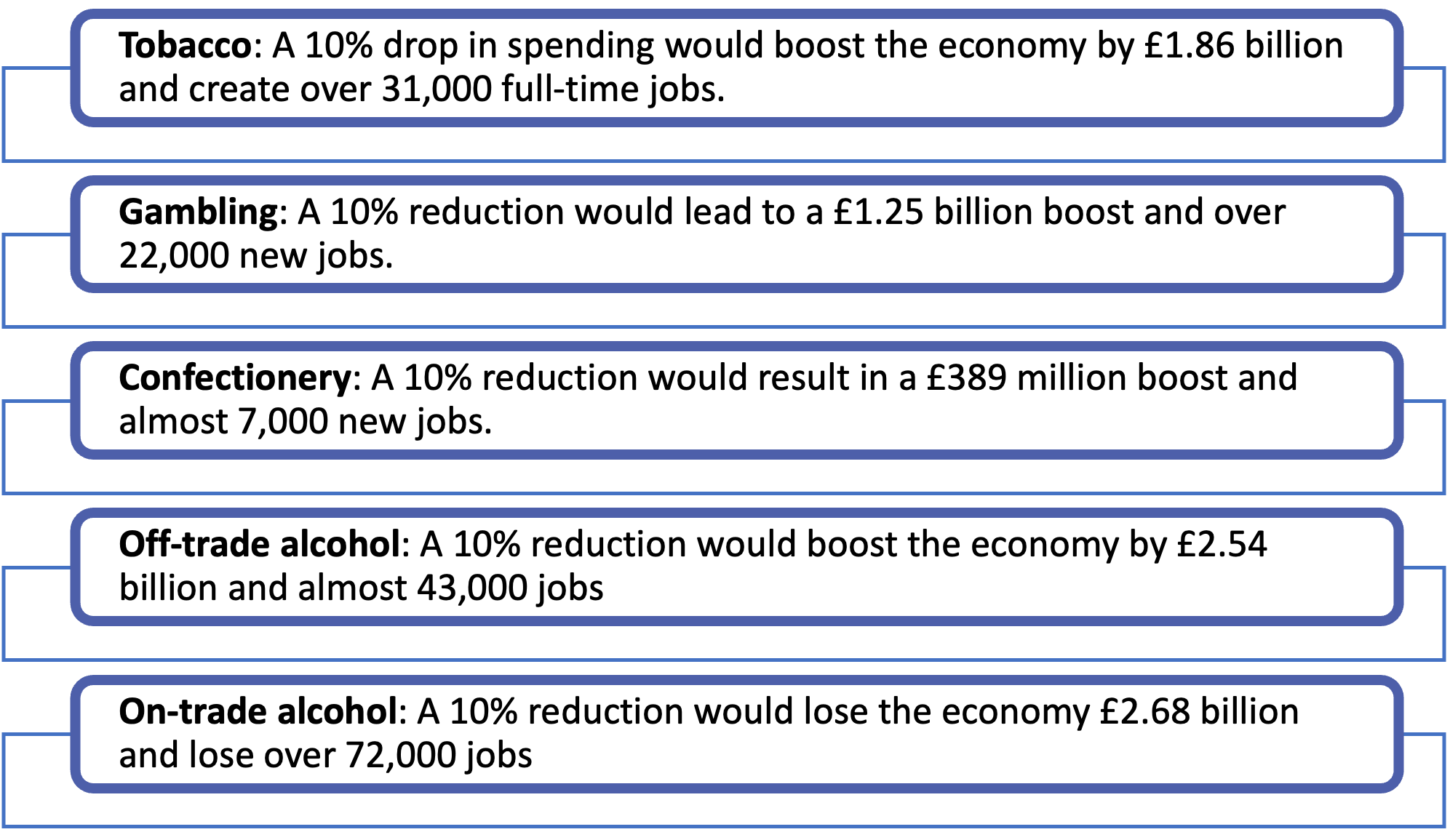
So for alcohol, while spending less on alcohol in supermarkets was a significant net positive for the economy, spending less in pubs and restaurants had a negative impact, as hospitality is a major employer within the UK.
The modelling assumes that all of the money is reallocated to other industries and not saved. However, it found that even if 99% of the money that was not spent on alcohol was actually saved, and only 1% reallocated to other industries, the economic impact would breakeven (measured by Gross Value Added), highlighting just how unproductive money spent on supermarket alcohol is for the UK economy.
Similarly, 96% of the tobacco money would have to be saved and not reallocated to breakeven. For confectionery and gambling it was slightly lower, with 75% and 69% having to be saved to breakeven. Realistically, far less of the reduction in money spent would be saved, and far more would be spent on other products and services, showing an unequivocal net positive for the UK economy.
Joining this month’s podcast, lead author Dr Damon Morris explained why these economic benefits are almost certainly underestimates:
by reducing consumption of these things we have a healthier population – so you’d expect fewer sick days from work, fewer people out of employment altogether because they’re too ill to work, or out of work because of premature mortality.
He went on to explain that if the productivity gains from improved health were also included, it would show an even greater benefit to the UK economy.
The findings have clear implications for alcohol policy. Policies that target off-trade alcohol consumption – such as minimum unit pricing or increasing the duty differential between off- and on-trade products – would not only bring economic benefits by shifting spending to more productive sectors, but would also support the on-trade hospitality sector by making pub and restaurant drinking relatively more affordable by comparison. This matters for public health too: research consistently shows that the heaviest drinkers consume proportionally more in the off-trade, meaning policies targeting cheap supermarket alcohol are most likely to reach those whose drinking poses the greatest risk to their health.
Big Alcohol in the Global South: how alcohol multinationals exploit some of the most disadvantaged people on Earth
Bribing politicians. Writing governments’ own alcohol policies. Targeting children with cheap sachets and mini-bottles. Exploiting migrant workers in conditions described as modern slavery. This is the alcohol industry in the Global South – and our new film exposes it.
While markets in wealthier countries stagnate, giants like Diageo, AB InBev and Heineken are pouring billions into Africa, Asia and Latin America – extracting vast profits while leaving behind addiction, gender-based violence, and preventable death. Over 95% of Big Alcohol’s value sits in Europe and the US. The money leaves. The harm stays.
Watch our new film, share it with your networks, and push it on social media. The industry counts on staying in the shadows.
Eight experts discuss the need for a new national alcohol strategy
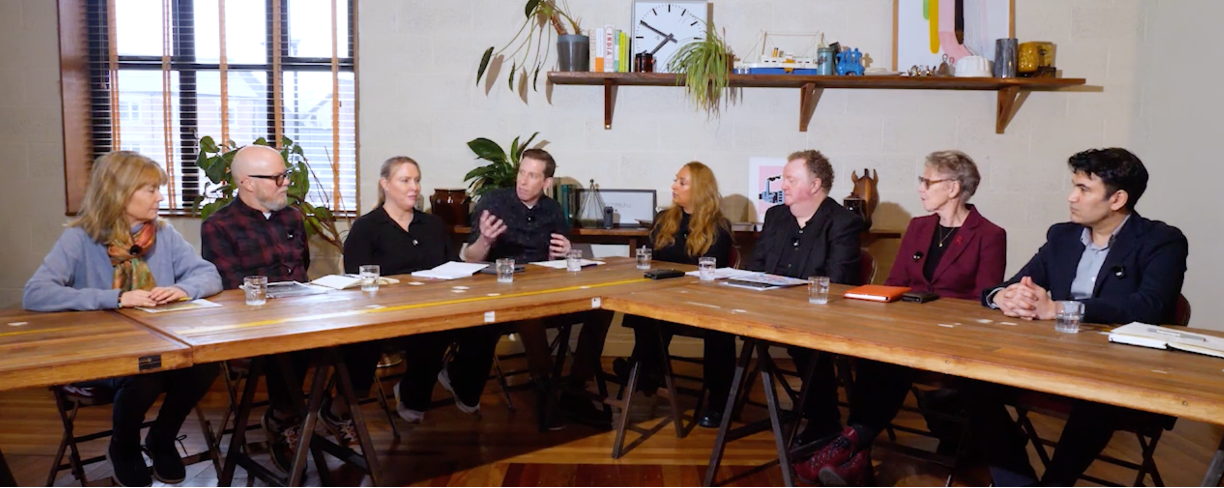
Alcohol causes cancer, liver disease, and widespread harm – yet the UK still lacks a coherent national alcohol strategy. So what would an effective one actually look like?
The SSA recently brought together researchers, clinicians, public health experts, and people with lived experience to examine exactly that question in a policy roundtable filmed in Sheffield.
The discussion covers the full picture: the scale of alcohol-related harms, what the evidence says works (minimum unit pricing, health warning labels, and more), the role of no- and low-alcohol products, and how the alcohol industry shapes – and too often distorts – policy debates.
As Professor John Holmes, Director of SARG said:
We know that the industry puts a lot of effort into controlling alcohol policy and influencing the way it works through its building of coalitions, its management of information and evidence and the debate, its relationships with the government, and then at times, ‘bringing in the big guns’ – bringing in legal threats, attacking evidence, withdrawing cooperation.
Zero alcohol, not zero risk
This month has seen several articles published on the potential risks of zero alcohol products.
A study in Drugs and Alcohol Review examined 382 Australian adolescents aged 15 to 17 and found that those who had seen and liked zero-alcohol advertisements from major alcohol brands reported more favourable attitudes towards those brands’ full-strength products – and stronger intentions to drink them. This held true even after accounting for whether teenagers had already tried alcohol. The researchers described zero-alcohol advertising as functioning like “surrogate marketing” – a back-door route to building brand affinity with an audience too young to be legally targeted.
The problem is compounded by a fragmented regulatory landscape. A second Drugs and Alcohol Review study, comparing governance across eight countries, found definitions vary enormously: a drink can be labelled alcohol-free at 0.05% ABV in the UK, but up to 1.15% ABV in parts of Australia. Marketing restrictions are largely voluntary and self-regulatory, leaving few firm guardrails on where and how these products are promoted.
In a BMJ feature, researcher Jacqueline Bowden warned that these products are “blurring the lines a lot, which psychology would tell you is not right for setting future patterns.” University of York researcher Emily Nicholls told the BMJ that zero alcohol advertising also rarely showed drinking in places like bars and pubs, instead showing drinking “in places like the gym, the workplace” sending a “problematic message” that these drinks are to be used as well as, and not instead of, standard alcohol.
The article goes on to point out that youth drinking started to rapidly drop around 2009, well before the nolo market picked up, indicating “that nolo drinks aren’t essential for keeping youth alcohol consumption low”.
The UK government is reportedly considering banning sales to under-18s, a step researchers broadly welcome. But the evidence suggests age-restricted sales alone won’t be enough. The branding is the same, the marketing does the same work, and for a teenager seeing a billboard for an alcohol brand linked to their favourite sports team, the alcohol content of the can is almost beside the point.
New research reveals the hidden complexity of alcohol inequalities in England
A new study published in BMC Public Health has shed fresh light on how socioeconomic circumstances shape drinking habits across England – with findings that challenge simple narratives about poverty and alcohol.
Researchers from the Universities of Southampton and UCL, and the Institute of Alcohol Studies, analysed data from over 14,000 adults using Health Survey for England data from 2019 and 2021. Rather than relying on single measures like income or occupation, they used a statistical technique called latent class analysis to identify distinct socioeconomic profiles – groups such as “Skilled Low Income Renters”, “Retired Homeowners”, and “Professional Private Renters” – and examined how each related to alcohol use.
It found that the most disadvantaged groups (Low Income Renters) were significantly more likely to abstain from alcohol, while professionally employed homeowners and private renters showed the highest rates of increasing- and high-risk drinking – consistent with the alcohol harm paradox.
Crucially, the findings held firm across both the pre- and during-pandemic data, suggesting the relationship between socioeconomic position and drinking is remarkably stable.
The authors argue that moving beyond crude SES measures could help policymakers design far more effective, targeted interventions. The authors call for targeted, context-sensitive interventions tailored to specific socioeconomic groups, and better equity assessment of population-level alcohol policies such as minimum unit pricing.
Heavy episodic drinking rises sharply among Gen Z when they reach their early 20s

New research from the UCL Centre for Longitudinal Studies challenges the narrative that Generation Z is turning away from alcohol, revealing a sharp rise in substance use as young people enter their early 20s.
Drawing on data from nearly 10,000 participants in the Millennium Cohort Study, the study shows that 68% of 23-year-olds reported ‘binge drinking’ in the past year, with almost a third (29%) doing so at least monthly – nearly triple the rate seen at age 17.
Drug use has also increased significantly over this period. Nearly half (49%) reported having tried cannabis, while almost one in three (32%) had used harder drugs such as cocaine, ketamine or ecstasy. Alongside this, daily vaping rose sharply to 19%, and around a third (32%) reported gambling in the past year.
Lead author Aase Villadsen said the findings challenge the idea of a more “sensible” generation:
Recent reports have suggested that young people are increasingly turning their backs on drinking alcohol… however, our new study appears to show that this might not be the case for some members of Gen Z as they reach their early 20s.
Crucially, the study finds that patterns of alcohol use among Gen Z are now comparable to – or even exceeding – those seen among millennials at the same age. This is particularly concerning given the heightened vulnerability of young adults to certain alcohol-related harms.
Dr Katherine Severi commented:
This points to the role of the wider alcohol environment, rather than individual choice alone. We know that affordability, availability and promotion are the key drivers of alcohol harm, and many students are exposed to all three.
Alcohol Toolkit Study: update
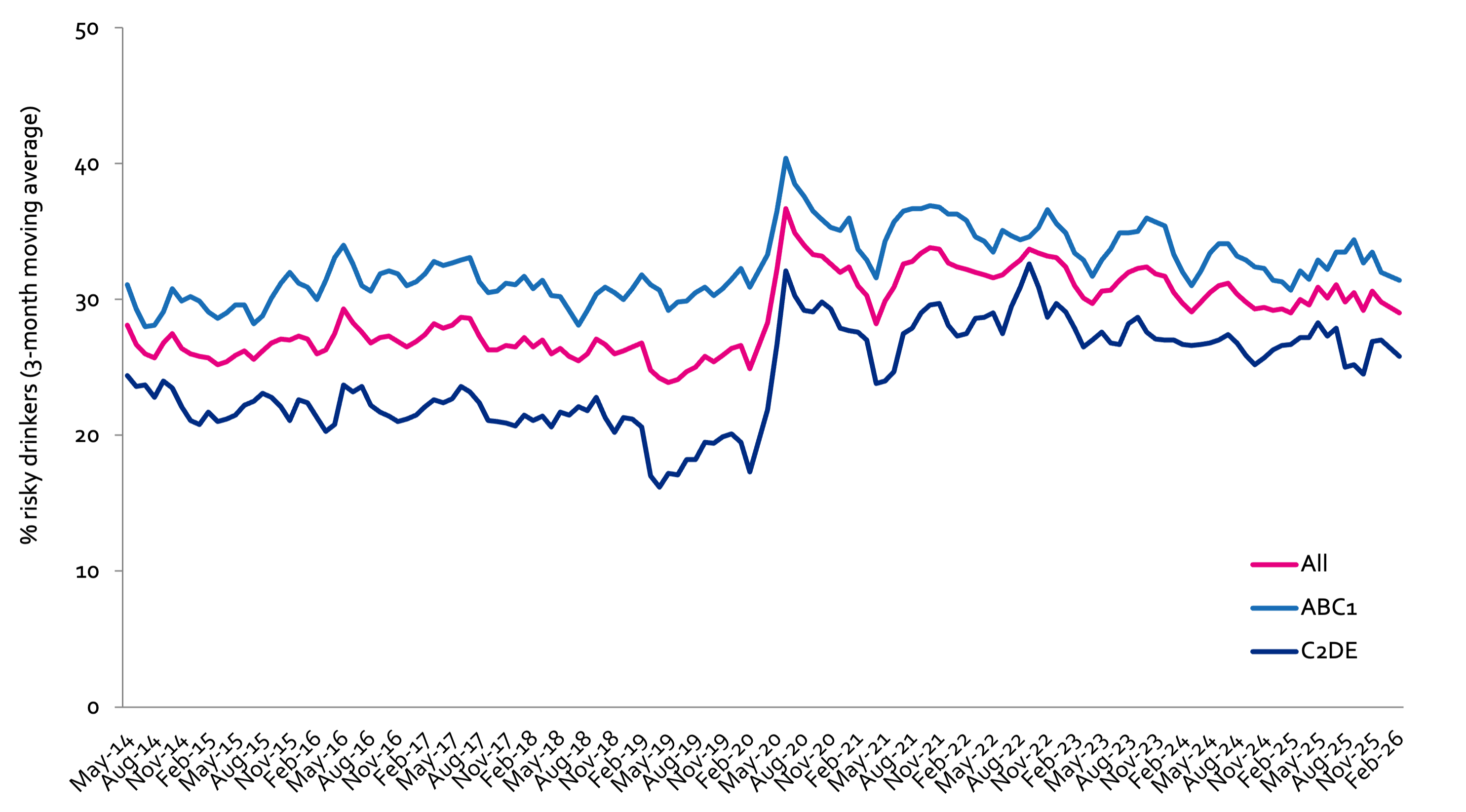
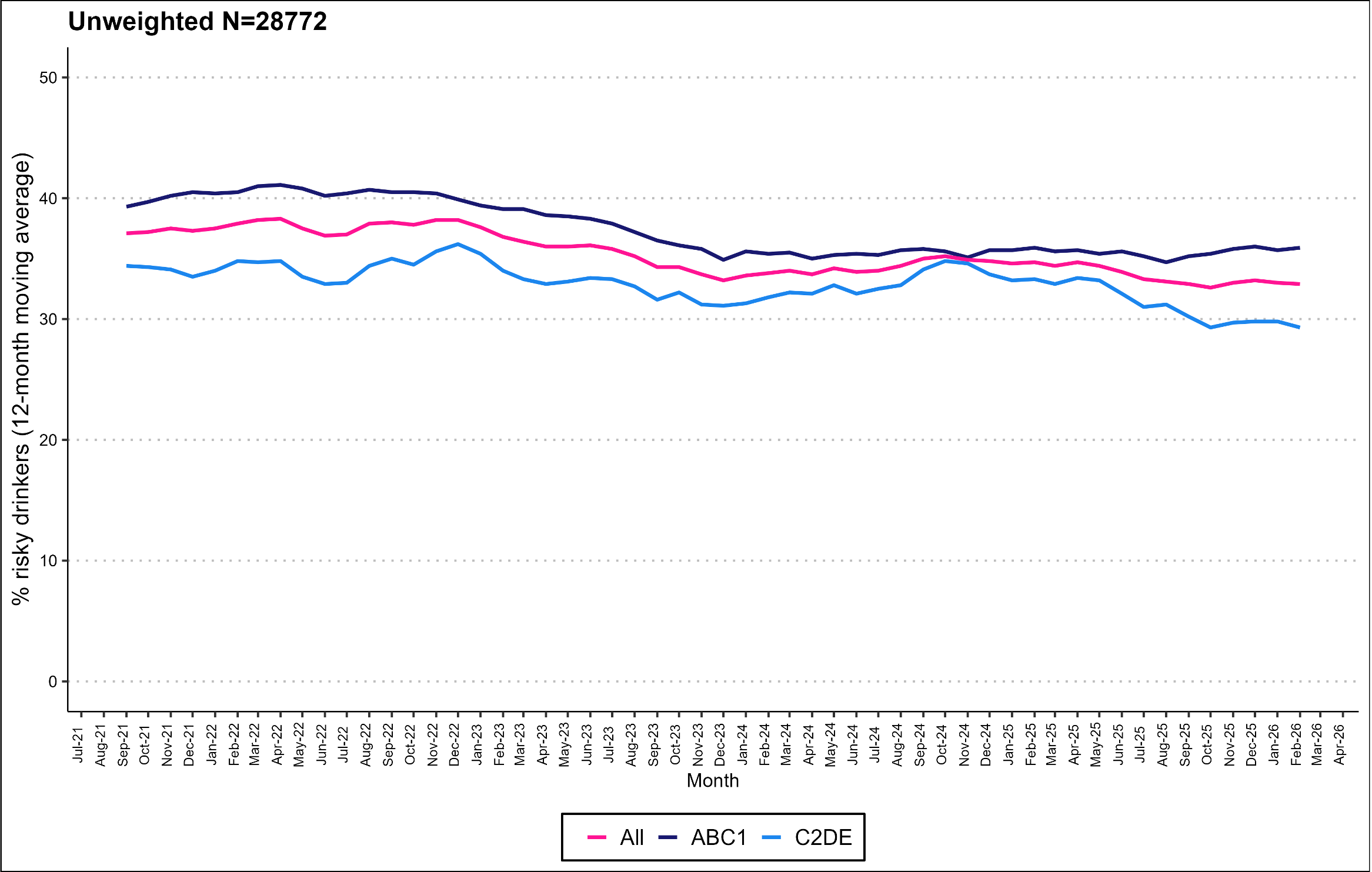
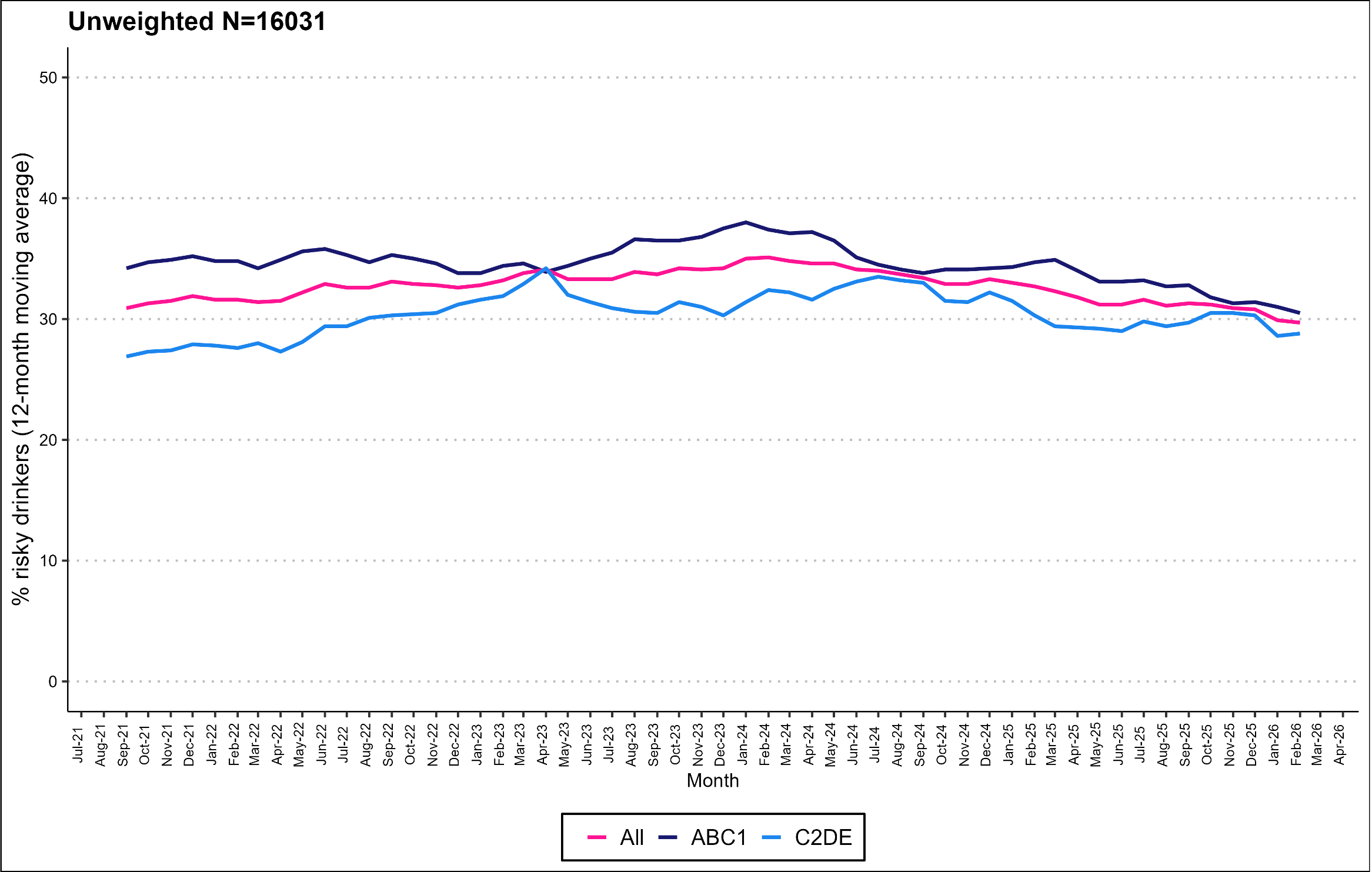
The Alcohol Toolkit Study is a long-running survey of alcohol consumption in England, Scotland, and Wales. The English monthly data has been collected since March 2014, and the Scottish and Welsh data from mid-2021. Each month involves a new representative sample of adults aged 16 and over.
You can find further charts and data for each country here:
· England
· Scotland
· Wales
The following charts are a snapshot of the prevalence of risky drinking by social grade.
Prevalence of increasing and higher risk drinking (AUDIT-C)
Risky drinking defined as those scoring AUDIT-C ≥5
ABC1: Professional to clerical occupation; C2DE: Manual occupation
England
Scotland
Wales
Podcast
Our monthly podcast features interviews with experts from across the sector.
Reduced consumption of supermarket alcohol, tobacco, gambling, and confectionery would be unequivocally good for the UK economy
Dr Damon Morris –
Research Fellow, Sheffield Addictions Research Group