
In this month’s alert
Green MP comments on the drinking culture in Westminster
Newly elected MP Hannah Spencer caused a stir with her comments on the drinking culture in Westminster. Speaking to Politics Joe, Ms Spencer said: “There is a room where I walk past, then double back and look in because people are just sat having a drink. But again, that is a job. I can’t imagine if a cleaner did that or someone working in a bank had a few drinks and went back to work smelling of alcohol.”
Several MPs responded, with Labour MP Jim McMahon saying he’d never seen anything that would amount to “drunkenness,” and Liberal Democrat MP Tom Morrison saying the claim “tarred all MPs with the same brush.” Nonetheless, reporting from Hyphen indicates that current and former staff say the issue is concerning. One ex-employee described a “really heavy drinking culture,” adding that alcohol was “synonymous with access” to opportunities. Former MP Khalid Mahmood warned it has a “very corrosive effect,” linking it to misconduct.
Spencer also raised the matter in Prime Minister’s Questions:
In Gorton and Denton, we have to pay full price for a pint, but here, for some reason, it is cheaper. Some MPs drink before voting, and that really shocked me when I came to Parliament, because this is our workplace. Does the Prime Minister agree with his own MPs who have defended their right to drink cheap alcohol at work, or does he agree with me that MPs should not be drinking on the job, given that we vote on huge things like the climate crisis, disabled people’s rights, housing and child poverty?
Prime Minister Keir Starmer responded:
There will be different views on whether people should be able to enjoy a drink here or not, but I think we can agree that the majority of people in this country want an economy that works for them, public services that are there when they need them, and every child going as far as their talent or ability will take them. The only way to deliver that is through a Labour Government, as we are doing. The Greens think that their leader walks on water. It turns out that he just lives on water and does not pay his council tax!
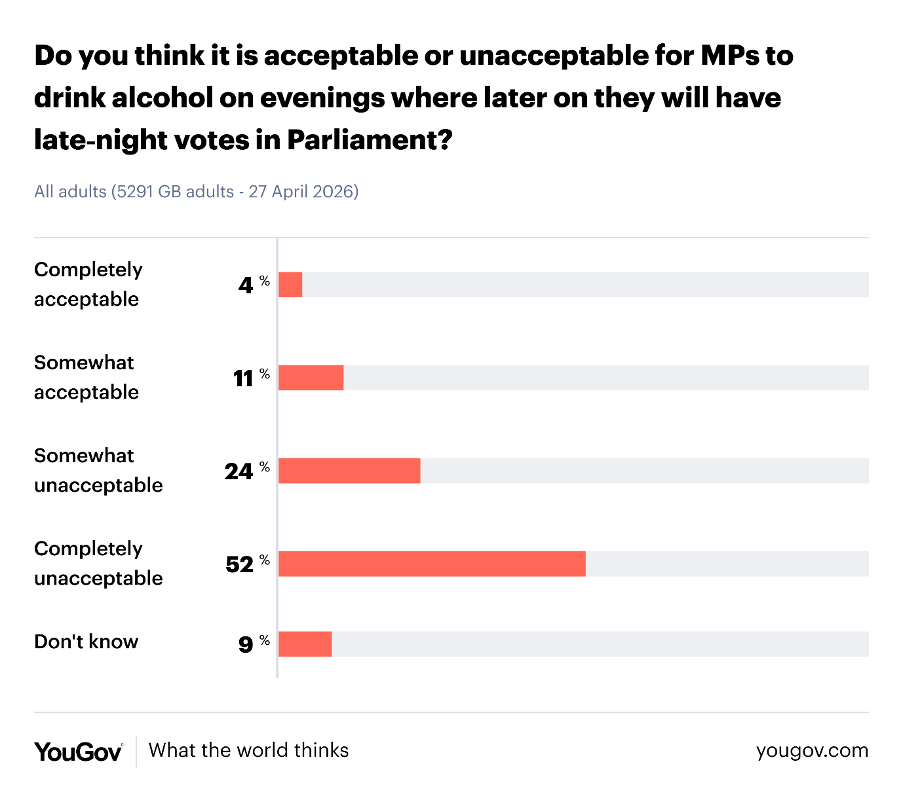
A YouGov poll found that over three quarters (76%) of the public thought it was unacceptable for MPs to drink alcohol on evenings where later on they will have late-night votes in Parliament.
Rate of alcohol-specific deaths in the UK decreases to lowest number since 2020
Figures from the Office for National Statistics released in May reveal that 9,809 deaths from alcohol-specific causes were registered in the UK. The rate of alcohol-specific deaths (14.8 per 100,000 people) is the lowest recorded since 2020 (13.9 deaths per 100,000 people).
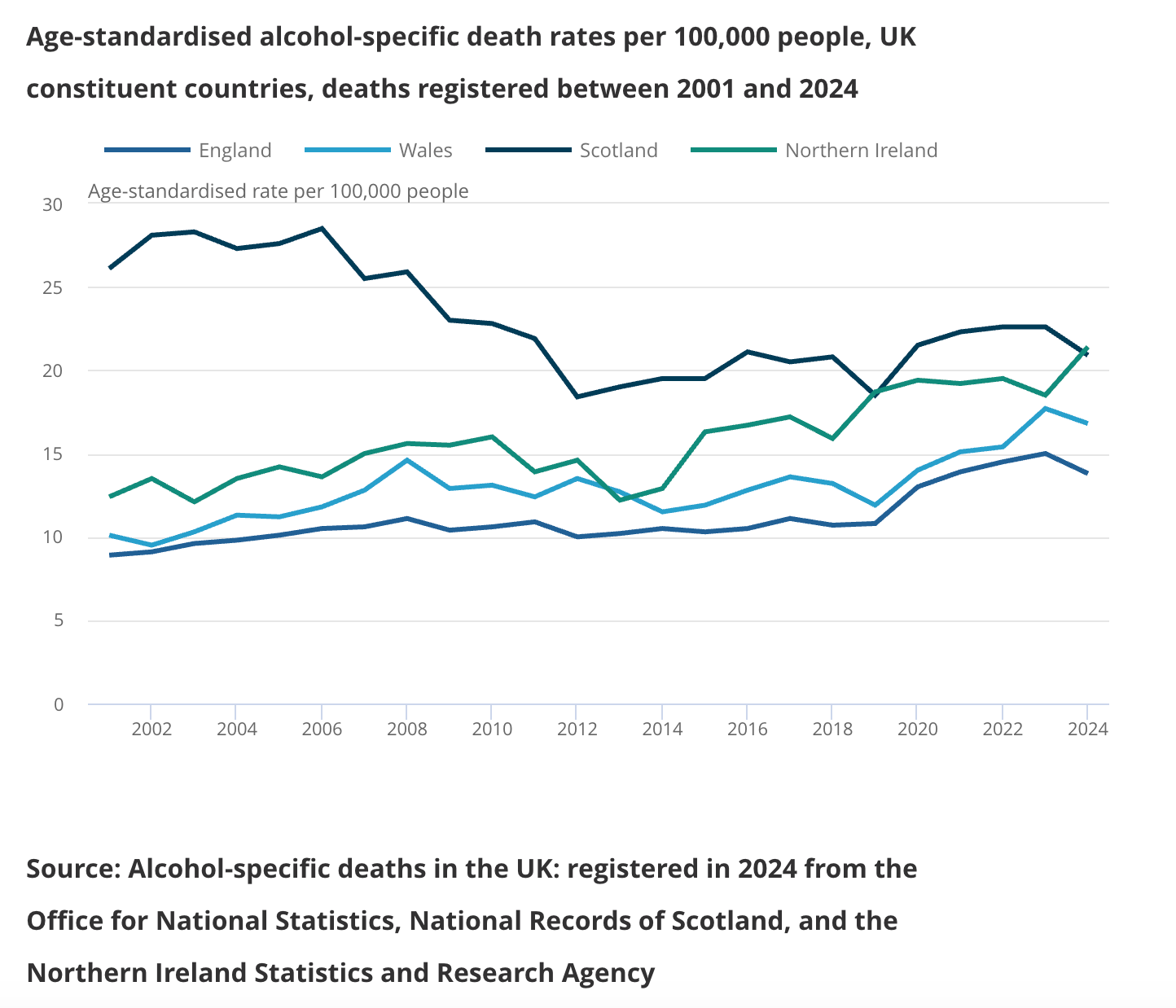
England and Wales had a decrease in the rate of alcohol-specific deaths (13.8 and 16.8 deaths per 100,000 people, respectively) compared with 2023. Scotland and Northern Ireland continued to have the highest rate of alcohol-specific deaths (20.9 and 21.4 deaths per 100,000 people, respectively), with a decrease in the rate in Scotland and an increase in Northern Ireland when compared with 2023.
The North East had the highest rate of alcohol-specific deaths of any English region (21.1 deaths per 100,000), and London had the lowest rate (10.9 deaths per 100,000). In England, men in the most deprived group were four times more likely to die than those in the least deprived group, and women were three times more likely. In Wales, those figures were 2.8 and 2.5 times, respectively.
Dr Katherine Severi, chief executive of the Institute of Alcohol Studies, said:
The fall in alcohol deaths from 2023 to 2024 offers a small but welcome sign that the UK is moving in the right direction – but let’s be clear: alcohol deaths remain at a deeply unacceptable level, and we cannot allow that to become normal. These deaths were unacceptably high before the pandemic. They rose sharply during it. A modest reduction is not cause for complacency – it is cause for redoubling efforts.
BBC coverage reported a comment from the Department of Health and Social Care:
Any death from alcohol is a tragedy. While these figures show a slight reduction, alcohol-related deaths remain at unacceptably high levels and we are determined to drive them down. Our 10 Year Health Plan commitment to alcohol labelling to provide better health and nutritional information is a crucial step in supporting people to make healthier choices. Over the next three years, the government is providing £3.4 bn of ring-fenced funding through the Public Health Grant to support drug and alcohol prevention, treatment and recovery services.
Podcast on commercial power and health policy with former Scottish minister
In this episode of Money Power Health, Dr Nason Maani speaks to Elena Whitham, who served as a Member of the Scottish Parliament and as Minister for Drugs and Alcohol Policy.
They discuss various areas of alcohol policy, including advertising and promotion and minimum unit pricing, and what commercial influence on health policymaking looks like in practice. Elena also explains what advice she would give to other policymakers based on her experiences.
What dependent drinkers think about alcohol pricing policies
In a recent briefing from the University of Sheffield, researchers interviewed people with current or recent experience of alcohol dependence who were in financial hardship to understand their experiences of rising alcohol prices, minimum unit pricing and taxes, and wider alcohol policy.
The research found:
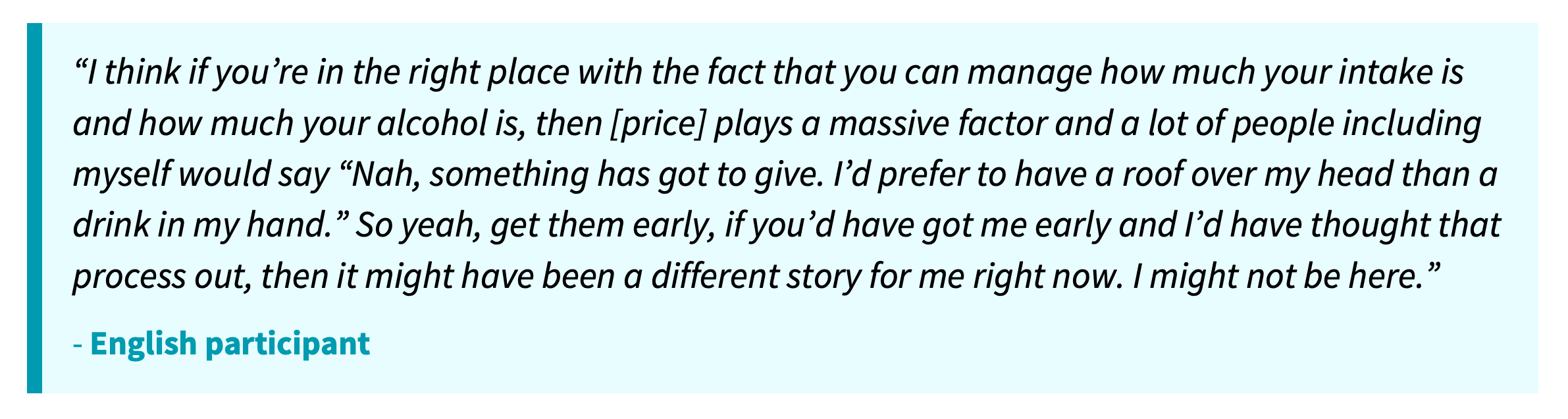
- People reported experiencing significant financial pressures when alcohol became more expensive and were sceptical about whether this would benefit those with established and severe alcohol dependence.
- Some still saw benefits of pricing policies because they could prevent people becoming dependent in the first place.
- There was support for hypothecation of revenue from pricing policies for treatment services.
- People also supported restrictions on alcohol advertising and availability, including home delivery services, reducing the visibility of alcohol in shops and providing greater education on the harms of alcohol.
The authors recommend that alcohol pricing policies should be introduced alongside treatment support, and that policymakers should consider hypothecating money raised from pricing policies for treatment. They also call for better restrictions on advertising, availability, and rapid home delivery.
Families devastated by rapid online alcohol deliveries
In a blog for the Alcohol Health Alliance, campaigner and advocate Cassie shares her family’s experience of alcohol addiction, and how online alcohol delivery apps have made alcohol easier than ever to access.
Losing my mum to alcoholism a decade ago broke my heart, and now seeing my uncle trapped in the same nightmare has been gut-wrenching. He’s a man with deep mental health struggles, and his addiction has nearly killed him countless times. Even now, in remission, the constant urge to order alcohol through online apps haunts him daily.
Cassie’s story shows how this system built for convenience is failing to protect people at their most vulnerable. She calls for stronger controls on delivery times for home alcohol orders, limits on the quantity that can be delivered in a single order, and tighter restrictions on price promotions.
Twin sisters Connie and Daisy Perkins are also campaigning for better safeguards, after their dad died aged 55 from alcohol-related problems. His daughters say rapid delivery apps enabled his heavy drinking by allowing repeated alcohol orders throughout the day.
In 2022, Uber Eats told them they could not prevent their father from ordering alcohol on the platform as they were not the account holder. He was able to place orders as often as every 90 minutes. Uber Eats says it has “an ongoing partnership with an alcohol education charity to implement further alcohol safety measures.”
A Home Office spokesperson said:
Our thoughts are with the family of Mr Perkins and all those affected by his tragic death. We understand the concerns relating to rapid online alcohol delivery, which can lead to increased alcohol harm. We are looking into how licensing rules apply to these delivery services, and are working with experts to ensure safeguards are effective.
Profits and losses for the alcohol industry
Donald Trump has announced the removal of certain tariffs on Scotch whisky following a White House visit by King Charles III and Queen Camilla, in a move he says will revive trade links between Scotland and Kentucky. Scottish First Minister John Swinney called it a “tremendous success,” highlighting the economic impact, while industry leaders said it would restore stability and support jobs on both sides of the Atlantic.
This news comes as figures from the British Beer and Pub Association indicate that the UK is losing two pubs a day, with 161 closures in the first quarter alone, apparently costing around 2,400 jobs.
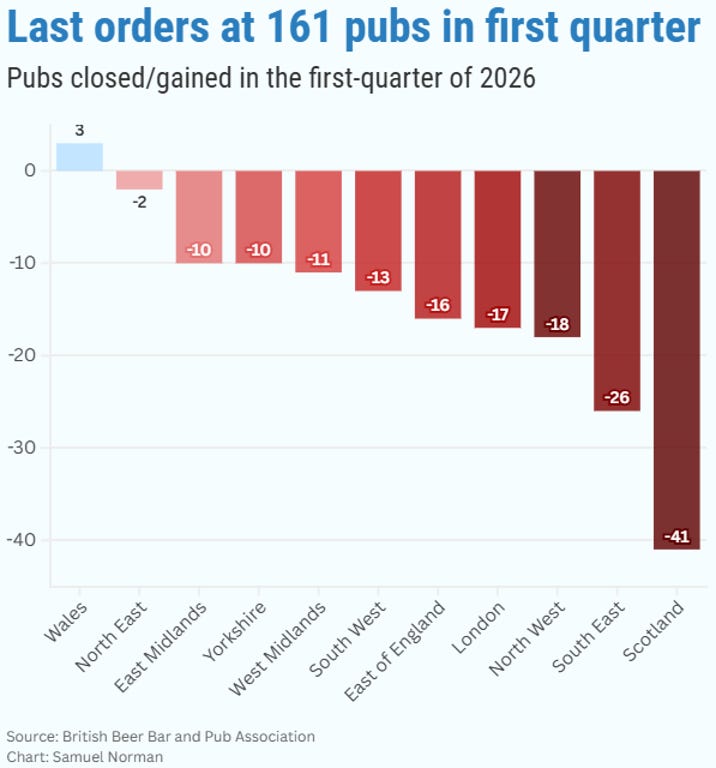
The trade body blames rising taxes, reduced business rates relief, and higher wage and energy costs, warning closures have accelerated sharply from earlier forecasts.
Chief executive Emma McClarkin said:
The scale of these closures is avoidable… but profits are wiped out by a disproportionate tax burden.
A government spokesperson said it was “backing Britain’s pubs” by cutting April’s business rates bills by 15%, which will be followed by a two-year freeze, extending World Cup opening hours, and increasing the Hospitality Support Fund to £10m to help venues grow. The government also plans to build on its Pride in Place programme, which sees grants allocated for “locally led solutions” in 280 neighbourhoods in England, as part of its scheme to revitalise high streets.
This comes on top of capping corporation tax, cutting alcohol duty on draught pints, and six cuts in interest rates, benefiting businesses in every part of Britain,” the spokesperson said.
Meanwhile, Greene King has reported a 3.6% increase in group revenue and 9.8% increase in operating profit, up to £2.54bn and £217m respectively. The pubco operates over 840 Greene King pubs and 980 leased, tenanted, and franchised sites.
Chief Executive Nick Mackenzie said applications to operate pubs are at their highest level to date, as prospective publicans continue to see opportunity in the sector.
Our performance reflects the quality of our pubs, underpinned by the strength of our operating model and the commitment of our teams. However, there are still significant headwinds facing the industry and these will only grow as inflationary pressure rises once again.
Growing ready-to-drink market appeals to young people and children
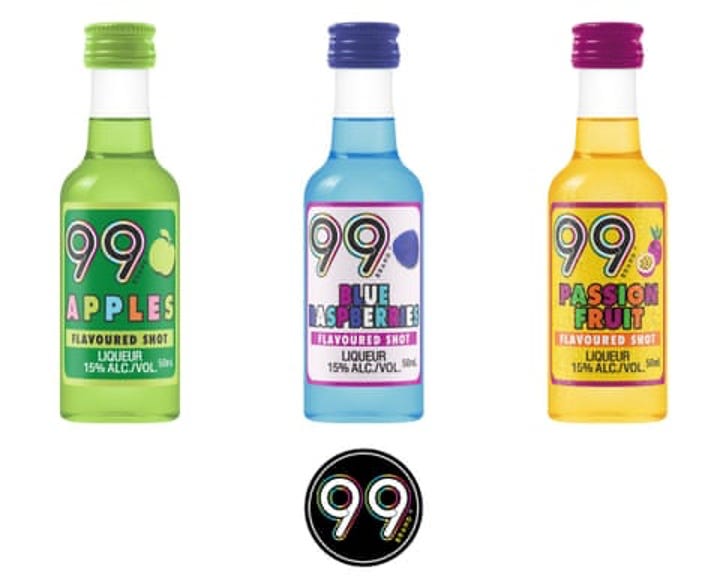
Alcohol charities have warned about a new product from the team behind BuzzBallz ready-to-drink cocktails, which have become increasingly popular with younger drinkers and on social media in recent years.
Jem Roberts, head of external affairs at the Institute of Alcohol Studies, said the launch of a 99p alcoholic shot “looks like a product entirely designed to appeal to children while hiding behind a thin ‘nostalgia’ label.”
Sweet flavours, TikTok-style branding, and even an ice-cream van, it’s hardly subtle. We know two of the biggest drivers of alcohol harm are cheap prices and heavy marketing. A 99p shot promoted as fun and shareable combines both. And while youth drinking has declined, the UK still has some of the highest levels of heavy episodic drinking among young people in Europe, so this is not a problem we’ve solved.
Joe Marley, executive director at Alcohol Change UK, added:
As a society, we need to create an environment that protects all of us, especially children and young people, from constant efforts to encourage drinking, with proper controls and sensible limits on how alcohol can be marketed.
The Sazerac brand, which manufactures the drink, said it takes
concerns around underage drinking seriously, which is why all activity is governed by strict UK alcohol marketing, retail and age-verification standards. Price alone does not determine whether a product appeals to minors; responsible marketing, clear adult targeting, and robust retail compliance are the critical factors.
Last year, ready-to-drink sales generated £704 million in the UK’s shops and supermarkets – a 12% year-on-year growth and a 17% rise in value.
Addiction research and treatment in the US under threat from Trump administration
A new report from the Addiction Science Defense Network documents how the second Trump administration’s federal actions during 2025 have severely disrupted addiction science, research, prevention, and treatment in the United States.
Through 225 executive orders, workforce reductions, and grant terminations, key agencies including the National Institutes of Health (NIH), the Substance Abuse and Mental Health Services Administration (SAMHSA), and the Centers for Disease Control and Prevention (CDC) have undergone sweeping budget cuts and restructuring. Nearly two-thirds of SAMHSA’s staff were terminated, over $588 million in addiction-related NIH grants were cancelled, and funding for new research grants fell to its lowest point since 2000. Public health surveillance datasets were altered or removed, harm reduction programmes were defunded, and DEI-related research and training were eliminated.
The report estimates these actions may have already cost the US economy over $87 million in lost economic activity, with far greater long-term consequences. The authors conclude that addiction science is “under siege” and call on policymakers, researchers, advocates, and the public to take action to protect evidence-based addiction research and services.
The report comes at a time when clinicians and researchers are calling for alcohol to be treated as a public health emergency.
New Zealand alcohol policies pivot from reducing violent crime to boosting the economy
In New Zealand, proposed alcohol law reforms have shifted focus from reducing violent crime to supporting economic growth, according to official documents.
Associate Justice Minister Nicole McKee initially explored measures such as shorter trading hours and minimum pricing, which officials estimated could prevent thousands of violent incidents annually. However, most of these were dropped as the policy emphasis pivoted.
The final proposals instead aim to reduce regulatory burdens and expand alcohol availability, such as easier licensing and extended trading for events, while maintaining some targeted harm-reduction measures. This reflects what officials describe as an “inherent tension” between boosting the economy and reducing alcohol-related harm.
Evidence cited shows alcohol is involved in over half of violent crime cases, yet the government argues restricting access for all would be “neither fair nor effective,” highlighting the political and policy balancing act at the heart of the reforms.
Alcohol Toolkit Study: update
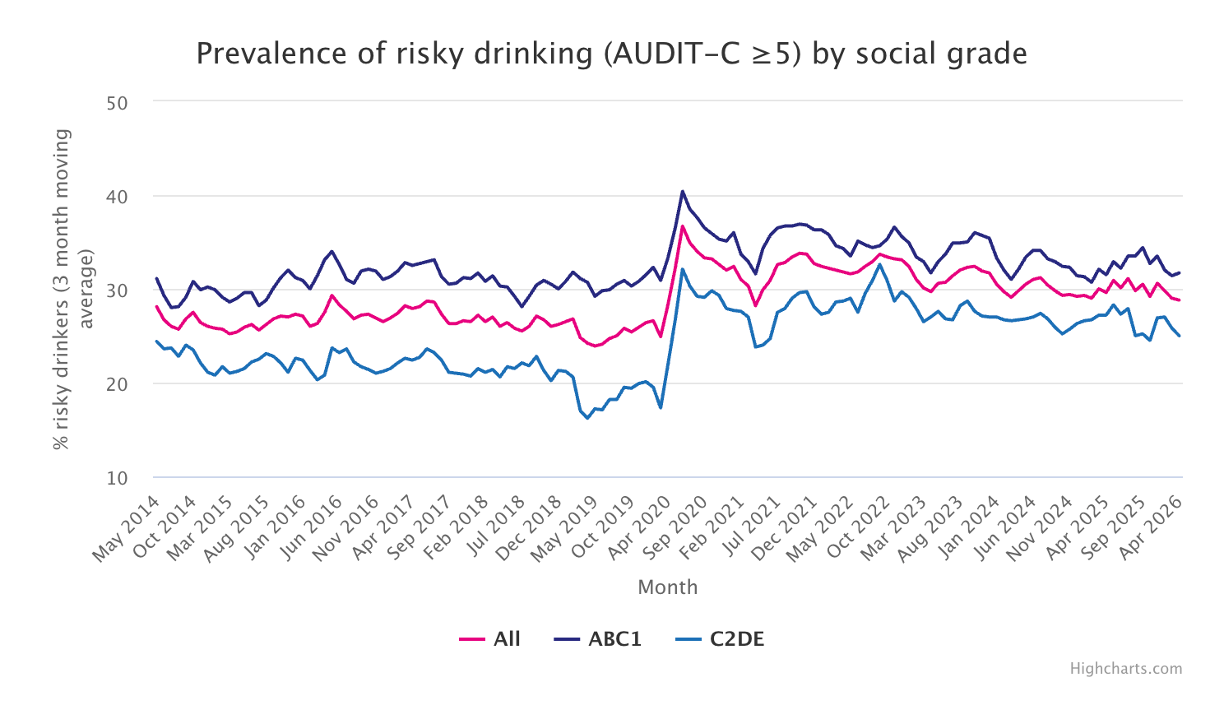
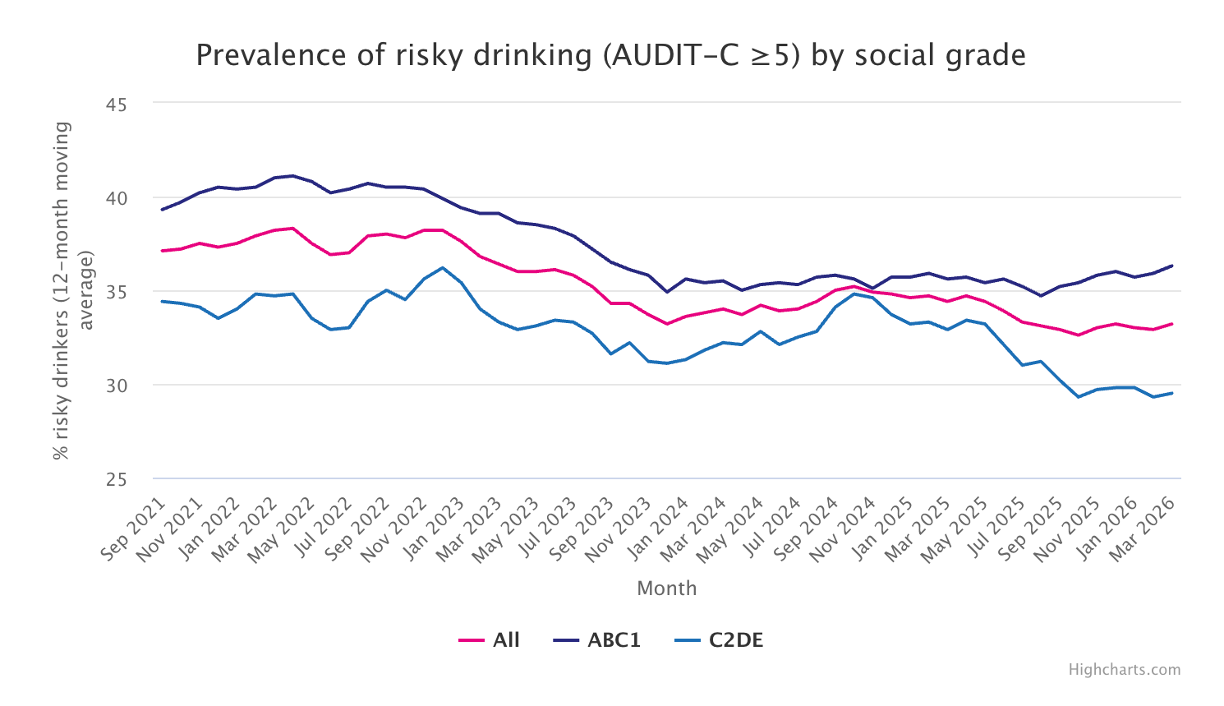
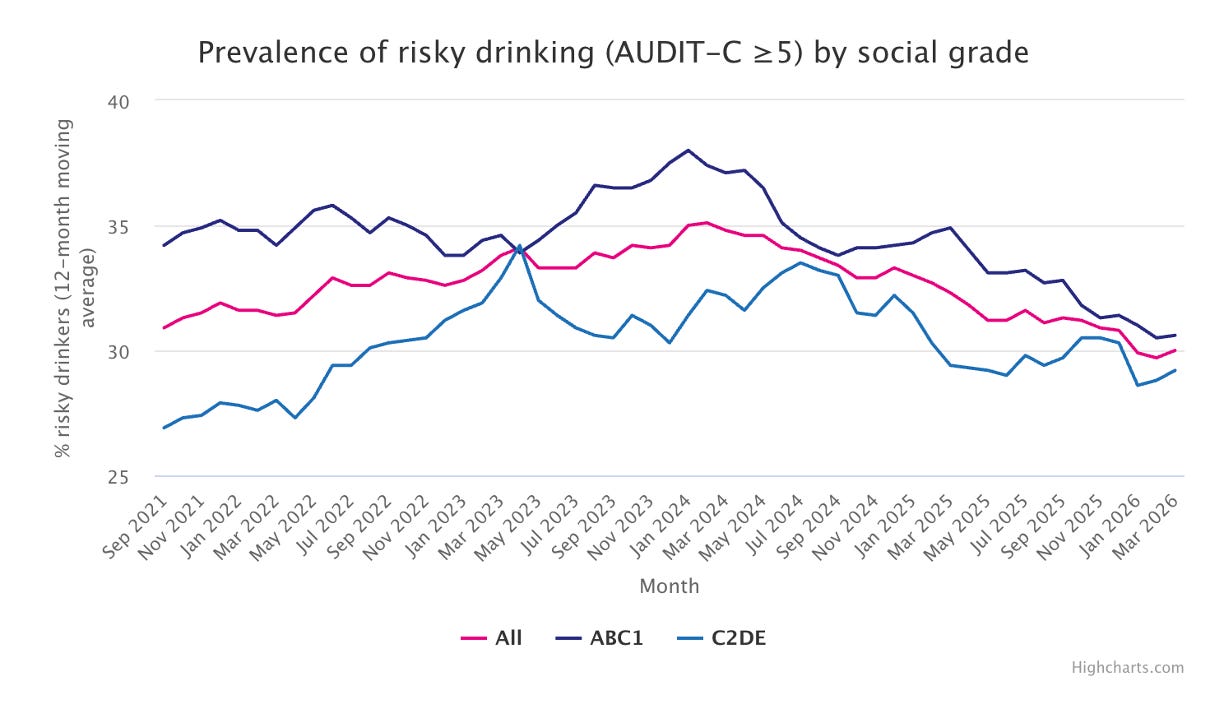
The Alcohol Toolkit Study is a long-running survey of alcohol consumption in England, Scotland, and Wales. The English monthly data has been collected since March 2014, and the Scottish and Welsh data from mid-2021. Each month involves a new representative sample of adults aged 16 and over.
You can find further charts and data for each country here:
The following charts are a snapshot of the prevalence of risky drinking by social grade.
Prevalence of increasing and higher risk drinking (AUDIT-C)
Risky drinking defined as those scoring AUDIT-C ≥5
ABC1: Professional to clerical occupation; C2DE: Manual occupation
England
Scotland
Wales
Podcast
Our monthly podcast features interviews with experts from across the sector.
The Tobacco and Vapes Act – and how alcohol is being left behind
Ailsa Rutter –
Director of Fresh and Balance