Analysis of Freedom of Information (FOI) documents released today reveals how alcohol companies and industry-funded bodies mounted a coordinated lobbying campaign to force the removal of alcohol marketing restrictions from England’s 10 Year Health Plan – an NHS strategy intended to improve the nation’s health.
The new report by the Institute of Alcohol Studies (IAS) shows that in the days leading up to the Plan’s publication, alcohol producers and trade groups including Diageo, Budweiser, Heineken, Molson Coors, and the Portman Group wrote directly to the Health Secretary, while urging The Chancellor and Business Secretary to intervene on their behalf.
Alcohol marketing restrictions – recommended by the World Health Organization as one of the most effective measures to reduce alcohol harm — were widely expected to feature in the Plan following media leaks and confirmation from the Department of Health and Social Care (DHSC). They were absent from the final document.
The FOI disclosures show alcohol companies explicitly asking the Chancellor to pressure Health Secretary Wes Streeting to drop proposed marketing restrictions – despite those measures being supported by strong international evidence and aligned with NHS prevention goals. In a letter to Rachel Reeves, Budweiser stated that: “As Chancellor, we urge that you make immediate representations to the Department of Health and ensure that these restrictions are not enforced.”
In total, 47 documents were released under FOI, revealing strikingly similar arguments, shared language, and coordinated timing – pointing to a concerted industry effort to derail health policy.
Dr Katherine Severi, Chief Executive of the Institute of Alcohol Studies and co-author of the report, said:
These documents reveal alcohol companies doing exactly what we might expect but should never accept: lobbying aggressively and out of sight to block public‑health measures that threaten their profits – even when those measures were part of an NHS plan to prevent illness and save lives.
We cannot allow this pattern to continue. With the industry causing such significant harm, the government must put guardrails in place to protect the remaining plans to reduce alcohol harm, including mandatory labelling and lowering the drink-drive limit. Private profit must never outweigh public safety, and policy decisions must be rooted in independent evidence and the public interest.
The report highlights how alcohol industry correspondence relied on misleading claims about evidence, exaggerated economic threats, and repeated assertions that the industry should be consulted on health policy, despite a clear conflict of interest. Industry trade body the Portman Group wrote to DHSC claiming that: “We believe that such a proposal would be disproportionate and ill-targeted, given the generally positive trends on alcohol across society” – despite record alcohol deaths year-on-year since 2020.
Public First polling shows that an overwhelming majority of people (74%) want the government to prioritise the public’s health over business growth and the NHS was ranked the second most important issue facing the country right now. This makes the removal of these measures not just a health failure, but also a clear departure from public priorities.
Alice Wiseman MBE, Director of Public Health at Gateshead and Newcastle, said:
This is a textbook example of why the alcohol industry should have no role in shaping health policy. Their business model depends on increasing consumption, while public health depends on reducing it.
Allowing companies that profit from harm to influence NHS policy undermines prevention, weakens public trust, and costs lives. The parallels with tobacco are impossible to ignore.
The findings raise serious concerns about the government’s continued treatment of the alcohol industry as a stakeholder in public health, despite evidence that such partnerships are ineffective and risk regulatory capture.
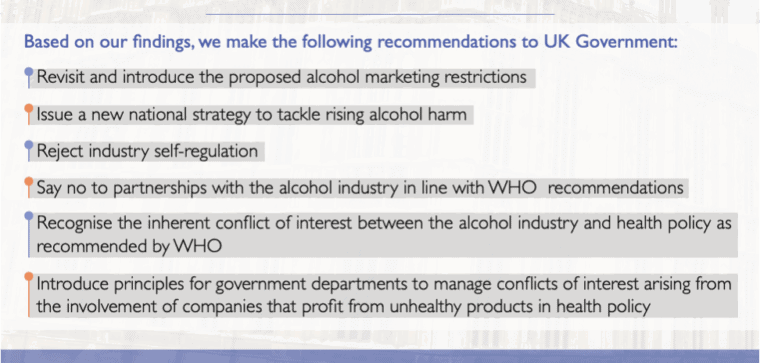
The authors argue that this case underlines the urgent need for formal safeguards to protect health policy from industry interference, including clear conflict-of-interest rules across government departments, in line with WHO recommendations.