
A major new report from the EASL–Lancet Liver Commission has issued a stark warning: liver disease is rising across Europe, and governments are failing to act on the evidence.
The Commission highlights that liver cancer deaths have increased by more than 50% since 2000, while cirrhosis remains a leading cause of preventable death. Alcohol is a key driver – not just of liver disease, but of a wide range of harms including cancer, heart disease, and injuries.
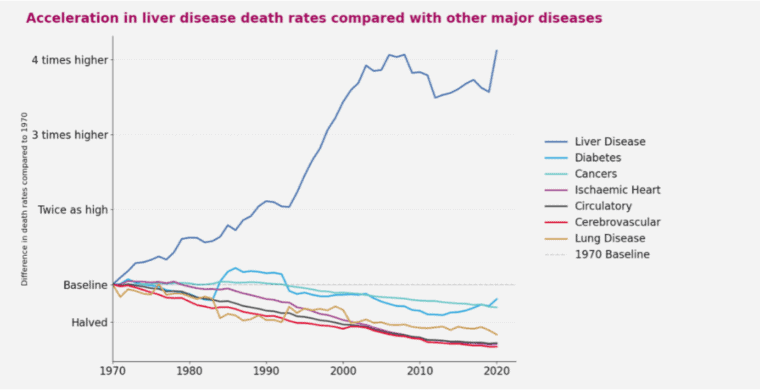
For the UK, the findings are particularly concerning. The UK already has some of the highest liver disease mortality rates in Western Europe, and it is one of the few major conditions where deaths are still increasing rather than falling, as the British Liver Trust chart below shows. Despite this, progress on effective alcohol policies has stalled in recent years.
The Commission sets out clear, evidence-based solutions, including stronger restrictions on digital marketing, improved health warnings, aligning alcohol taxes with the true cost of harm, and protecting public health policymaking from industry influence.
In a statement, IAS wrote that:
UK liver disease rates have risen sharply in recent years, while many other major diseases have declined. As The EASL–Lancet Liver Commission makes clear, a key reason is political inaction on policies we already know would reduce alcohol harm.
We have decades of evidence on what works. The Commission is right to stress that this must begin with excluding the alcohol industry from public health policymaking. Yet we are still seeing industry actors invited to shape licensing policy, which exists to protect public safety, not commercial interests. In addition, industry self-regulation of marketing means children remain exposed to harmful content.
A central recommendation is to better align alcohol taxation with the real cost of harm. Alcohol places a substantial burden on the NHS, the criminal justice system, and wider society – but current tax rates fall far short of covering these costs, particularly those linked to cheap supermarket alcohol.
Increasing taxes would work in three important ways. First, it would reduce consumption by raising alcohol prices, which have been kept artificially low for decades due to duty cuts and freezes. Second, it would incentivise producers to bring more lower strength products to the market, and third it would ensure that companies profiting from high levels of drinking contribute more fairly to the costs they create.
Furthermore, the UK has the benefit of an additional pricing measure which directly targets ultra cheap harmful alcohol in shops and supermarkets. Minimum Unit Pricing, already in place in Scotland and Wales, has been proven to reduce deaths and hospitalisations, with the biggest health gains seen in our most disadvantaged communities. Experts have long called for its introduction in England alongside tax increases to save lives, protect the NHS, and curb the devastating rates of alcohol harm across the nation.
Importantly, this approach would also support pubs and hospitality by narrowing the price gap between on-trade and off-trade alcohol, helping shift drinking away from the home and into more regulated settings.
Ultimately, better alcohol pricing is not just a health measure – it is an economic one. Reducing alcohol harm improves workforce productivity, eases pressure on public services, and supports long-term growth. Failing to act now will have grave consequences for the future.