

In recent years, No-and Low- alcohol (NoLo) drinks have become increasingly popular. If handled well, this could have the potential to reduce alcohol harm making it easier for consumers to switch from higher alcohol drinks to NoLo alternatives. The NHS’ 10-year plan for England highlights NoLo alternatives as part of its approach to tackling harmful alcohol consumption.
However, there is limited evidence on how to support consumers to switch from alcoholic drinks to NoLos. Simply introducing a healthier option in the market might not be enough to help people reduce their alcohol intake.
Behavioural sciences consistently find that the way in which different products are presented can have a strong impact on what products people select. One way to encourage switching could therefore be through the design of pub menus.
At The Behavioural Insights Team (BIT), we developed and evaluated health interventions using our online behavioural experimentation lab. Using this online behavioural experimentation lab, we recruited thousands of participants to test whether changing the way NoLo products are displayed on pub menus encourage more people to choose them over higher-alcohol alternatives?
What did we do?
We ran an online study to test four behavioural interventions, which presented NoLo products in different ways on a pub menu. These included changes in menu placement, using labels highlighting positive properties of NoLos, and increasing the range of NoLo beverages available.
We set up simulated online pub menus and asked over 11,000 participants across the UK (3,795), Germany (3,912) and Mexico (3,780) to imagine they were ordering food and drinks for a night out.
Each person was randomly allocated to do a simulated order using a ‘business as usual’ pub menu or one of four menus featuring small tweaks to make the swap to NoLos easier:
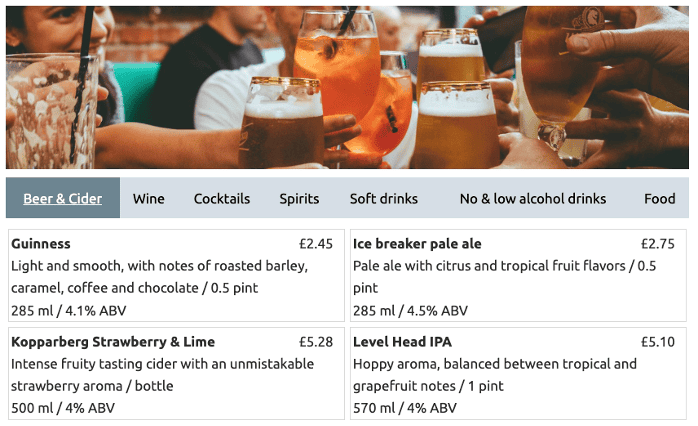
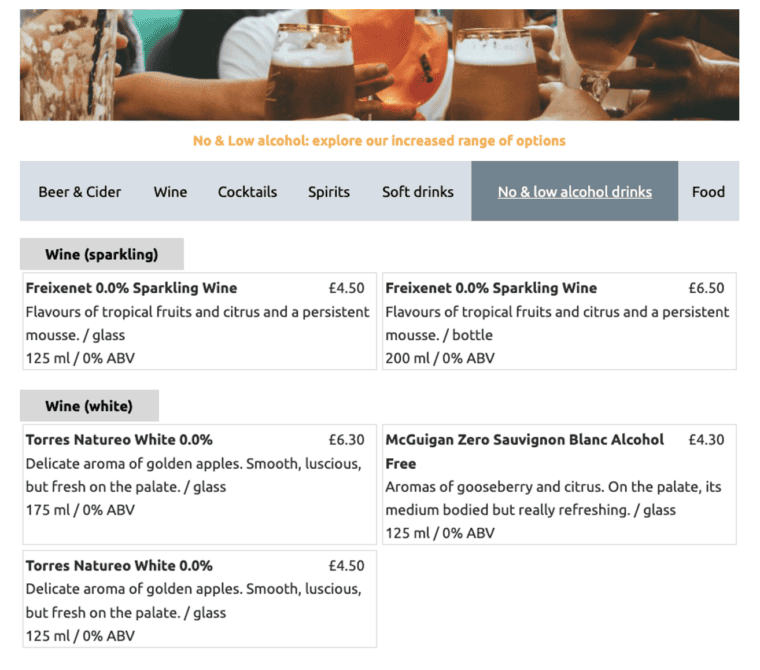
1. Business as usual: A typical pub menu with alcoholic drinks front and centre. NoLo drinks had their own section. If you wanted a NoLo drink you actively had to go in the NoLo section of the menu.
Figure 1: The ‘standard’ menu seen by participants in our experiment
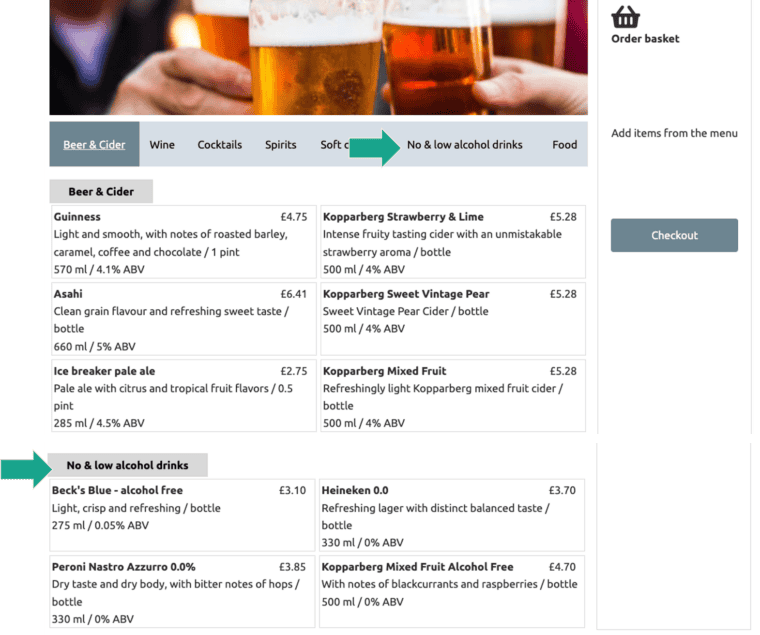
2. Integration: NoLo drinks were presented both in their own section of the menu and at the bottom of all the alcoholic drinks sections – placing them next to their alcoholic counterparts. If you were browsing the beer section of the menu and felt inspired to look for new options by scrolling all the way to the bottom you’d stumble on NoLo options and might feel inspired to try one.
Figure 2: Example of NoLo integrated into the menu
3. Prominence: Same idea as integration, but this time NoLo drinks were displayed at the top of the alcohol section, making them more noticeable. If you accessed the beer section of the menu this time the NoLo options would be presented first. You’d have to actively decide to scroll past the NoLos to get to the higher alcohol products.
Figure 3: Example of menu with NoLo drinks prominently at the top of all alcoholic drink sections
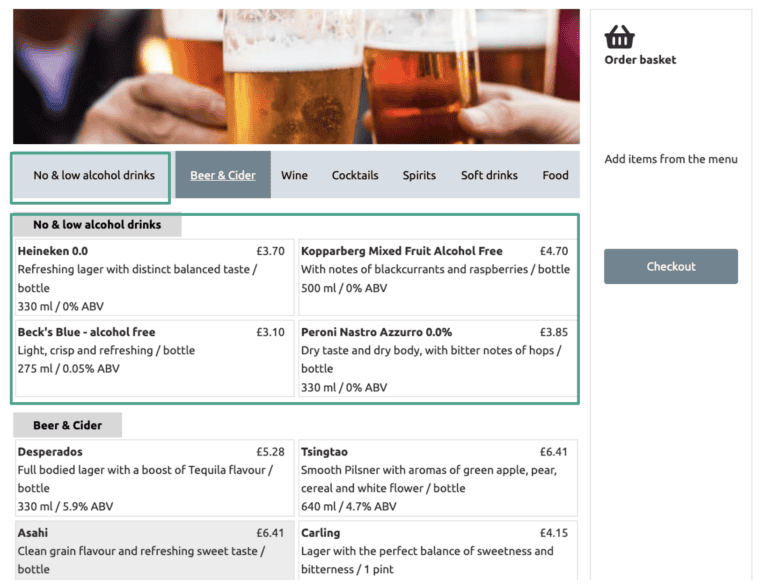
The promising element of this menu is that we reduced the risk of people sticking with higher alcohol drinks simply out of unawareness of lower-alcohol products. This menu preserved all the traditional options and protected consumer choices, but its design encouraged consumers to at least consider lower alcohol products. – Dr Filippo Bianchi, Director of Health – BIT
4. Framing: We also tested three different messages alongside NoLo drinks to highlight some positive elements of No-Lo drinks:
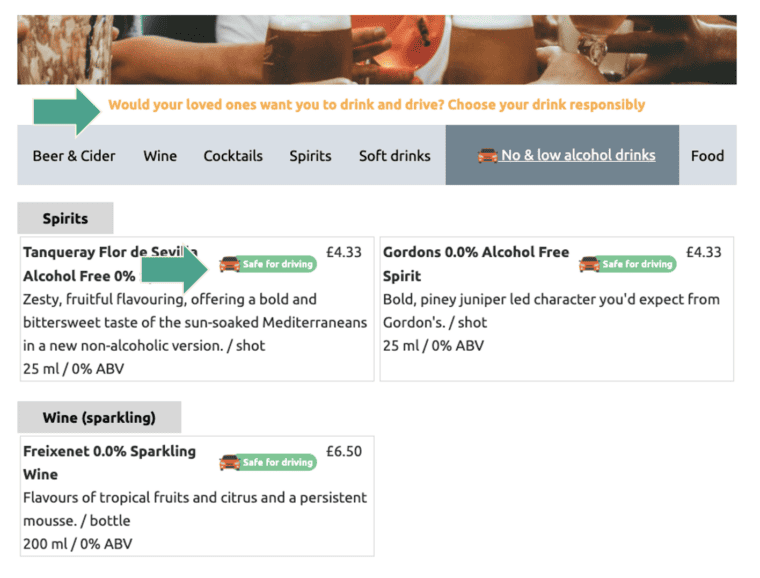
- Safe for driving for no-alcohol products: Highlighting that these options won’t impair your ability to drive.
- Handpicked by us: Highlighting that some No-Lo drinks are actually really nice and recommended by the pub owner. This addresses the concern that often healthier alternatives are perceived as less enjoyable.
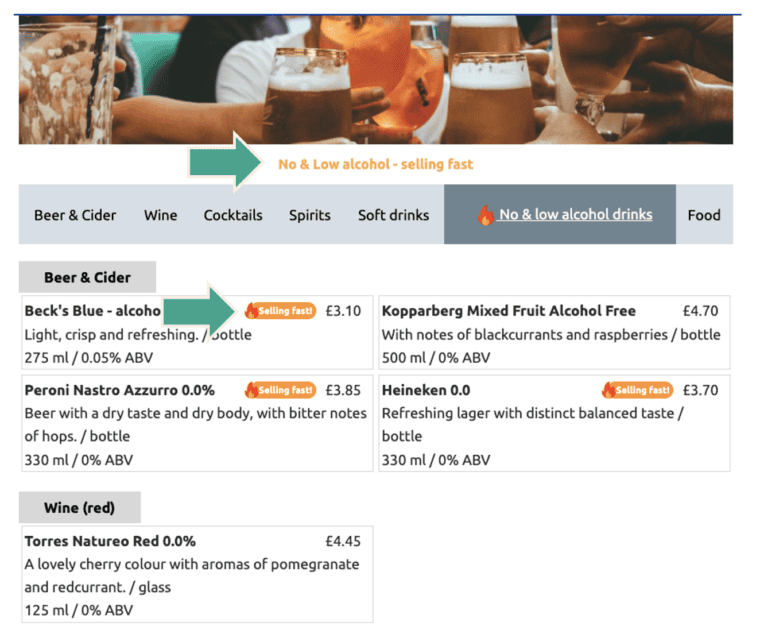
- Selling fast: This label uses the social norm concept in behavioural sciences. It suggests to consumers that the product is popular, which often signals to consumers that the product is likely to be a good pick! This is a technique often used in advertisement – but here we use it to encourage a healthier behaviour.
Figure 4: Example of menu with “selling fast” label
5. Availability: In this menu we simply increased the number and range of NoLos on offer. People still had to actively go in the NoLo section of the menu, but we wanted to reduce the risk of people sticking with higher alcohol beverage due to a lack of options for lower alcohol alternatives.
Figure 5: Example of menu with a greater range of NoLo options
After participants placed their simulated orders, we looked at how much alcohol they ordered (in millilitres of pure alcohol, so we could compare across drink types) and how much they spent.
What did we find?
Putting NoLo drinks at the top of menus (prominence intervention) worked in all three countries
Figure 6: Results of all interventions on alcohol ordered across Mexico, Germany and the UK
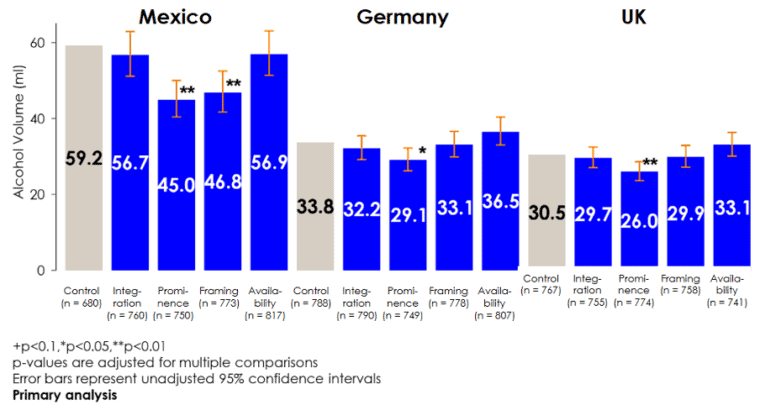
In the prominence intervention, NoLo drinks were placed at the top of each alcoholic drinks section, for example having a 0% beer appearing above the lagers and ales, rather than only in a separate NoLo section.
UK participants who saw this version of the menu ordered 15% less alcohol (-4.5 ml, equivalent to roughly half a standard unit of alcohol) compared to those who saw a standard menu. They were also 30% more likely to order at least one NoLo drink, suggesting the reduction came from genuine substitution rather than people ordering fewer drinks. This intervention also led to less alcohol ordered in Germany (-4.7 ml compared to control) and Mexico (-14.2 ml compared to control).
Other interventions weren’t enough to shift ordering behaviour, though the integration intervention showed promise
The integration intervention, which placed NoLo drinks within each alcoholic section at the bottom of the menu, directionally reduced the amount of alcohol ordered in the UK (-0.8 ml), Germany (-1.6 ml) and Mexico (-2.45 ml). But these effects weren’t large enough to rule out the possibility that they occurred by chance. Increasing the number of NoLos on offer (the availability intervention) also wasn’t enough to encourage people to order less alcohol.
These interventions may not have been effective because they were less visible – people had to scroll to the end of the alcohol drinks section, or click specifically on the NoLo section of the menu. This may not have been a substantial enough change to the design of the menu to attract attention to NoLo options, or break entrenched ordering habits.
Framing NoLo drinks effectively could depend on considering local cultural context
Of the three framing messages tested (“Safe for driving”, “Handpicked by us”, or “Selling fast”), the “Safe for driving” worked to reduce the amount of alcohol ordered, but only in Mexico – we did not find this effect in Germany or the UK.
This points to careful local testing of interventions aiming to use messaging to promote substitution of higher alcohol drinks with NoLos: what works in one cultural context can’t be assumed to translate to others.
Figure: Example of menu with “safe for driving” label
NoLo drinks don’t need to come at a cost to businesses
The amount spent per order remained the same for UK participants, regardless of the interventions. Putting NoLo drinks at the top of menus also didn’t change the average spend by participants in Germany and Mexico.
These findings align with evidence from a small recent, real-world study in UK pubs, showing that alcohol-free drinks reduced the sales of alcoholic beer by 5% without pubs losing out on revenue.
The evidence points to a win-win scenario: better health outcomes for consumers, and consistent revenue for businesses.
So what does this mean?
The core takeaway from our research is that simple changes to how NoLo drinks are presented at the point of purchase could reduce alcohol consumption in the UK. Based on our research the most promising solutions seem to be those that put NoLos on people’s radar, even when people are not actively going out of their ways to find these products. For example, in our study placing NoLos at the top of the standard menu sections together with their alcoholic alternatives emerged as an effective way to help people order less alcohol.
This leads to three key policy implications for reducing alcohol harm:
- Make NoLo drinks more prominent when people are choosing what to drink. Placing NoLo drinks at the top of each alcohol category on menus is the most effective change we tested. Smaller changes, such as simply adding NoLo drinks to menus, or increasing the range of NoLo drinks might not be enough to change people’s ordering habits and behaviours.
- Work alongside businesses to test and adopt interventions for NoLo drinks. Our results point to people spending the same amount regardless of interventions highlighting NoLo options. This can help reassure businesses that interventions encouraging NoLo drinks may not lead to them losing revenue. Further research should collaboratively design and test interventions with businesses that achieve healthier drinking, without compromising revenue.
- Validate what works in real-world contexts. While our results are promising, further research is needed to test these interventions in settings like pubs, restaurants, supermarkets, or festivals, and assess their impact on people’s alcohol consumption.
What’s next?
We now have a better understanding of some interventions that hold promise for helping people reduce their alcohol consumption.
If you’re working in hospitality, supermarkets, public health, or policymaking, these findings show there are simple changes that could make a big difference.
We are excited to work with partners and policymakers to continue building the evidence base for what works to reduce harmful drinking.
Let’s make the healthier choice the easier one, starting with what’s on the menu.
You can download your free copy of BIT’s Alcohol Substitution Playbook to learn more about using behavioural science to promote healthier choices.
Written by Neeraj Rahal, Ailidh Finlayson, and Filippo Bianchi, the Behavioural Insights Team.
The study was developed for Comunidad Mexicana, a civil society organisation that works to improve governance in to build a prosperous country where people can live better lives.
All IAS Blogposts are published with the permission of the author. The views expressed are solely the author’s own and do not necessarily represent the views of the Institute of Alcohol Studies.