
When we talk about stigma related to drug and alcohol use, we are drawn to looking outwards as if it’s a beast on the horizon.
Public stigma gives us a clear target in the form of tangible language, labels or narratives. It allows us as the campaigners to position ourselves as part of the solution. We can point to harmful stereotypes and say, quite rightly, that they need to change, and they do need to change.
Yet some of the most powerful forms of stigma are not found in newspaper headlines or public opinion. They are embedded in professional practice, organisational cultures, policies and systems. They are often intangible or even invisible to us and can exist even within organisations whose mission is rooted in a history of compassion, inclusion and trauma-informed care.
Professional and structural stigma rarely announces itself. Instead, it appears in everyday processes, assumptions and decisions. Professional stigma can show up in language such as describing someone as “failing to engage”, or an attitude that if someone wants support enough, they will navigate our system. Structural stigma can be found in policies that only allow admission once someone is already abstinent, requirements that people must have “previously used” lower-intensity treatment before residential care is considered, or waiting times so long that access becomes unrealistic.
This form of stigma is stubborn because it is held in place by hierarchy, tradition, compliance requirements, competing priorities and resistance to change. Most challenging of all, it requires honest reflection without blame. It asks us to consider the uncomfortable possibility that, despite the best of intentions, we may sometimes, on some days, and in some ways, contribute to the very barriers we seek to remove.
Professional and structural stigma create the conditions in which public stigma can flourish. They provide the permission, the justification, and sometimes the relief that allows discrimination to persist.
This does not mean organisations are failing. It just means organisations are made up of humans and we can be messy.
The beast is not on the horizon, it is inside us all. Are we are prepared to look for it, really see it and work out how to change it?
The impact of these barriers is not abstract. In England, only 47% of people who could benefit from treatment for crack and opioid use are currently receiving it, alongside just 27% of people who could benefit from alcohol treatment (NDTMS 2026)
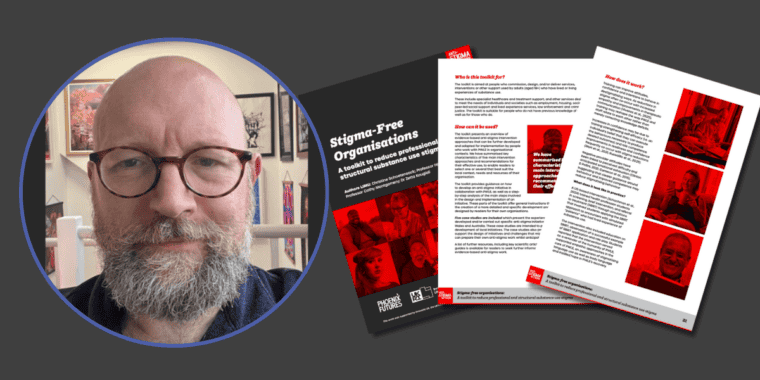
So this was the challenge we set ourselves. With support from an Innovate UK Knowledge Transfer Partnership grant and the wisdom of Liverpool John Moores University we developed the Stigma-Free Organisations Toolkit to help organisations undertake this difficult but necessary work.
The toolkit is designed to move organisations from awareness to action. It sets out four evidence-based approaches to reducing stigma, alongside practical guidance on how to apply them in real organisational settings. It also includes a step-by-step process for co-producing initiatives with people with lived experience, helping organisations think carefully about power, involvement, decision-making and accountability rather than treating lived experience as a one-off consultation exercise.
Just as importantly, it brings these ideas to life through real-world case studies. These examples show what anti-stigma work looks like in practice as a process of changing language, relationships, policies, service design and organisational culture over time.
But knowing what works and making it work are two very different things.
Creating stigma-free organisations requires honesty about where we are today. It requires organisations to share power, listen differently, create the space amongst the busy-ness to challenge assumptions and take risks. A risk that may challenge who we think we are. Without those conditions, anti-stigma initiatives can unintentionally reinforce the very harms they are seeking to address.
When we explored the evidence base, one theme emerged again and again. If we want to understand the real-world impact of decisions made within organisations, we must listen to the people who experience the material reality of those decisions.
That is why lived experience sits at the centre of effective anti-stigma practice.
The people who use services, navigate systems and experience policies in real life are uniquely placed to tell us what works, what does not, and where unintended harm occurs.
If we genuinely want services to be kind, effective and empathetic, we need to understand the mechanisms that create those outcomes, strengthen them and design them into our organisations. I’m often asked how to make a start on this journey, well the Stigma-Free Organisations Toolkit is a great starting place but if you wanted one question to ask yourself, your team or your organisation I’d start with the question “Are we asking what’s wrong with the person, or what’s wrong with the system?”
Written by James Armstrong, Director of Marketing and Innovation, Phoenix Futures and the Anti-Stigma Network.
All IAS Blogposts are published with the permission of the author. The views expressed are solely the author’s own and do not necessarily represent the views of the Institute of Alcohol Studies.