

Pubs are an important part of British social life. They bring people together, provide opportunities to socialise and contribute to local communities. But drinking habits are changing. More people are choosing to moderate their alcohol consumption, while others prefer not to drink alcohol at all. According to research by KAM and Lucky Saint, around one-third of pub visits involve no alcohol consumption and more recently, a 2025 KAM survey found that 37% of UK adults had either left a hospitality venue early or felt disappointed because of its limited low- and no-alcohol options
For pubs, offering alcohol-free beer provides an opportunity to respond to changing customer preferences and demand and cater to both those seeking to moderate their alcohol consumption and those who do not drink alcohol. Yet an important question remains: can pubs introduce or expand their alcohol-free offering without putting their business at risk?
For public health advocates, alcohol-free alternatives could help people reduce their alcohol consumption. For customers, they provide greater choice and potentially more inclusive drinking environments. But for pub operators, the financial implications matter. As previous research has recognised, concerns about potential revenue losses may discourage landlords from introducing alcohol-free alternatives.
Our recently published study in the Drug and Alcohol Review examines these interconnected questions by investigating what happens when alcohol-free beer is introduced into everyday pub environments.
What happens when pubs introduce alcohol-free beer?
Previous research suggests that increasing the availability of alcohol-free alternatives can influence consumer choices. For example, experimental research by Clarke and colleagues found that changing the proportion of available non-alcoholic drinks could influence purchasing decisions.
More recently, a randomised study by De-Loyde and colleagues, conducted in 14 English pubs and bars over eight weeks, found that introducing alcohol-free beer on draught was associated with reduced sales of alcoholic draught beer, while the effect on overall drinks revenue was statistically inconclusive.
Building on this research, we wanted to understand how purchasing patterns evolve over a longer period, including whether initial changes persist as customers become familiar with alcohol-free alternatives.
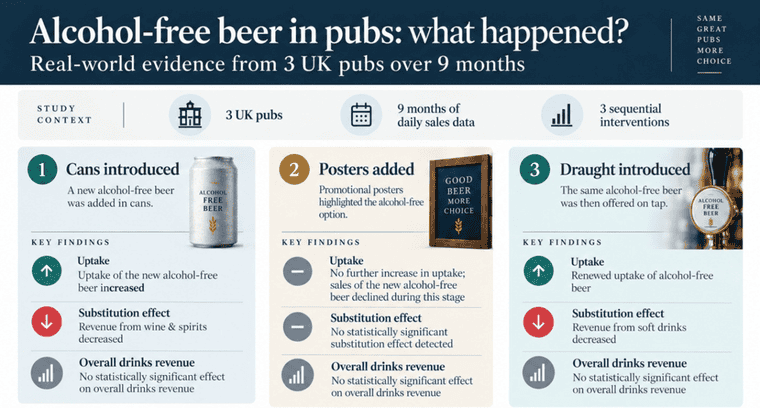
We worked with three UK pubs over nine months in 2023, analysing their daily drinks sales. The pubs introduced three changes, one after another:
- Introducing a new alcohol-free beer in cans, replacing one row of alcoholic beer in the fridge.
- Displaying posters promoting the alcohol-free option.
- Introducing the same alcohol-free beer on draught, replacing an existing alcoholic draught beer.
We also interviewed pub managers and staff to understand how customers responded.
The results revealed that introducing alcohol-free beer can influence purchasing patterns, but not necessarily in the ways we might expect.
Alcohol-free beer doesn’t just replace alcoholic beer
One of our most interesting findings concerns which drinks customers appeared to substitute when alcohol-free beer became available.
Introducing canned alcohol-free beer was associated with a statistically significant reduction in revenue from wine and spirits. However, we found no statistically significant reduction in revenue from alcoholic beer.
This suggests that alcohol-free beer may serve as an alternative to wine and spirits, rather than simply replacing conventional beer.
That matters for moderation. If someone chooses alcohol-free beer instead of wine or spirits, this could reduce their alcohol consumption while allowing them to continue enjoying a visit to the pub.
However, when we introduced alcohol-free beer on draught, a different pattern emerged.
Draught alcohol-free beer was associated with reduced sales of other non-alcoholic drinks, including soft drinks. Interviews with pub staff supported this interpretation, suggesting that some customers preferred a pint of alcohol-free beer to a conventional soft drink.
This is important for a different reason. Not everyone visiting a pub wants to drink alcohol, but that does not mean they want to drink a soft drink either.
Offering alcohol-free beer, particularly on draught, provides another option. Customers can enjoy the familiar experience of ordering a pint without consuming alcohol.
Research by Emily Nicholls highlights how NoLo drinks can help people feel included in social situations where drinking alcohol is the norm, while also raising questions about the persistence of those drinking norms.
Our findings suggest that increasing alcohol-free choices in pubs may therefore serve two different purposes: supporting people who want to moderate their drinking and providing more appealing options for those who already choose non-alcoholic drinks.
How alcohol-free beer is offered matters
Another interesting finding was that the way alcohol-free beer was offered appeared to matter.
Introducing cans initially increased sales of the new product, but this effect weakened over time. Displaying promotional posters did not generate a further increase. Instead, sales of the new alcohol-free beer declined during this stage.
Introducing the alcohol-free beer on draught was associated with renewed interest and higher sales, while sales of the canned version declined further.
Pub staff reported that customers often preferred the draught option once they knew it was available.
These findings complement recent research discussed by the Institute of Alcohol Studies, which suggests that how NoLo drinks are presented can influence purchasing decisions.
Simply telling customers that an alcohol-free option exists may not be enough. Making that option attractive, visible, accessible and part of the normal drinks offering may be equally important.
More choice could benefit customers, pubs and public health
Our findings suggest that alcohol-free beer could play a valuable role in the future of pubs.
For people seeking to moderate their drinking, it may provide an alternative to alcoholic beverages. For those who already avoid alcohol, it increases the range of drinks available and may make pub visits more appealing. While alcohol-free alternatives are not a solution to alcohol-related harm on their own, making them more widely available could support healthier drinking choices and help pubs remain inclusive spaces where people can socialise regardless of whether they drink alcohol.
For pubs, offering alcohol-free beer provides an opportunity to respond to changing customer preferences and demands. However, more research is needed to establish its longer-term effects on revenue and profitability.
Our study involved only three pubs and did not include a separate control group, so its findings should be treated as initial evidence rather than definitive proof of the interventions’ effects.
Future research should investigate these changes across more venues and over longer periods, while also examining individual purchasing behaviour. Understanding whether customers are replacing alcoholic drinks with alcohol-free alternatives, purchasing them in addition to other drinks, or making entirely different choices would help clarify the substitution effects and potential implications for alcohol consumption. More detailed information about business profitability would also help establish the commercial sustainability of these products.
Making alcohol-free choices more accessible is not just a public health question. It is also about providing customers with choices they genuinely want and ensuring that pubs can afford to offer them.
If we want alcohol-free alternatives to become a normal part of pub culture, we need to understand all three.
Written by Dr Franziska Sohns, Anglia Ruskin University; and Prof Victoria Wells and Dr Nadine Waehning, University of York.
All IAS Blogposts are published with the permission of the author. The views expressed are solely the author’s own and do not necessarily represent the views of the Institute of Alcohol Studies.