

Effective alcohol policies, such as increasing alcohol prices or restricting where alcohol is sold, are among the best tools we have for reducing alcohol harm. But they tend to be the least popular with the public compared to less effective policies (such as education). So how do we close the gap between effectiveness and public support?
Our recent study across five EU countries suggests that what people know about alcohol and cancer could be part of the answer.
What we did
We ran an online survey in autumn 2024, reaching 3,620 adults across Bulgaria, Ireland, Latvia, Slovakia, and Spain. We asked them how much they supported 15 different alcohol control measures – everything from drink-driving enforcement to marketing restrictions and price increases.
We also measured their knowledge of alcohol-related health harms, with a particular focus on two things: whether they knew alcohol can cause cancer, and whether they believed alcohol is good for the heart.
We then looked at whether these beliefs were linked to policy support, after accounting for factors like age, gender, education, and how much people drank.
What we found
Across all five countries, the pattern of support was strikingly similar. Drink-driving measures were the most popular. Price increases were the least. This is consistent with what other research has found; the policies which would have the most impact are often the hardest to get public support for. The demographic patterns showed that women and people in younger age groups tended to have higher policy support. Alcohol consumption also played a role: those who reported drinking more often and getting drunk more frequently were less keen on restrictions.
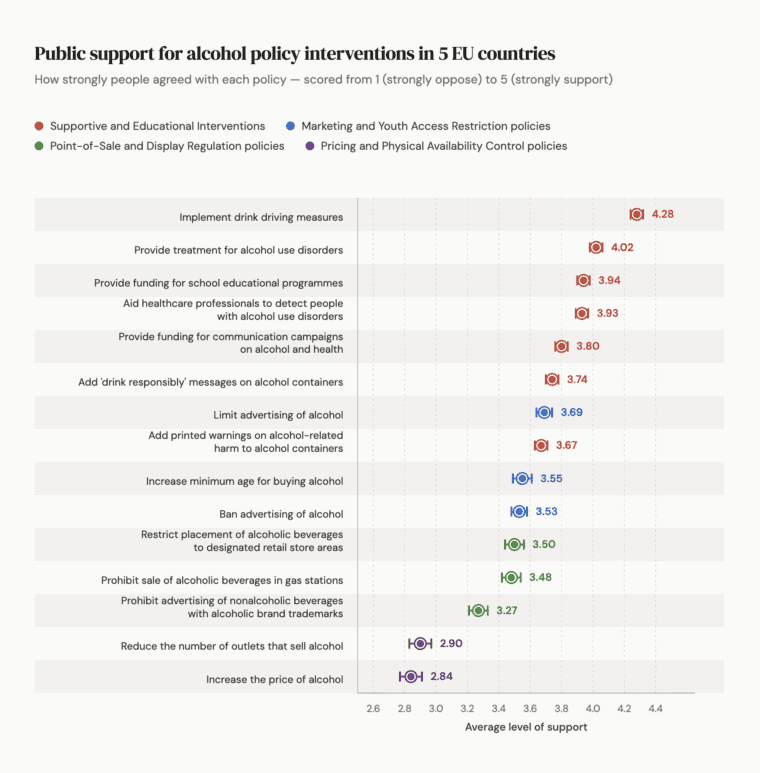
When we grouped the 15 policies based on similar patterns of support, four clusters emerged:
- supportive and educational interventions (including treatment programs, school education or health warning labels);
- marketing and youth protection policies (including age limits and advertising restrictions);
- point-of-sale and display regulations (such as restricting store placement, sale in gas stations);
- and pricing and physical availability controls (including price increases and reducing points of sale).
Knowing that alcohol causes cancer was significantly associated with higher support for the two policy areas where public support in our study was the lowest: point-of-sale and display regulations, and pricing and physical availability controls. In other words, cancer knowledge appeared to matter most precisely where it is most needed. We also found that the belief that alcohol is good for the heart was associated with lower support for marketing and youth protection policies, as well as pricing and availability controls.
Why this matters
These findings suggest that public knowledge of alcohol’s health risks is not just a health literacy issue – it is also a policy issue. If people do not fully understand the effects alcohol has on people’s health, or know that alcohol causes cancer, they may see pricing or availability restrictions as unnecessary personal interference rather than public health protection.
Most European countries still do little to communicate specific health risks on alcohol products. Our results suggest this is a missed opportunity. By improving public awareness of alcohol and cancer – through health warning labels, public campaigns, or simply conversations about alcohol, including in healthcare – governments might find greater public interest in the very policies that the evidence says work best.
At the same time, tackling the myth that moderate drinking protects the heart could also help remove a barrier to policy support. If people believe alcohol is good for them, they are understandably less likely to support measures that restrict access to it.
What should happen next
Policymakers should consider a dual approach: improve public understanding of alcohol-related cancer risk, while introducing the evidence-based policies that already tend to have higher support. For example, restrictions on alcohol marketing and protections for young people could be a smart starting point for governments. Introducing these first, while steadily growing public awareness around cancer risk, starts building on what is already acceptable, while creating the conditions for further evolution of alcohol policy in the future.
The full study is available here.
Written by Dr Daša Kokole, Consultant at the World Health Organization, Regional Office for Europe.
All IAS Blogposts are published with the permission of the author. The views expressed are solely the author’s own and do not necessarily represent the views of the Institute of Alcohol Studies.