

Previous research has illustrated the tactics that industry groups have used to oppose public health measures. One such strategy, used across alcohol, tobacco, and HFSS foods, is that policies which reduce consumption of these commodities – such as increasing excise duties to raise prices and discourage consumption – are an “attack on the economy” that will cost jobs and stifle growth. New research from the Sheffield Addictions Research Group (SARG) at the University of Sheffield, published in Addiction, reveals that this argument is overly simplistic and fundamentally flawed. The study uses an “input–output” model of the UK economy, based on publicly available data tables published by the Office for National Statistics, to track behaviour that is overlooked by industry arguments: when consumers spend less on unhealthy commodities, that money doesn’t vanish—it is reallocated to other sectors. The nature of this reallocation to other sectors is fundamental to determining whether reduced spending on alcohol and other unhealthy commodities is in fact a net negative for national economic performance, or potentially a net positive.
The Reallocation Effect
The core of the research lies in the “Commercial Determinants of Health Input-Output” (CDOHIO) model. It examines what happens if we reduce spending on unhealthy goods by 10% and assume that money is instead spent according to typical UK household patterns—on things like clothing, electronics, or entertainment. What determines whether or not a reallocation is beneficial to the economy? The model answers this by deriving economic multipliers from the input-output tables. These multipliers tell us, for every additional £1 spent in a sector, how much that will increase outcomes like employment or Gross Value Added (GVA) – a key measure of economic productivity. If spending moves from sectors with low multipliers to sectors with high multipliers, economic outcomes increase.
For tobacco, sweets, and gambling, the results show that shifting spending away from these products actually boosts UK GVA and employment. For example, a 10% reduction in tobacco spending, when reallocated, was estimated to increase GVA by £1.859 billion and create over 31,000 jobs. This is because tobacco is highly taxed and imported rather than produced domestically, which means that most of the money spent flows either to businesses based overseas or to the government as excise duty and VAT. This means less money is left over as income in the domestic economy, either as income to UK businesses in the domestic supply chain, or wages to UK workers. Very little of the retail price actually stays within the UK economy directly benefiting domestic businesses and supporting local jobs.
The ‘Alcohol Paradox’: Off-Trade vs. On-Trade
The findings concerning alcohol are the most nuanced. A 10% reduction in alcohol spending appears to have a small negative impact on the economy (-£0.134 billion GVA). However, this headline figure masks a dramatic divide between how we buy our drinks.
- The Off-Trade (Supermarkets and shops): Reducing spending on supermarket alcohol by 10% is an economic boon, estimated to boost GVA by £2.543 billion. Like tobacco, the price of alcohol has a high tax component relative to other goods because of alcohol duty. This is particularly the case for cheaper, off-trade alcohol; once you strip away taxes and imports, very little of your £10 bottle of wine directly supports UK production or wages, with almost all wine sold in the UK (the most consumed alcoholic beverage in the off-trade) produced overseas and imported.
- The On-Trade (Pubs and Restaurants): Conversely, reducing spending in pubs and bars by 10% had a negative impact of -£2.677 billion GVA. This is because the hospitality sector is highly labour-intensive and integrated into the domestic economy. Taxes and imports are a smaller percentage of the overall retail price in the on-trade, where alcohol sales have higher margins for domestic businesses in the supply chain and support more jobs compared to alcohol sales in supermarkets and shops.
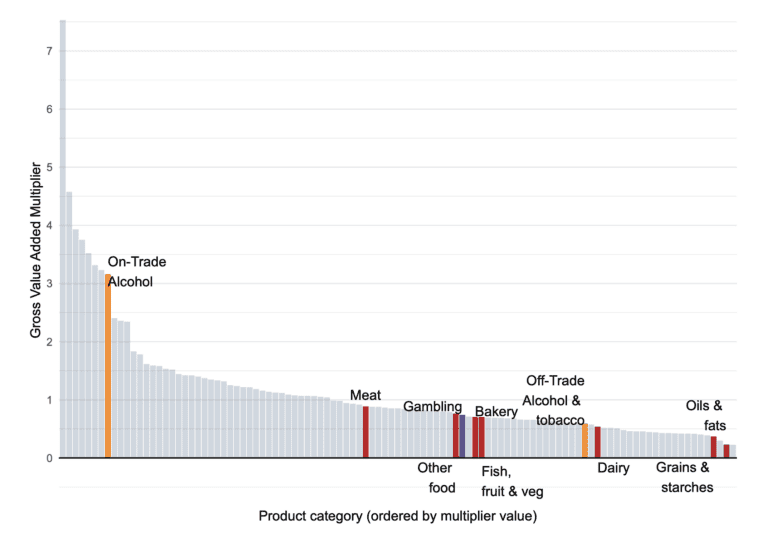
The graph below showing the multipliers for GVA illustrates the reason for this finding. Of 105 sectors in the model, on-trade alcohol (hospitality) has the 8th largest GVA multiplier, with £1 of spending delivering just over £3 more GVA. Off-trade alcohol and tobacco, however, is in the bottom quarter of sectors ranked by GVA multiplier. When spending is reallocated away from the on-trade, it is likely to flow to sectors which are less productive to the UK economy and, conversely, when reallocated away from the off-trade it is likely to flow to sectors which are more productive.
An Economic and Public Health ‘Win-Win for Policy Makers
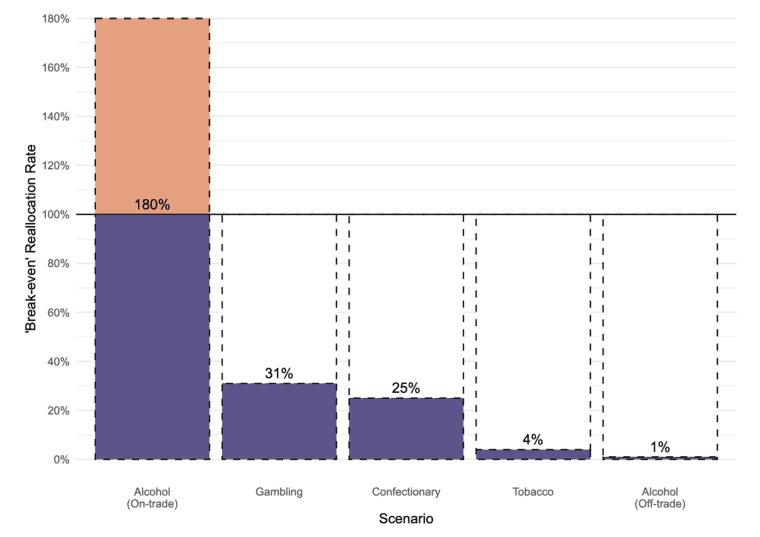
The research found that off-trade alcohol and tobacco are particularly unproductive, in terms of generating economic activity. We found that if just 4% of spending saved from tobacco, or 1% from off-trade alcohol, were spent on other goods and services the net effects on GVA would be neutral. These figures rise to 25% for confectionary and 31% for gambling. This means that even if only half of the savings were spent elsewhere (and the rest was saved, for example), reducing consumption of these commodities would comfortably produce a net positive effect on the economy. The graph below shows these ‘break-even’ percentages for GVA. For on-trade alcohol the figure is 180% – this means if consumption of on-trade alcohol were reduced, all of the money that had been spent on the on-trade plus another 80% would have to be spent elsewhere to make up for the loss of GVA.
Our findings provide an economic endorsement for targeted policies like Minimum Unit Pricing (MUP). Because MUP specifically targets the cheap, high-strength alcohol sold in the off-trade (see, for example, previous UK-based modelling of MUP policies for Scotland and Wales), it is likely to deliver a “double dividend”: improving population health while simultaneously stimulating economic activity as consumers shift their spending from relatively low-value off-trade alcohol to higher-value sectors. Similarly, the recent reforms to alcohol excise duty in the UK which introduced separate “draught relief” rates for beers and ciders sold in pubs give the government flexibility to target duty increases at alcohol sold in the off-trade, which is more likely to be economically beneficial in addition to tackling alcohol-related harm.
Crucially, the model is conservative and underestimates the total economic benefits of reducing alcohol harms. It only looks at the “demand side” of the national economy—the flow of cash to different sectors of the economy. It does not include the economic gains from improved labour productivity arising from a healthier workforce. Alcohol harm currently costs UK society billions every year through absenteeism (absence from work due to ill health), “presenteeism” (being at work but unproductive), working years of life lost due to premature death, and individuals being out of work altogether due to alcohol-attributable poor health. One recent estimate by IAS placed the wider economic cost of alcohol in England alone at £5.06 billion annually.
Reducing alcohol-related harm should not be thought of as a trade-off between improving population health and economic damage. Policies which improve population health by reducing consumption of alcohol uniformly across the on- and off-trades can be implemented with minimal negative consequences for the economy. When those reductions in consumption are achieved primarily in the off-trade – where most alcohol is consumed by those experiencing the most harm – population health and the economy both benefit.
Written by Dr Damon Morris, Research Fellow, Sheffield Addictions Research Group (SARG), School of Medicine and Population Health, University of Sheffield.
All IAS Blogposts are published with the permission of the author. The views expressed are solely the author’s own and do not necessarily represent the views of the Institute of Alcohol Studies.