
In this month’s alert
Behind the bar: what publicans really think about alcohol policy

Alcohol harm reached record highs after the pandemic, but at the same time pubs across the country have been struggling. This paradox raises an important question: what is driving harm to both health and hospitality?
Our latest report, produced with Balance, finds that pubs and public health have more in common than many people consider. Notably, many publicans see cheap supermarket alcohol as a major challenge for both their businesses and local communities:
- 62% said alcohol sold in supermarkets and off-licences is too cheap.
- 60% said government should act to narrow the price gap between pubs and the off trade.
- One in four identified cheap off-trade alcohol as one of their three biggest business challenges.
The findings also reveal strong support for policies often opposed by alcohol industry trade bodies that claim to speak for publicans:
- 58% support minimum unit pricing in England, compared with 14% opposed.
- 75% support tougher drink-drive limits.
- More than half support health warning labels on alcohol products.
- 46% support bringing alcohol marketing regulations into line with those for unhealthy food.
Adam Taylor, who runs the White Lion in Barrow-in-Furness, said:
We don’t need alcohol to be cheaper. We need government to recognise the difference between a pint served in a regulated community pub and cheap alcohol sold for consumption at home.
The report concludes that there is no single solution to the challenges facing pubs or to rising alcohol harm. Instead, it recommends a package of measures, including minimum unit pricing in England, narrowing the pub-supermarket price gap, strengthening drink-drive laws, investing in treatment and prevention, and reducing cost pressures on pubs.
Read ‘Behind the bar: what publicans really think about alcohol policy.’
Updated briefing: Domestic abuse, sexual assault, and child abuse
Our updated briefing reviews evidence on the links between alcohol, domestic abuse, sexual assault and child maltreatment. It emphasises that alcohol does not cause abuse and is never an excuse for violence, but can increase the likelihood and severity of harm. The report explores the disproportionate impact on women and children, the role of alcohol in abusive and controlling behaviour, and the effects of parental alcohol use on child wellbeing.
It also examines how alcohol policy may help prevent violence and abuse, highlighting measures such as reducing availability and increasing price. While evidence suggests that these approaches can be effective, the report highlights important gaps in understanding and calls for further research.
Read the updated briefing: ‘Domestic abuse, sexual assault, and child abuse.’
Debate grows over alcohol in football stands

Prime Minister Andy Burnham has restated his position that a ban on drinking in view of the pitch at football grounds should be reviewed and relaxed. The ban, introduced in 1985, applies to stadiums for clubs in the top five tiers of men’s football in England.
Burnham said:
I think that legislation dates to an era where football was very different. And I do believe there is a case to remove that discrimination. There are different ways it could be done. It could happen on a trial basis.
But I’m not going to back away from what’s been a long held view of mine. I don’t see how it can be fair that some supporters of one sport can be treated differently.
Football supporters, he argues, are treated differently from spectators at sports such as rugby, cricket and horse racing, where drinking within view of the pitch is permitted and commonplace.
The argument has found support among parts of the football establishment. The English Football League and Football Supporters’ Association both indicated support for a review of legislation, while a Times opinion piece argued that allowing alcohol in stands could bring a windfall for lower-league clubs.
However, the suggestions have also seen substantial pushback, largely centred on public safety and the fan experience. A spokesperson for the UK Football Policing Unit said:
Other sports simply don’t see the violence and criminal behaviour from their supporters that football does, albeit a minority, with alcohol often playing a significant part in violent and disorderly behaviour. It would be irresponsible to fuel this by allowing greater alcohol consumption during games.
Letters from fans – including in the Sunday Times, the Daily Echo, and the Guardian – have additionally highlighted the risk of undoing decades of work in making football “safer, calmer and more family-friendly.” Meanwhile, an opinion piece in the Independent argues that increased drinking at matches could worsen harms including domestic violence, and disproportionately affect women and families attending games.
Overall, reception remains mixed, with articles in the Telegraph and BBC Sport highlighting various stances both for and against. A poll embedded in the latter suggests 41% of readers support fans being able to drink in stands, with 59% against. Various key stakeholders are also yet to take a stance on the matter, with Premier League CEO Richard Masters saying:
We don’t have a specific view on that topic, and we would need to give it some really careful thought.
The debate comes alongside academic scrutiny of alcohol’s place in sport. This month, a new study from the University of Bristol and University of Oxford found that viewers of the 2026 FIFA World Cup were exposed to adverts for junk food, alcohol and gambling roughly every seven seconds, with more than 93,000 such adverts appearing during match coverage.
Alcohol branding specifically appeared in every single World Cup match. Across the tournament, 9,266 alcohol logos were shown, in 3,621 instances, with alcohol branding visible for 8.2 hours of live play. The report found that alcohol advertising was shown globally, including in countries where alcohol advertising or even alcohol itself is prohibited, because FIFA distributed the same international feed worldwide. This went against the precedent set by UEFA, which used localised virtual advertising replacement technology during EURO 2024.
For more on alcohol in sport, see our July edition of Alcohol Alert.
Spotlight on rapid alcohol deliveries
The Department for Health and Social Care and the Home Office have confirmed they are looking at how current licensing rules apply to alcohol purchases via online platforms and rapid delivery services.
Sarah Jones MP, Minister of State for the Home Office, wrote:
This includes engaging with experts, people with lived experience, and other stakeholders, and assessing emerging evidence on the impact that this may be having on health outcomes and on the effective promotion of the licensing objectives. I chaired a roundtable in June on this issue, jointly with the then Minister for Public Health and Prevention, and we are now determining our next steps, including engagement with delivery companies.
This comes as 18-year-old Anissa Khalfa shared the story of her cousin Tom Greest, who died aged 33 after struggling with alcohol-related harms and mental health harms. Greest was receiving rapid alcohol deliveries around the clock, despite his family’s efforts to intervene.
Khalfa said:
There was absolutely no safeguarding at all, and it was killing him. […] When family, friends and doctors know that somebody is seriously ill from alcohol, there should be a right on these apps to be able to impose a block.
Balance and Alcohol Change UK have been working with Khalfa to highlight the harm that rapid alcohol deliveries are causing in communities, securing coverage including The Northern Echo, BBC News, ITV Newsand on Good Morning Britain. Alcohol Change UK statistics found one in five UK adults report ordering alcohol for rapid delivery at least once a week.
Meanwhile, South Australia has become the first Australian state to pass major alcohol delivery reforms, as part of broader reforms around domestic abuse. The new laws restrict alcohol deliveries to 10am to 10pm and introduce a mandatory two-hour delay between ordering and delivery, measures intended to reduce harms associated with rapid alcohol delivery services.
Digital proof of age adopted for alcohol sales

Digital ID will now be accepted as proof of age when purchasing of alcohol in pubs and shops in England and Wales, following amendments to the Licensing Act. The change follows a 2024 Government consultation, in which 72% of respondents supported the use of digital identities for age verification when buying alcohol.
Digital proof of age must be provided through certified suppliers listed on a government register. The system is technology-neutral, with the government setting standards rather than prescribing how individual apps operate. Many providers use facial matching or similar checks to verify that the person presenting the ID is its legitimate holder.
Digital Government Minister Stephanie Peacock said:
It will remain an individual or business’ choice whether to use or adopt it, and physical ID will remain a valid way for customers to prove their age.
Inadequate labels leave consumers unaware of health harms
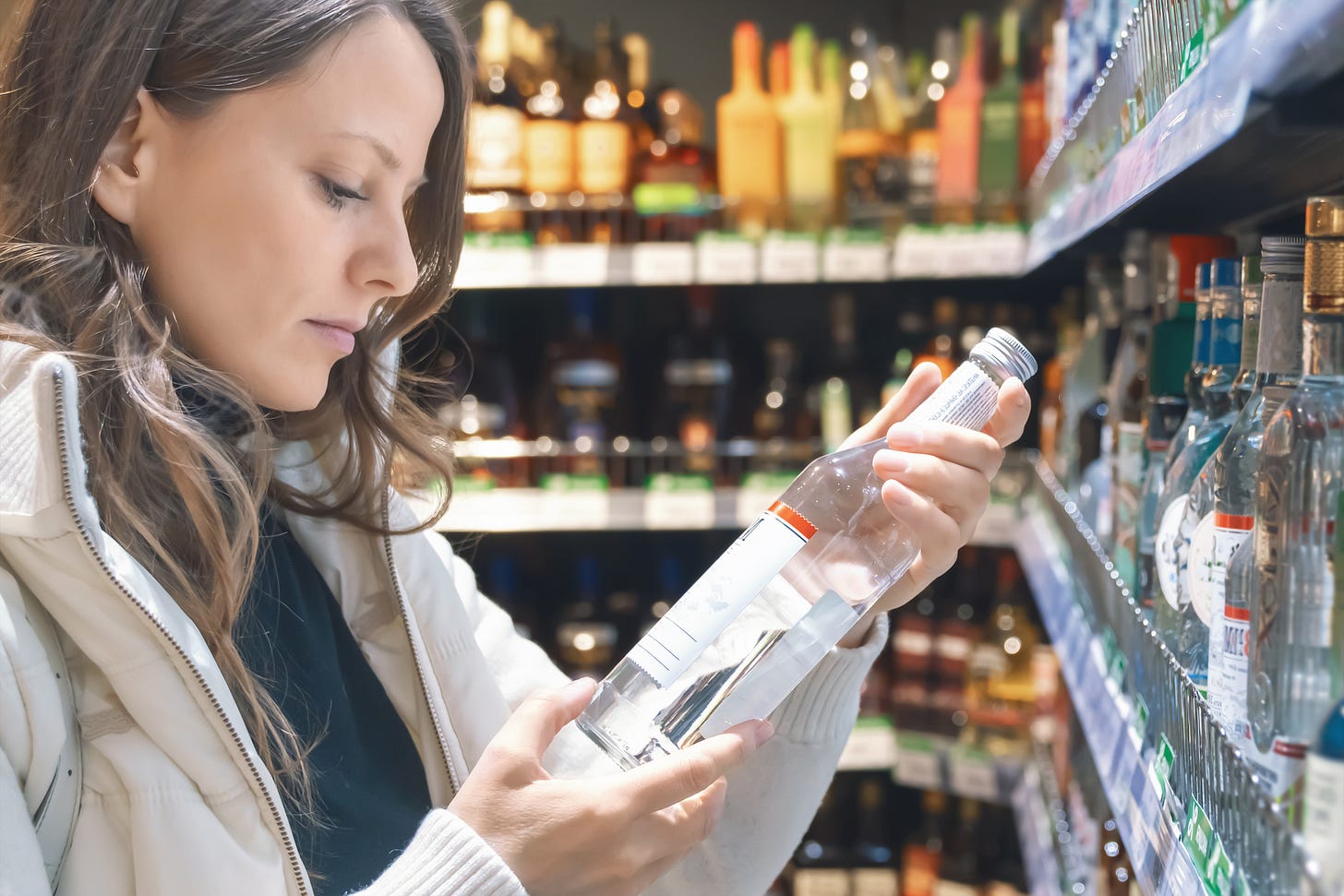
An Australian study of 6,037 alcohol products found that only one in four carried a voluntary health warning, prompting renewed calls for mandatory, prominent labels highlighting risks such as cancer and liver disease. Researchers argued that industry-led approaches leave many consumers unaware of alcohol-related harms.
Lead author Asad Yusoff, from The George Institute for Global Health, said:
Our study reveals that alcohol companies are using weak voluntary health messaging and labels to feign corporate responsibility while keeping consumers in the dark about the real health harms of drinking.
The findings come as the Department of Health and Social Care (DHSC) prepares to launch a consultation on mandatory alcohol labelling and health warnings in England later this year. This month, Emma Reynolds MP, Chief Secretary to the Treasury, wrote:
As outlined in the 10 Year Health Plan for England, the Department of Health and Social Care is working towards launching a consultation in late 2026 on options to make it a legal requirement for alcohol labels to display health warnings and consistent nutritional information, which will support people to make healthier choices about alcohol.
Advocates for stronger labelling argue that similar concerns to those highlighted in Yusoff and colleagues’ study exist in the UK. A July audit by the Alcohol Health Alliance and Alcohol Focus Scotland of 530 products found that one in five products failed to meet even the industry’s own voluntary standards, while health information was often absent, difficult to read, or overshadowed by branding. Just 1.3% of products carried specific warnings about cancer or liver disease, despite alcohol causing at least seven types of cancer.
The consultation is likely to reignite debate over the effectiveness of voluntary regulation. In a PoliticsHome opinion piece marking 30 years of the Portman Group’s Code of Practice, chief executive Matt Lambert argued that the self-regulatory system has helped shape responsible alcohol marketing and labelling since 1996. The Portman Group says more than 99% of products carry pregnancy warnings, 96% include unit information and 89% display the UK’s low-risk drinking guidelines, while its complaints process has led to the removal or amendment of more than 200 products.
Meanwhile, a new UK campaign, Fair AF Labelling, is calling on the UK government to allow drinks containing up to 0.5% ABV to be labelled “alcohol-free”, arguing that current UK rules are unnecessarily strict and out of step with international standards. Founder Ben Gibbs said the UK’s current 0.05% ABV threshold is the lowest in the world and creates barriers for independent breweries producing no- and low-alcohol drinks.
BrewDog “bottomless beer” adverts banned
Two BrewDog Facebook adverts promoting a “bottomless beer” offer have been banned after the Advertising Standards Authority (ASA) ruled that they encouraged excessive drinking and breached UK alcohol marketing rules. One advert promoted “Unlimited beers for 90 mins under £20”, while another showed two men becoming noticeably more upbeat after drinking.
The ASA found that the adverts presented excessive alcohol consumption as an attractive feature of the promotion and suggested alcohol could improve mood or behaviour. BrewDog owner Tilray Brands UK Ltd argued that the adverts were intended to be humorous and to highlight the range of drinks available, but the regulator rejected these arguments and ordered that the adverts must not appear again in their current form.
ASA rules state that advertisements must not imply that alcohol can enhance confidence, social success, or personal wellbeing.
An “evidence jigsaw” approach to public health policy
What kind of evidence actually changes public health policy? New research suggests that there is no single piece of research that leads to policy change. Instead, successful regulation of health-harming commodities such as alcohol, tobacco and unhealthy food relies on an “evidence jigsaw” made up of different types of evidence, each most useful at different stages of the policymaking process.
Through a UK-based cross-sectional survey and focus group-based study, researchers Alice Fabbri, Britta K. Matthes, and Katherine Smith found that:
- Epidemiological evidence helps put problems on the political agenda.
- Modelling studies and evidence from other jurisdictions help build the case for policy solutions.
- Lived experience and public opinion can be particularly influential when winning political support for policy adoption.
- Monitoring and evaluation are essential for defending policies against rollback once implemented.
Evidence on industry tactics and influence was seen as relevant across every stage of policymaking, with participants suggesting this body of research is much more developed in tobacco control than in alcohol policy. Equally, building relationships with policymakers, working with advocates, and communicating research at the right moment were all identified as critical for translating evidence into policy change.
IAS podcast appearances
The whole policy package around reducing harm is so important because there isn’t just one intervention that is going to solve everything overnight.
This month, Institute of Alcohol Studies Chief Executive Dr Katherine Severi appeared on the Alcohol ‘Problem’ Podcast with Dr James Morris. The conversation explores why alcohol policy matters, what the evidence says about reducing harm, and the challenges of turning evidence into action, from minimum unit pricing and alcohol labelling to rapid delivery apps and Westminster’s drinking culture.
IAS Head of External Affairs Jem Roberts also spoke with Alcohol Review about our latest Explained Series film, ‘Digital Intoxication: Online Alcohol Marketing Explained.’
Finally, this month on the Alcohol Alert podcast we’re joined by Ailsa Rutter, Director of Fresh and Balance, the northeast England programme tackling tobacco and alcohol harm. Ailsa shares the deeply personal story behind her career and reflects on the history of tobacco control, from the 1962 Royal College of Physicians report to today’s Tobacco and Vapes Act.
She said:
The big stark contrast between tobacco and alcohol is the absolute lack of national regulation, the lack of legislation there has been for alcohol.
Alcohol Toolkit Study: update
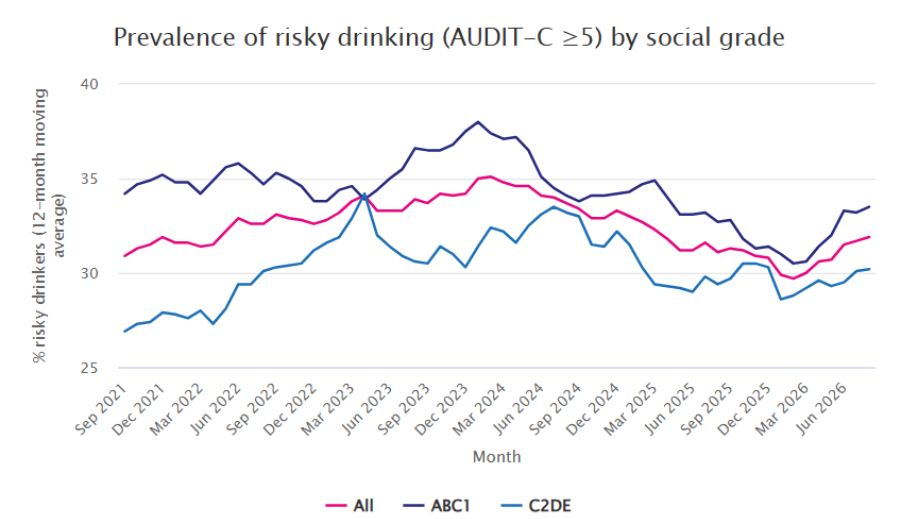
The Alcohol Toolkit Study is a long-running survey of alcohol consumption in England, Scotland, and Wales. The English monthly data has been collected since March 2014, and the Scottish and Welsh data from mid-2021. Each month involves a new representative sample of adults aged 16 and over.
You can find further charts and data for each country here:
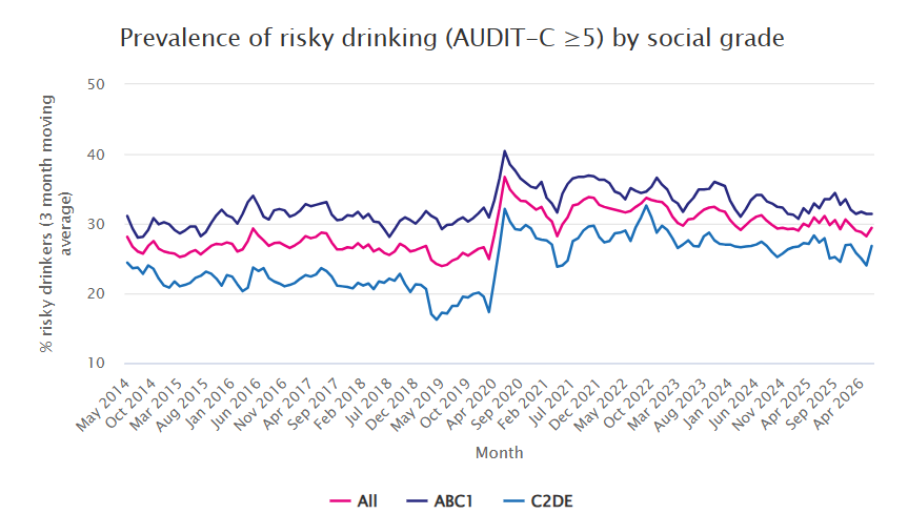
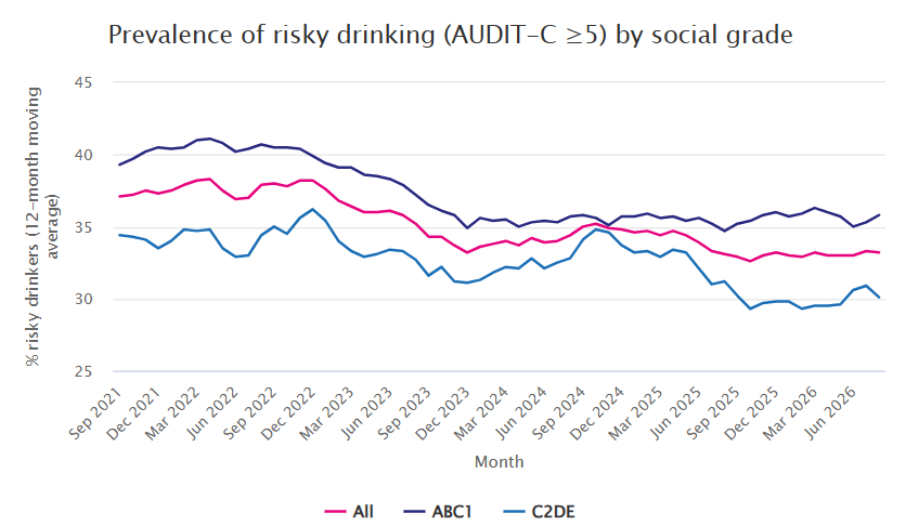
The following charts are a snapshot of the prevalence of risky drinking by social grade.
Prevalence of increasing and higher risk drinking (AUDIT-C)
Risky drinking defined as those scoring AUDIT-C ≥5
ABC1: Professional to clerical occupation; C2DE: Manual occupation
England
Scotland
Wales
Podcast
Our monthly podcast features interviews with experts from across the sector.
The Tobacco and Vapes Act – and how alcohol is being left behind
Ailsa Rutter –
Director of Fresh and Balance