

Public debate about alcohol-related offending sits at the intersection of criminal justice, public health, and moral judgement. Questions about intoxication, dependence, and treatment are frequently raised in discussions of culpability and sentencing—but how the public actually weighs these factors is less well understood.
New findings from a large conjoint experiment, commissioned from YouGov, provide insight into how different aspects of alcohol involvement shape public views on punishment in a hypothetical assault scenario. The results highlight important distinctions between intoxication, dependence, and treatment, with implications for public health and policy.
Most people favour equal punishment
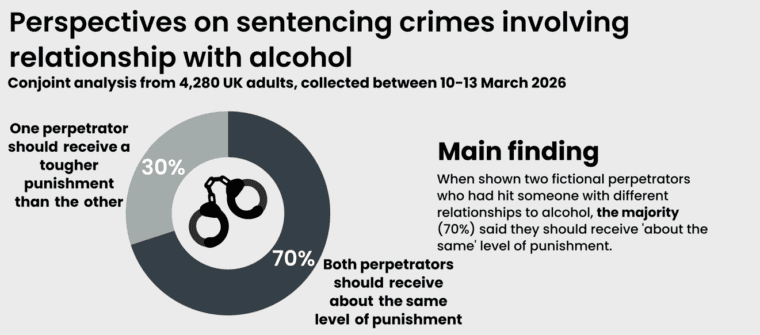
A key starting point is that most respondents did not differentiate between cases. Around 70% believed both perpetrators of an assault – one who is and one who isn’t intoxicated – should receive roughly the same punishment, regardless of intoxication or history. Only 30% favoured tougher punishment for one of the cases.
Intoxication drives punitive responses
Among those who did differentiate, intoxication at the time of the offence was the most influential factor.
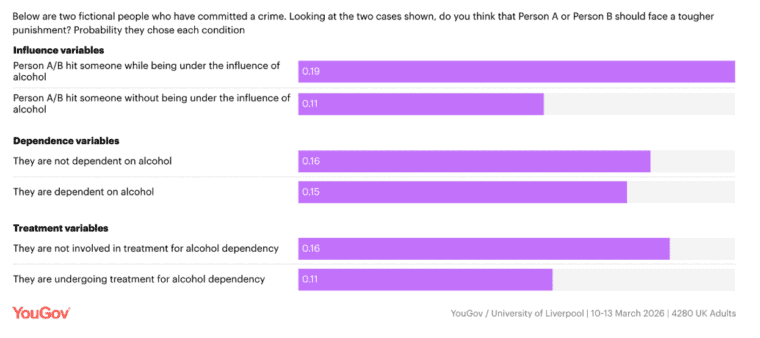
The largest difference is that there is a substantially higher probability of an individual being chosen for tougher punishment if they are under the influence of alcohol at the time of hitting someone (0.19), compared to not (0.11). This could point to a public who are harsher on those who are under the influence compared to not when it comes to punishment.
Whereas treatment engagement softens judgement
In contrast, engagement with treatment reduced support for harsher punishment (0.16 vs 0.11), suggesting treatment is seen as a signal of responsibility.
Figure 1: Probability of selecting tougher punishment by individual characteristics
Combined factors reinforce these patterns
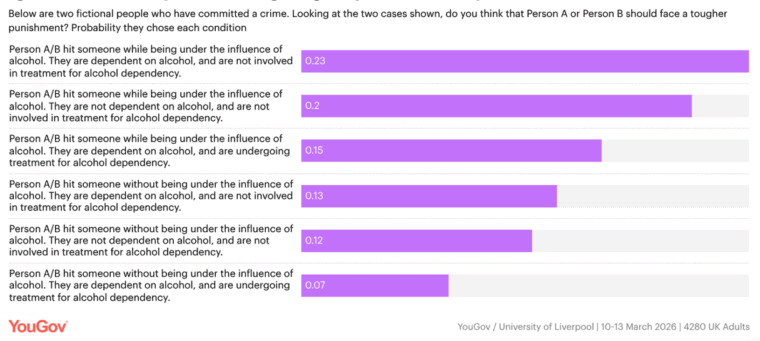
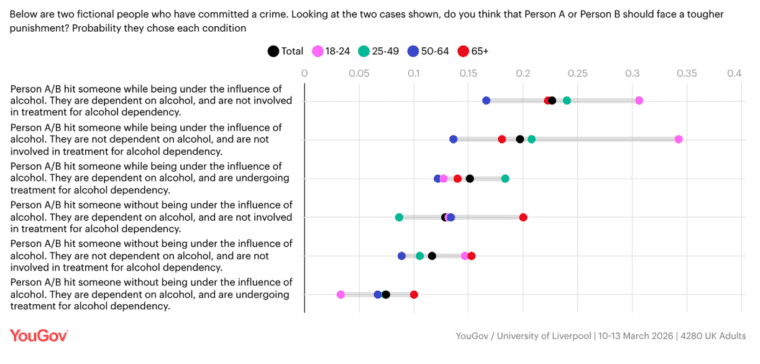
The most punitive scenario (intoxicated, dependent, not in treatment) had probability 0.23, while the least punitive (not intoxicated, dependent, in treatment) was 0.07.
Figure 2: Probability of selecting tougher punishment by combined conditions
Limited role of personal drinking behaviour
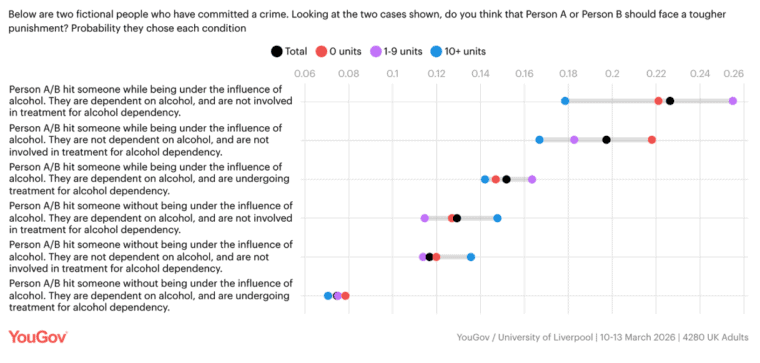
Respondents’ own drinking behaviour showed a generally weak relationship with their sentencing preferences across most scenarios. For example, where the individual was under the influence, dependent, and not in treatment, the probability that a tougher punishment was chosen was:
- 0.26 among moderate drinkers (1–9 units per week)
- 0.22 among abstainers
- 0.18 among heavier drinkers (10+ units per week)
Figure 3: Probability of selecting tougher punishment by respondent drinking behaviour
Generational differences are more pronounced
Younger respondents (18–24) were more likely to differentiate (38%) and more punitive in intoxication scenarios but more lenient when treatment was present. For example, among 18–24-year-olds, there was a 0.31 probability that a tougher punishment was selected where the individual was intoxicated, dependent, and not in treatment, and 0.34 where the individual was intoxicated, not dependent, and not in treatment —higher than in older age groups.
Figure 4: Probability of selecting tougher punishment by age group
What is punishment for?
When presented with the same cases they had seen in the prior conjoint, views were balanced between reform and rehabilitation (25%), protecting the public (24%), and punishing offenders (21%).
Dependence shifts views toward rehabilitation
Where dependence was present, support for rehabilitation rose (27–36% vs 16–19%), while support for punishment fell (17–19% vs 24–25%). This suggests that when offending is linked to an underlying dependence upon alcohol—particularly if being actively addressed—the public shifts toward a more rehabilitative framing.
In contrast, where dependence was not present, behaviour was more likely to be interpreted in terms of individual responsibility and deserving of punishment.
Differences by drinking behaviour and age
Patterns by respondents’ own drinking behaviour were modest but suggest a slightly stronger orientation toward rehabilitation among heavier drinkers, with those consuming 10+ units per week more likely to prioritise reform and rehabilitation (29% vs 24–25% in other groups).
Age differences were more pronounced. Younger respondents (18–24) were substantially more likely to prioritise rehabilitation (40% vs 21–26%) and less likely to prioritise punishment (15% vs 22–23%). They also showed particularly strong support for rehabilitation in cases involving dependence, reinforcing the importance of context and treatment in shaping public views.
Implications for public health and policy
Public attitudes reflect beliefs about culpability and the purpose of punishment. Public judgements are driven more by intoxication than dependence, highlighting the need to address acute alcohol-related harm.
Public attitudes to alcohol-related offending are shaped not only by views on how severe punishment should be, but also by what punishment is understood to achieve. While intoxication drives perceptions of culpability and sentence severity, dependence and treatment engagement shape whether responses are framed in punitive or rehabilitative terms. In other words, the same factors that influence who is punished more harshly also influence what punishment is seen as for—with dependence, in particular, shifting preferences toward reform and rehabilitation.
Several implications follow:
- Public judgements are pragmatic rather than diagnostic. Being under the influence at the time of an offence carries more weight than dependence, highlighting the salience of immediate harm and impaired behaviour.
- Treatment signals responsibility and change. Engagement with treatment softens punitive judgement, suggesting that visible, credible treatment pathways can enhance the perceived legitimacy of health-led responses.
- Support for rehabilitation. There is clear public support for rehabilitative approaches, particularly where dependence and treatment are evident—aligning with public health goals of reducing harm and reoffending.
- One-size messaging is unlikely to resonate. Generational differences point to distinct ways of interpreting alcohol-related offending, suggesting a need for tailored policy communication.
As debates around alcohol-related offending continue, understanding not just what the public thinks, but how those judgements are formed, remains a crucial part of evidence‑informed policymaking and these findings are important in improving public communication and confidence in combining criminal justice and public health responses to alcohol-related harm.
Methods in brief
Findings are drawn from a UK-wide online survey conducted by YouGov in March 2026, with a representative sample of 4,280 adults.
The study used a conjoint experiment, in which respondents were shown pairs of hypothetical assault cases (all involving the same offence) and asked which individual should receive a (slightly or significantly) tougher punishment, or whether both should be treated the same. Three characteristics were systematically varied:
- intoxication at the time of the offence
- alcohol dependence
- engagement with treatment for dependency
Each profile was evaluated by between 1,100 and 2,000 respondents. Around 70% of participants favoured equal punishment, so reported differences reflect the 30% who chose ‘tougher punishment’ for one side.
Responses were analysed by examining the modelled probability that a given characteristic or combination of characteristics was associated with calls for tougher punishment, among respondents who expressed a preference between the two cases.
Subgroup analyses explored variation by age and drinking behaviour. The analysis is descriptive and exploratory, meaning findings should be interpreted as indicative patterns rather than causal effects. Please also note that this is experimental data, and as such should not be reported as reflecting population point estimates.
The follow-up question on the purpose of punishment exposed respondents to the same two hypothetical cases.
Written by Dr Carly Lightowlers, Senior Lecturer in Criminology, University of Liverpool
All IAS Blogposts are published with the permission of the author. The views expressed are solely the author’s own and do not necessarily represent the views of the Institute of Alcohol Studies.