• Skip to primary navigation
  • Skip to main content
  • Skip to footer

Institute of Alcohol Studies HomepageInstitute of Alcohol Studies

Bringing together evidence, policy and practice to reduce alcohol harm

  • Home
  • About us
    • People
    • Our strategy
    • Small Grants Scheme
    • Networks
    • Vacancies
    • Contact us
  • Publications
  • Explore by Topic
    • Alcohol unit calculator
    • Alcohol across society
    • Availability
    • Consumption
    • Economy
    • Health
    • Marketing
    • Price
    • The alcohol industry
    • Transport
    • Violence and crime
    • Help and support
  • News & Comment
    • Latest news and events
    • Blog
    • Alcohol Alert
    • Podcasts
    • Videos
    • See all
  • Search

Health

On this page

  • Facts and stats
  • Briefings
  • Publications
  • Blogs
  • Podcasts
  • Videos

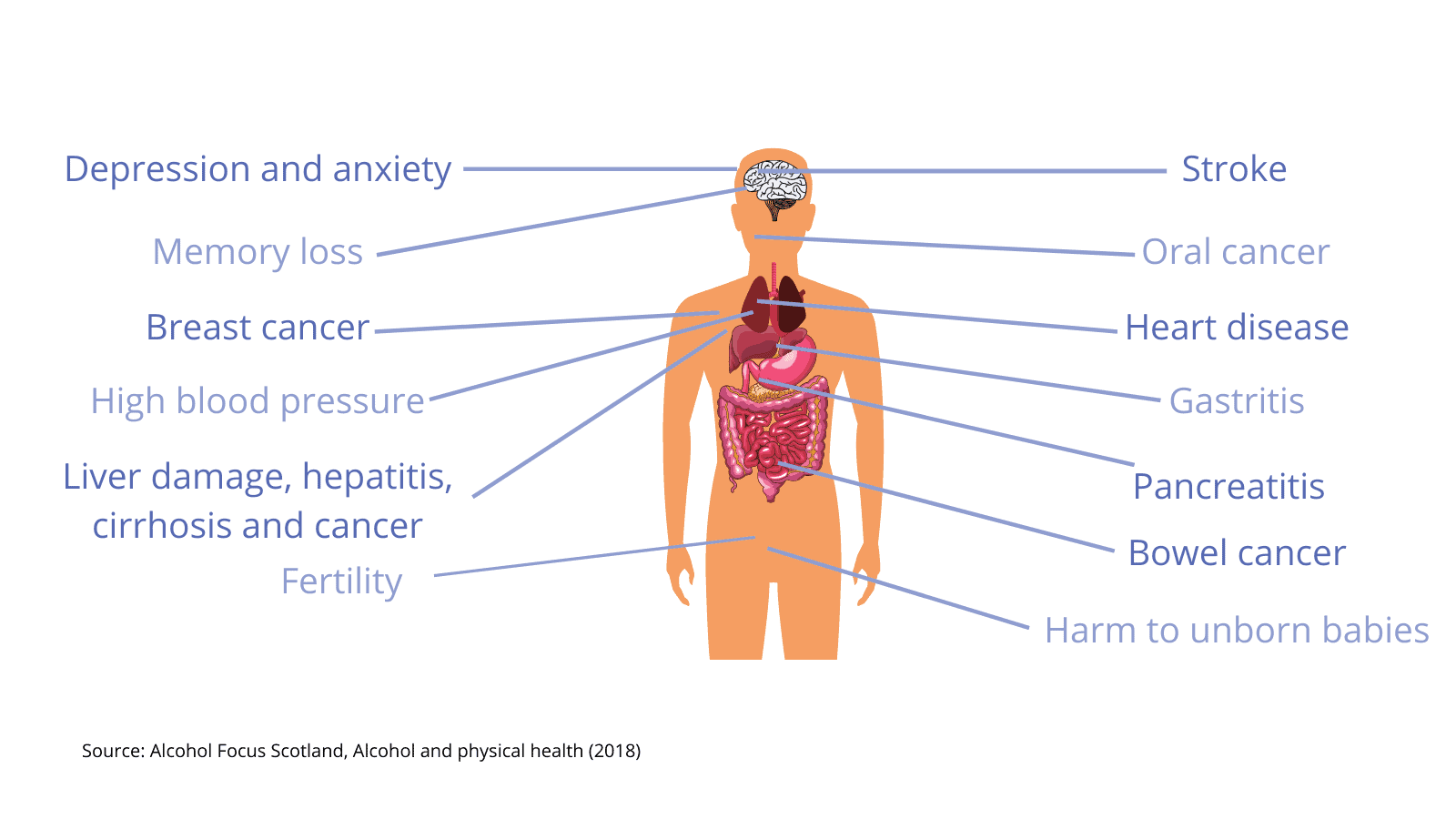
Alcohol significantly impacts health. Globally, the World Health Organisation (WHO) estimates that harmful use of alcohol results in 3.3 million deaths every year, representing 5.9% of all deaths, and that alcohol is a causal factor in more than 200 disease and injury conditions. Overall 5.1% of the global burden of disease and injury is attributable to alcohol, as measured in disability-adjusted life years (DALYs).

Alcohol consumption causes death and disability relatively early in life, and there are gender differences in alcohol-related mortality, morbidity, as well as levels and patterns of alcohol consumption.

The impact of alcohol consumption on health outcomes in populations is largely determined by two separate but related dimensions of drinking: 1) the total volume of alcohol consumed; and 2) the pattern of drinking. In addition, there is evidence that a nation’s alcohol consumption directly impacts on the health of its citizens.

Facts and stats

  • Alcohol is a causal factor associated with over 200 medical conditions (WHO, 2022)
  • Alcohol is the second biggest risk factor for death and years lived with disability, and the biggest risk factor for disability-adjusted life years among 15-49-year-olds. (Alcohol Profiles)

Download this chart

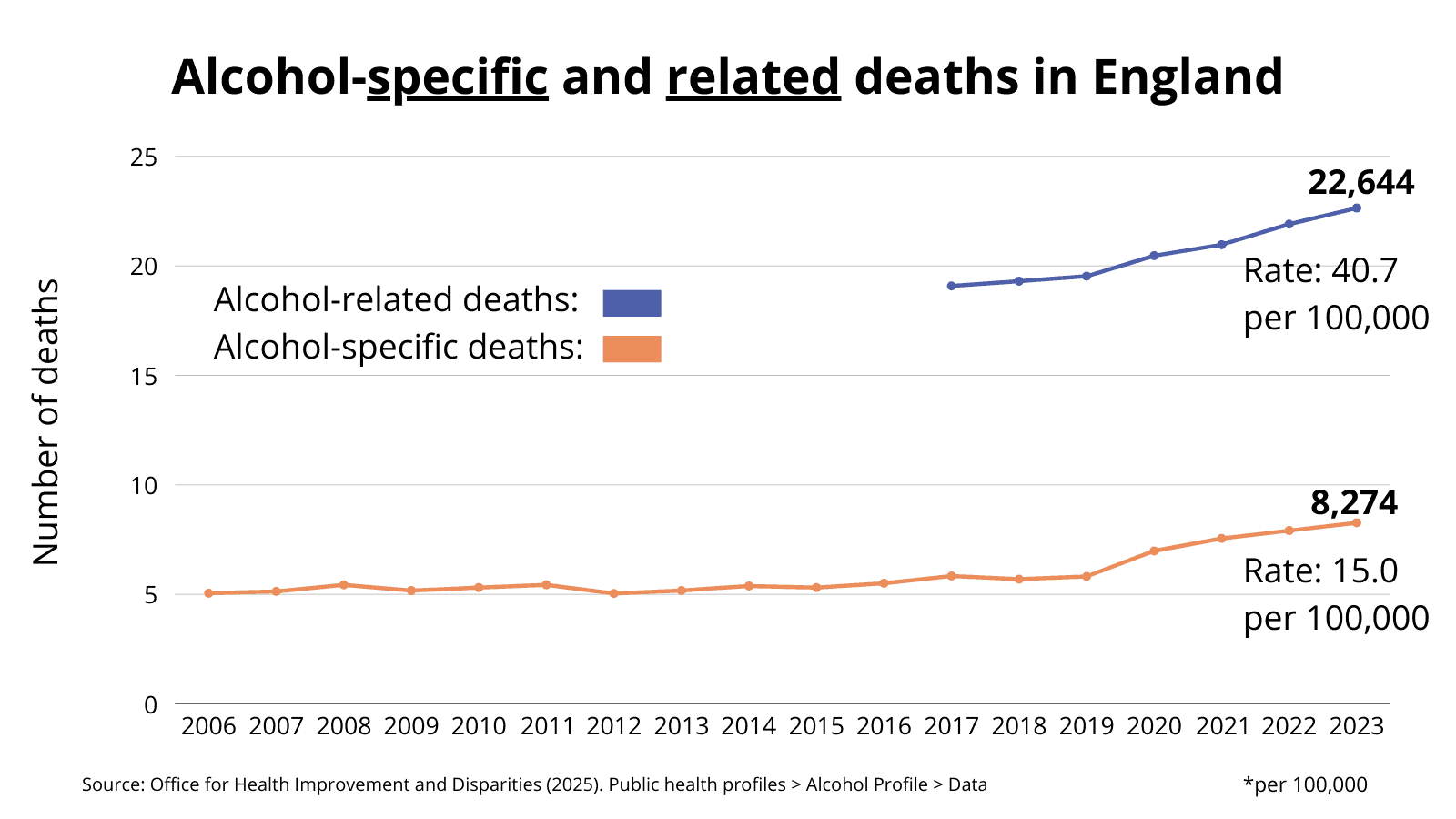
  • Alcohol-specific mortality: Deaths from conditions wholly caused by alcohol. This definition is also used by the Office of National Statistics in their annual UK data release.
  • Alcohol-related mortality: Deaths from conditions which are wholly or partially caused by alcohol. For partially attributable conditions, a fraction of the deaths is included based on the latest academic evidence about the contribution alcohol makes to the condition. (OHID, 2023)

Download this chart

  • In 2023, there were 10,473 alcohol-specific deaths registered in the UK, a rate of 15.9 deaths per 100,000 people (Office for National Statistic, 2025)
  • This is 4.2% more deaths than in 2022, and 38.4% more deaths than 2019 (pre-coronavirus pandemic)
  • This is the highest number of annual deaths from alcohol recorded since 2001 when recording began

Download this chart

Download this chart

  • In 2024, 7,673 people died in England from alcohol-specific causes, a rate of 13.8 deaths per 100,000
  • 1,185 people died in Scotland, a rate of 20.9 deaths per 100,000
  • In 2023, 562 people died in Wales, a rate of 17.7 deaths per 100,000
  • In 2023, 341 died in Northern Ireland, a rate of 18.5 deaths per 100,000

Download this chart

Download this chart

Ratio of Scot:Eng death rate – log scale by The Institute of Alcohol Studies

  • Male alcohol-specific deaths in England and Wales are 4 times higher in the most deprived areas than the least deprived areas. (ONS, 2025)
  • In Scotland, people in the most deprived areas are six times more likely to be admitted than those in the least deprived areas. (PHS, 2023)
  • The alcohol-specific death rate is 50% higher in the North East relative to the English average. (ONS, 2025)
  • Across the UK, the alcohol-specific death rate for males is twice the rate for females (ONS, 2025)

Download this chart

Download this chart

  • Over 75 people die every day in the UK because of alcohol (Scotland, Wales and Northern Ireland do not regularly publish data on alcohol-related deaths)
    • 21,971 people died from alcohol-related causes in England in 2024 (OHID, 2025)
    • 3,705 people died from alcohol-related causes in Scotland in 2015 (ScotPHO)
    • 1,500 people die from alcohol-related causes in Wales each year (PHW)
    • 341 people died from alcohol-specific causes in Northern Ireland in 2023 (ONS)
  • The highest alcohol death rates in the UK are among men and women aged 50 to 69 years of age

Download this chart

  • Alcoholic liver disease accounts for over three quarters of alcohol-specific deaths in the UK

Download this chart

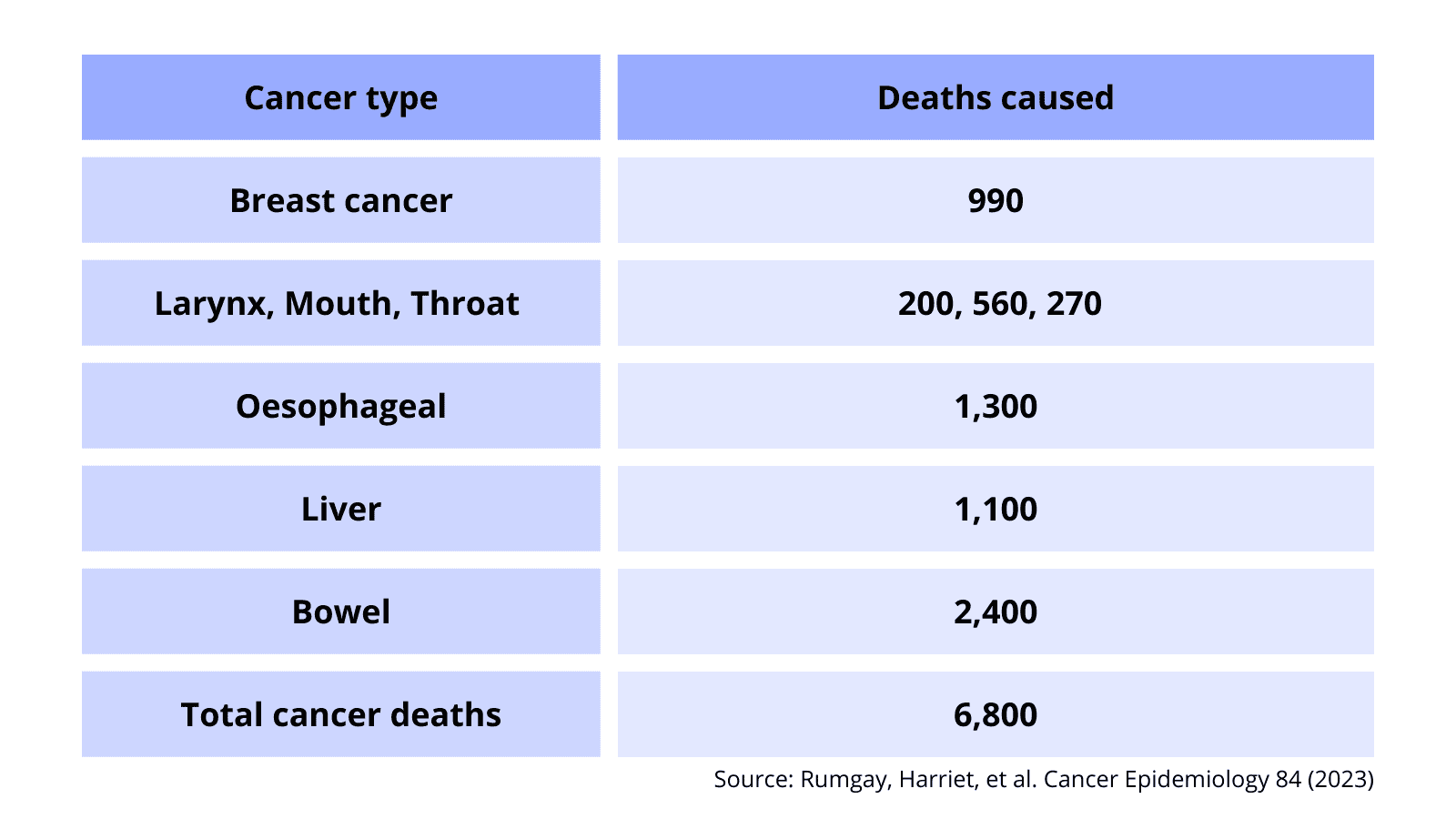
  • Alcohol causes 7 types of cancer: Breast, Larynx, Mouth, Throat/Pharynx, Oesophageal, Liver, and Bowel
  • This happens because your body breaks alcohol down into the reactive, highly toxic chemical ‘acetaldehyde’, which damages DNA and prevents your body from repairing the damage
  • When DNA is damaged, a cell can begin growing out of control and create a cancer tumour

Download this chart

  • Alcohol-related cancers cause a similar number of deaths to alcohol-related liver disease
  • Public awareness that alcohol causes cancer is very low, with only 13% of people identifying cancer as a health outcome of alcohol consumption (ScHARR)

Download this chart

  • Broad measure – where the primary reason for hospital admission or a secondary diagnosis was linked to alcohol.
  • Narrow measure – where the main reason for admission to hospital was attributable to alcohol. (NHS, 2022)
  • By the broad measure:
    • In 2023/24, there were a total 1,018,986 alcohol-related hospital admissions in England, at a rate of 1,824 per 100,000 persons (OHID, 2025)
  • By the narrow measure:
    • In 2023/24, there were a total 280,747 alcohol-related hospital admissions in England, at a rate of 504 per 100,000 persons (OHID, 2025)

In 2022/2023 there were:

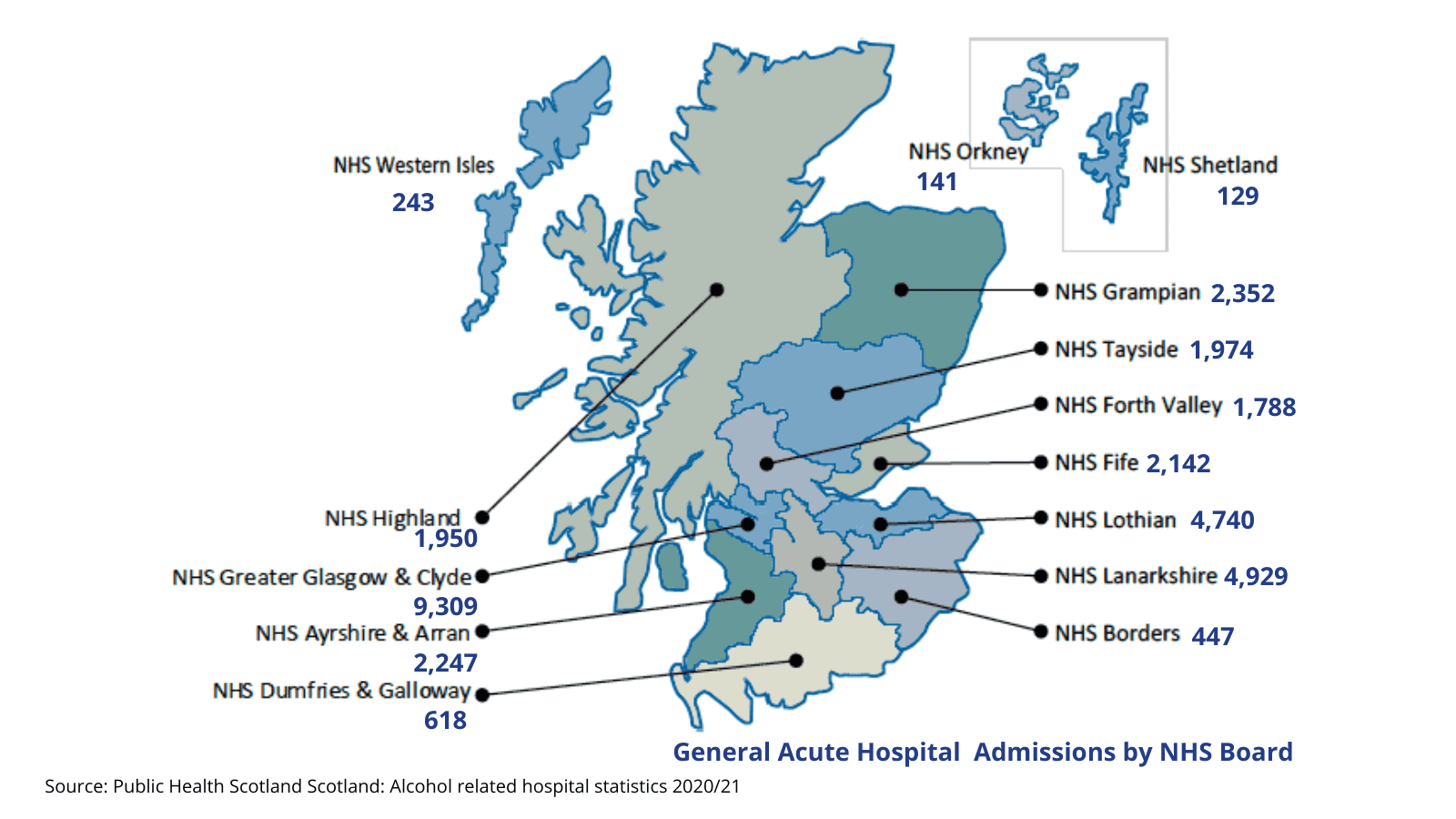
    • 31,206 alcohol-related hospital admissions in Scotland (PHS, 2024).
      • 92% were treated in general acute hospitals (28,800)
      • 8% of admissions occurred in psychiatric hospitals (2,406)
    • Men were 2.4 times more likely than women to be admitted to general acute hospitals for alcohol-related conditions (749 stays per 100,000 compared to 315 stays per 100,000)
    • People in the most deprived areas were seven times more likely to be admitted to general acute hospitals for an alcohol-related condition than those in the least deprived areas (849 patients per 100,000 compared to 127 patients per 100,000)

Download this chart

  • By the broad measure:
    • There were 52,118 admissions of 32,716 patients to Welsh hospitals in 2022/2023.
    • (Public Health Wales, 2024)
  • By the narrow measure:
    • There were 12,628 admissions involving 8,464 patients to Welsh hospitals in 2022/23. (Public Health Wales, 2024)
  • There were over 27,000 alcohol-related admissions to hospitals in 2017/18, the majority of which were for mental and behavioural disorders
    • 21,087 mental and behavioural disorders due to use of alcohol
    • 5,071 alcoholic liver disease cases
    • 1,715 cases due to toxic effect of alcohol (DoH, 2019)
  • In England in 2024/25, there were 99,955 adults in contact with alcohol-only treatment services and 47,758 with treatment services for non-opiate and alcohol substance use (OHID, 2025).
  • Only 136,371 out of an estimated 608,416 people with alcohol dependence are accessing treatment, which is 22.4% (NDTMS).

  • This means 170,893 were in treatment for alcohol use.
  • For those in for alcohol only, 60% were male and 40% female.
  • 52% of people in treatment for substance use had a problem with alcohol.
  • In England, only one in five dependent drinkers are predicted to be in treatment. (PHE, 2021)
  • 57% of those starting treatment for alcohol in 2024/25 were self-referred. 28% were referred by a health and social care provider, such as a GP.
  • From 2020/21 to 2024/25, there has been a 34% increase in new presentations for alcohol treatment (OHID, 2025). This is the highest number since records began in 2005/06.

New presentations to alcohol treatment by The Institute of Alcohol Studies

Briefings

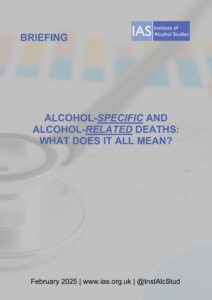
Alcohol-specific and Alcohol-related deaths: What does it all mean?

February 2025

Autumn Budget Analysis 2024

November 2024

Alcohol and Economic Crises

April 2024

Cannabis liberalisation: Lessons for alcohol policy

October 2023

Alcohol-related accidents and injuries

How alcohol morbidity and morbidity rates are calculated in the UK

The physical and mental health effects of alcohol

Alcohol energy (calorie) labelling: Evidence, public support, alternatives, and wider labelling considerations

November 2021

Publications
Barriers to Recovery: Overcoming obstacles to alcohol recovery in the UK

November 2025

Technical report for ‘A Healthier Future: A long-term vision to tackle alcohol harm in the UK’

November 2025

A Healthier Future: A long-term vision to tackle alcohol harm in the UK

November 2025

IAS response to Licensing Reforms Programme

November 2025

Autumn Budget Submission 2025

September 2025

IAS response to LGBT+ health evidence review

September 2025

IAS response to consultation on Welsh MUP 2025

August 2025

IAS response to consultation on Men’s Health Strategy 2025

July 2025

Spin the bottle: How the UK alcohol industry twists the facts on harm and responsibility

June 2025

The Price is Right: Minimum unit pricing for alcohol and the case for a windfall tax

May 2025

Spending Review submission 2025

January 2025

IAS Autumn Budget Submission 2024

October 2024

Spring Budget 2023 – IAS submission

February 2023

People, Planet, or Profit: alcohol’s impact on a sustainable future

November 2022

The COVID Hangover: summary report

July 2022

The COVID Hangover: addressing long-term health impacts of changes in alcohol consumption during the pandemic

July 2022

IAS response to consultation on Mental health and wellbeing plan

July 2022

IAS Annual Report 2021/22

May 2022

IAS response to consultation on WHO Framework to strengthen Alcohol Action Plan

April 2022

October 2021 Budget Analysis

December 2021

IAS response to consultation on revised WHO Global Alcohol Action Plan

August 2021

March 2021 Budget Analysis

April 2021

IAS response to consultation on Transforming the Public Health System

April 2021

IAS response to Public Health England consultation on proposed changes to the calculation of alcohol-related mortality and hospital admissions

March 2021

Exploring men’s alcohol consumption in the context of becoming a father: A scoping review

February 2021

IAS response to consultation on the New Substance Use Strategy in Northern Ireland

February 2021

IAS Response to WHO Global Alcohol Action Plan

December 2020

IAS response to Early years healthy development review: call for evidence

October 2020

IAS response to Consultation on the WHO European Programme of Work

July 2020

Minimum Unit Pricing in Scotland: What we know so far about its effects on consumption and health harms

May 2020

IAS response to NICE digital interventions consultation

March 2020

IAS response to Advancing our health: prevention in the 2020s (Green Paper) consultation

October 2019

IAS response to WHO Global Alcohol Strategy consultation

October 2019

IAS response to Northern Ireland consultation on new substance misuse strategy

September 2019

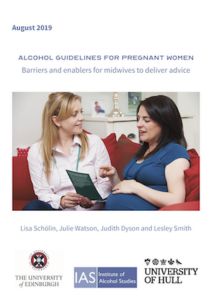
Alcohol guidelines for pregnant women: Barriers and enablers for midwives to deliver advice

September 2019

IAS response to the Online harms white paper

July 2019

IAS response to Toxic trio consultation

June 2019

IAS response to Coexisting severe mental illness and substance misuse — NATIONAL INSTITUTE FOR HEALTH AND CARE EXCELLENCE

April 2019

IAS response to ‘Mental health of men and boys’ consultation

March 2019

IAS response to the Relationships education, relationships and sex education, and health education: Department for Education consultation

November 2018

IAS response to draft London Food Strategy

July 2018

Families First: An evidence-based approach to protecting UK families from alcohol-related harm

July 2018

IAS response to web consultation on WHO Independent High-Level Commission on NCDs draft report

May 2018

IAS response to Department of Health and Social Care – A Consultation on Low Alcohol Descriptors

May 2018

Alcohol and mental health: Policy and practice in England

April 2018

IAS response to the impact of social media and screen-use on young people’s health inquiry

April 2018

IAS response to Smoking, Drinking and Drug Use Among Young People in England (SDD) consultation survey

January 2018

IAS response to Consultation: Public Health (Minimum Price for Alcohol) (Wales) Bill

January 2018

IAS response to the Office of National Statistics alcohol mortality definition review

August 2017

IAS response to the AA-HA! Draft guidelines

January 2017

IAS response to the WHO Global NCD Action Plan consultation, 2013-20, Appendix 3

August 2016

IAS response to Consultation on changes to HSCIC Statistics

June 2016

IAS response to the Chief Medical Officer’s Alcohol Guidelines Review consultation

April 2016

IAS response to consultation on HSCIC Lifestyles Compendia Reports

January 2016

IAS response to the Draft Public Health (Minimum Price for Alcohol) Bill Consultation

December 2015

IAS response to the Health Select Committee short overview inquiry into the impact on public health post-2013 of the Health and Social Care Act reforms

December 2015

Dead on Arrival? Evaluating the Public Health Responsibility Deal for Alcohol

November 2015

Alcohol’s impact on emergency services

October 2015

IAS response to the All-Party Parliamentary Group on Alcohol Harm Inquiry: ‘Impact of Alcohol on the Emergency Services’

October 2015

IAS response to the call for evidence from the All Party Parliamentary Group for Foetal Alcohol Spectrum Disorder (FASD)

September 2015

IAS response to Department for Work & Pensions call for evidence on the impact on employment outcomes of drug or alcohol addiction, and obesity (Black review)

September 2015

IAS response to Smoking Drinking and Drug Use Among Young People in England (SDD) Consultation

August 2015

Alcohol’s harm to others

July 2015

Alcohol, health inequalities and the harm paradox: Why some groups face greater problems despite consuming less alcohol

November 2014

IAS response to All Party Parliamentary Hepatology Group (APPHG) inquiry

December 2013

IAS response to ONS consultation on statistical products 2013

October 2013

IAS response to the Department of Health balance of competence review

February 2013

IAS response to North West Public Health Observatory consultation on the methods used to estimate alcohol-related hospital admissions for England

August 2012

IAS response to House of Commons Health Committee inquiry on alcohol

May 2012

IAS response to World Health Organization meeting on non-communicable diseases

June 2011

IAS response to Public Consultation on Healthy Lives, Health People White Paper: Our Strategy for Public Health in England – Supplementary response to the submission from the Alcohol Health Alliance

March 2011

IAS response to Alcohol Scotland Bill

October 2010

Conflict of interest in the alcoholic drinks industry: how important are ‘unhealthy drinkers’ in total UK consumption?

December 2009

IAS response to NICE consultation on alcohol use disorders (prevention)

September 2009

IAS response to Health Select Committee inquiry into alcohol

March 2009

IAS response to Department of Health consultation on Safe Sensible Social

October 2008

Alcohol in Europe: A public health perspective

June 2006

IAS response to Drinking responsibly: The government’s proposals

February 2005

IAS response to the Alcohol Harm Reduction Strategy for England

July 2004

IAS response to Improving health and social care

July 2003

IAS response to the Consultation document on the National Alcohol Harm Reduction Strategy

January 2003

Blogs

12836Why we need a long-term vision to tackle alcohol harm in the UK

Why we need a long-term vision to tackle alcohol harm in the UK

Poppy Hull

11th November 2025

12812Deregulating alcohol licensing: how the government’s proposals risk undermining public health and democracy

Deregulating alcohol licensing: how the government’s proposals risk undermining public health and democracy

Institute of Alcohol Studies

4th November 2025

12764Making the case for regulating alcohol marketing in Scotland: A recent review of the evidence and next steps

Making the case for regulating alcohol marketing in Scotland: A recent review of the evidence and next steps

Peter Rice

2nd October 2025

12751Does Dry January change how we drink?

Does Dry January change how we drink?

Aisha Moolla

23rd September 2025

12706The effects of alcohol on employment and social outcomes in the UK

The effects of alcohol on employment and social outcomes in the UK

Dr Desmond Campbell

2nd September 2025

12697Why England and Wales need a lower drink drive limit

Why England and Wales need a lower drink drive limit

Jem Roberts and Dr Katherine Severi

26th August 2025

12647Growing up with alcohol harm at home: the difference a trusted adult can make

Growing up with alcohol harm at home: the difference a trusted adult can make

Professor Siri Håvås Haugland

12th August 2025

12628“We’re managing the chaos”: Why Alcohol Care Teams matter more than ever

“We’re managing the chaos”: Why Alcohol Care Teams matter more than ever

Alcohol Alert Podcast

5th August 2025

Podcasts

Government licensing reform sparks concerns over public health and local accountability

In our latest podcast we spoke to Professor Niamh Fitzgerald and Dr James Nicholls of the University of Stirling about […]

Professor Niamh Fitzgerald – University of Stirling
Dr James Nicholls – University of Stirling

November 2025

Alcohol harm: A hidden productivity crisis in the UK workforce

On this month’s podcast we spoke to Dr Jamie O’Halloran, senior research fellow at the influential progressive think tank IPPR, […]

Dr Jamie O’Halloran – Senior research fellow, IPPR

October 2025

Developing a roadmap for tackling alcohol harm in the UK

On this month’s podcast we spoke to Dr Katherine Severi, IAS’s Chief Executive, and Karen Biggs, Chief Executive of treatment […]

Dr Katherine Severi – Chief Executive of IAS
Karen Biggs – Chief Executive of Phoenix Futures

October 2025

The missing policies in the UK’s 10-Year Health Plan

This month’s episode of the Alcohol Alert Podcast is a special cross-post from The Alcohol Debate Podcast, hosted by alcohol-freedom […]

Jem Roberts – IAS

August 2025

Videos

Minimum Unit Pricing: Explained

May 2025

Alcohol-specific and Alcohol-related deaths: What does it all mean?

February 2025

The Impact of Alcohol on our Healthcare Services: Explained

February 2025

Alcohol and the Brain: Explained

November 2024

TOPIC
  • Alcohol across society
  • Availability
  • Consumption
  • Economy
  • Health
  • Marketing
  • Price
  • The alcohol industry
  • Transport
  • Violence and crime

Footer

IAS is proud to be a member of

  • Twitter
  • Bluesky
  • Spotify
  • YouTube
  • LinkedIn

Contact us

©2025 Institute of Alcohol Studies

Terms and Conditions | Privacy Policy

We use cookies to ensure that we give you the best experience on our website. If you continue to use this site we will assume that you are happy with it.